Our team

The people behind Living Tongues

Linguists, technologists and language activists working across South Asia, Africa, the Americas and the Asia-Pacific region.

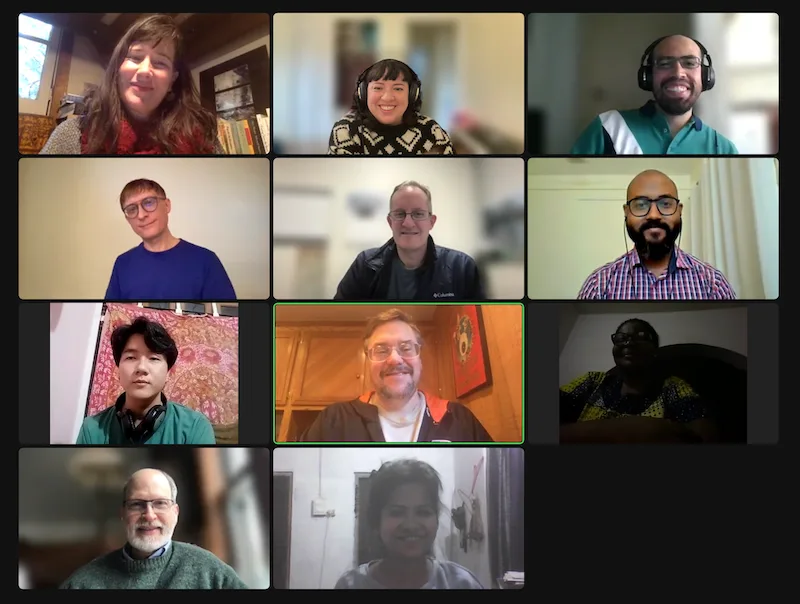
Eleven Living Tongues team members on a video call
Some of the Living Tongues researchers around the globe! This team meeting brought together linguists and anthropologists based in the US, India, Mexico, Nigeria, Ukraine and South Africa.

Officers

Dr. Gregory D. S. Anderson

President, Founder & Director

Dr. Anderson specializes in the languages of Siberia and tribal languages of India. He has degrees in Linguistics from Harvard (A.B. 1989) and the University of Chicago (Ph.D. 2000), and has conducted extensive fieldwork into the languages of the Altai Sayan group and among speakers of Munda languages in India. Greg has done fieldwork in Nigeria on Eleme, on Koro Aka, Hruso and other Tibeto-Burman languages in Arunachal Pradesh, in Bolivia on Kallawaya and Chipaya, in Paraguay on Yshyr (Chamacoco), Mak’a and Toba-Qom, on nearly a dozen languages belonging to eight different families in Papua New Guinea, in Chile on Tsesungun (Hulliche), and in Oregon on Siletz Dee-Ni. He has published widely in the fields of historical linguistics, descriptive grammar, morphology, verb typology, and the linguistics of Munda, Salishan, and Ogonoid languages.

Prof. Jeffrey Wills

Vice-President

Jeffrey Wills currently specializes in the languages of southern Africa and reconstruction of the history of the Niger-Congo language family. Educated at Harvard and Oxford in classical languages and Indo-European linguistics, he was subsequently a professor at the University of Wisconsin. Since the mid-90s, he has been active in rebuilding educational institutions and non-profits in Ukraine. Prof. Wills has taught at the University of Zimbabwe and been a fellow at the African Languages Research Institute. He continues to lead projects related to documenting and revitalizing languages at risk (including Kalanga, Nambya, Ndau, Chikunda, and Tawara of the Bantu family and Tjwao of the Khoisan group). His recent scholarship focuses on the historical phonology of Proto-Bantu and the Grassfields languages.

Jonathan M. Anderson, Esq.

Treasurer & Attorney-in-Fact

Jonathan M. Anderson has served as our principal financial officer since August 2008 and as our legal counsel since our inception. Jonathan currently advises small businesses and financial sponsors on matters of corporate and finance law in Seattle, Washington, and brings years of legal and financial expertise and experience to the Living Tongues table. He also serves on our board of directors. Jonathan received his Juris Doctor degree from New York University School of Law in 1996 and his B.A. degree in German Studies from Amherst College in 1991.

Researchers and staff

Dr. Mark Donohue

Senior Director, Asia-Pacific Region, 2017–present

Mark Donohue is a linguist who has worked on the languages of Indonesia and Papua New Guinea (both Austronesian and Papuan) for the last 25 years. More recently, he has documented languages of the Himalayas in Nepal and Bhutan. His work employs the gamut of investigative techniques, from primary work with informants to naturalistic corpora, through to computational analyses of secondary datasets. He has written about questions in the phonetics, phonology, morphology and syntax of the languages.

The unifying thread that runs through his different projects is the non-static and non-independent nature of language and language use: rather than describing static systems, his research investigates the way languages interact with each other (contact), change over time (history), and show variation both in terms of geography (dialects and internal variation) and culture (gender, religion, trade), and within the same speaker’s speech, depending on social and linguistic contexts (multilingualism and polyglossia).

Some of his ongoing linguistics projects:

  • Phonotactics, the study of patterns in syllable structure
  • Phonology, particularly non-segmental patterns
  • Morphosyntax, in particular case marking, agreement, and quantification
  • Language description
  • Language histories
  • Language assistance to local communities
  • Austronesian culture history, and the deconstruction of the myth of an ‘Austronesian steamroller’ neolithic event that reshaped Island Southeast Asia

Dr. Luke Horo

Senior Researcher in Phonetics, 2022–present

Institute Fellow & Post-doctoral Researcher for the South Asia Region, 2018–present

Dr. Luke Horo is an experienced field-based researcher and a specialist in conducting instrumental studies in phonetic science. His research mainly focuses on the description and documentation of Munda languages in India, and his publications include a detailed phonetic description of vowels and syllable prominence in the Sora varieties of Assam and Odisha. Dr. Horo is also an alumnus of the Indian Institute of Technology Guwahati where he completed his PhD dissertation “A Phonetic Description of Assam Sora” in 2018. He is currently one of the lead researchers on the Sora language documentation project.

Dr. Bikram Jora

Regional Coordinator, South Asia, 2015–present

Local Project Manager (India), 2010–2014

Dr. Bikram Jora has extensive field experience with India tribal languages in Jharkhand, Odisha, Himachal Pradesh, Arunachal Pradesh and Karnataka. His research is on morphology, phonology, syntax and child language acquisition. He received his PhD in Linguistics from Delhi University in 2014.

Dr. Jora has taken part and helped lead a number of Living Tongues field trips (2011 – 2022) to Munda-speaking communities throughout his home state of Jharkhand, and in Odisha, where the majority of Munda speakers are found. This includes surveys of Birhor, Bhumij, Ho, Santali, Kharia, Kera’ Mundari and Tamaria Mundari communities. He has also taken part in field expeditions with Dr. Greg Anderson to Arunachal Pradesh to document the Koro Aka, Hruso Aka, Bangru, Puroik and Sartang languages. He is currently one of the lead researchers on Living Tongues’ Birhor Documentation Project, which has published the first-ever children’s book in the Birhor language, an ethnobotanical study of Birhor plants as well as a trilingual Birhor-Hindi-English dictionary.

Dr. Jora gave two joint presentations at the Twenty Seventh Meeting of the Southeast Asian Linguistics Society (SEALS 27) in Padang, West Sumatra, Indonesia. The first paper, in collaboration with linguist Luke Horo, was entitled Phonetic realisation of a Schwa like vowel “x” in Santali and the next, in collaboration with Living Tongues Director Dr. Gregory D. S. Anderson, was entitled Introduction to Birhor verb morphology. Dr. Bikram Jora also attended an international linguistics seminar on expressives in Tokyo, Japan. Along with other scholars of Munda languages, he proposed a joint Indo-Japanese research group called the International Munda Studies Network.

Opino Gomango

Sora Language Project, 2007–present

Local Project Coordinator & Field Researcher: Remo and Gta’ projects (India), 2010–present

Opino Gomango is a Sora language activist who began working with Living Tongues Institute for Endangered Languages in 2007 to help document his native Sora language. In 2008, he initiated the “Sora Talking Dictionary and Online Grammar Project” that continues through the present day, and will be published as the Sora Living Dictionary in 2023. In 2010, Opino took on the role of Local Project Coordinator and Field Researcher for the State of Odisha for the Documentation of Remo Project, and for the Gta’ Living Dictionary and Online Grammar Project that are components of Living Tongues Institute’s Munda Languages Initiative.

In 2017, Opino Gomango gave a presentation at the National Language Conference, which took place at the National Institute of Science and Technology (NIST) in Berhampur, India. His presentation was about the current status of the Sora-Juray dialect continuum. Mr. Gomango presented his Sora sociolinguistic research at the 3rd International Linguistics Conference in Sri Lanka, and also travelled to the 38th Annual Conference of the Linguistic Society of Nepal, where he presented a paper on Sora noun incorporation.

Dr. Nathan Badenoch

Regional Coordinator, Southeast Asia, 2021–present

Dr. Nathan Badenoch has been working in the field in mainland Southeast since 1999, researching languages, cultures and ecosystems of upland people. He is interested in the diversity of languages spoken in the region and the networks of language use that connect people. His previous work in local environmental governance facilitated his exposure to how language is used and changes within specific socio-ecological settings. His recent geographic focus has been northern Laos, where he is currently engaged in ethnolinguistic research on Austroasiatic (Bit, Ksingmul, Phong) and Tibeto-Burman languages (Pana, Paza, Sida). He also works on Mundari, spoken in eastern India, particularly with regards to expressives in oral performance. In terms of cross-cutting themes, Nathan is interested in the aesthetics of language use, ecological knowledge and narratives of human-nature spirit interactions.

Dr. Alexander Andrason

Coordinator for Documentation in Africa, 2022–present

Dr. Alexander Andrason has contributed to the description and visibility of under-researched and minority languages in Tanzania (Arusa and Hadza), Zimbabwe (Tjwao), Gambia (Mandinka), and Nigeria (Dza and Mingang Doso). He is currently based in Ghana.

A global nomad, Andrason was brought up in a multilingual environment and has resided in nine European and African countries. A hyper-multilingual whose language repertoire draws on forty languages (ten of which he speaks with native or native-like proficiency), he is a pluri-disciplinary scholar who thrives at disciplines and theories’ crossroads. Andrason is an idealist who fights for the preservation and revitalization of ethnic, cultural, and language minorities.

Andrason holds three doctoral degrees: PhD in Semitic Languages (University Complutense in Madrid), PhD in African Languages (Stellenbosch University), and PhD in General Linguistics (University of Iceland). The scope of his research is broad and includes the areas of linguistics, cognitive science, complexity theory, anthropology, pedagogy, and philosophy. He specializes in (cognitive) linguistics, and its various sub-types, especially, semantics and morphosyntax, sociolinguistics and language contact, typology and grammaticalization theory, language documentation, human-to-animal communication, as well as the so-called “peripheral” grammatical phenomenon such as interjections, onomatopoeias, ideophones, and conative animal calls.

His interests include the Indo-European (Germanic, Slavic, Romance, and Greek), Afro-Asiatic (Semitic, Egyptian, and Chadic) and Niger-Congo (Mande, Adamawa, Kwa, Bantu) families, as well as Nilotic (Maa), Khoe-Kwadi (Eastern Kalahari), and Turkic (Oghuz Turkic) languages. Since 2006, he has been engaged in the documentation and preservation of Wymysorys, a nearly extinct Germanic language spoken in Poland.
Dr. Pamir Gogoi

Researcher in Phonetics, 2023–present

Dr. Pamir Gogoi received her PhD in Linguistics from University of Florida in 2021, prior to which she received her Masters in Linguistics from the English and Foreign Languages University, Hyderabad (India). Her core areas of interest are Phonetics and Phonology and her research has primarily focused on topics related to voice quality and nasality. She is also the co-founder of a non-profit company called VANI (Vernacular Archive of Northeast India), which aims at creating digital resources and language technology tools for low-resource and endangered languages of Northeast India. She is currently working on analyzing the phonetics of Munda languages such as Sora and Mundari.

Dr. Ganesh Murmu

Koro Aka Documentation Project, 2008–present

Munda Languages Project, 2007–present

Local Project Coordinator, Jharkhand State (India)

Dr. Ganesh Murmu works at the Department of Tribal and Regional Languages at the University of Ranchi in Jharkhand, India. Dr. Murmu is an expert in the tribal languages of Jharkhand and in particular a tireless advocate and activist for his native Santali language. Between 2008 and 2012, he worked with Dr. Greg Anderson on the Documentation of Koro Aka Project, on the poorly known Koro Aka language of Arunachal Pradesh, northeastern India, and on three Enduring Voices trips to Arunachal Pradesh.

In addition to Koro Aka, Dr. Murmu served as primary or secondary eliciting linguist in the recordings Living Tongues Institute has made of numerous languages of the region, including Hruso Aka, Miji, Apatani, Hill Miri and Nishi.

Diego Córdova Nieto

Web Developer, August 2021–present

Diego Córdova Nieto is a linguist and web developer based in México City, México. He holds a Bachelor’s degree in Linguistics from Universidad Autónoma Metropolitana and worked as a web developer at the Instituto de Investigaciones en Matemáticas Aplicadas y Sistemas. He has a background in creating digital projects for indigenous languages. His role at Living Tongues focuses on importing linguistic data for new dictionaries, maintaining the Living Dictionaries platform as well as developing new features for it.

Jacob Bowdoin

Web Developer, 2018–present

Jacob Bowdoin is a language-loving web developer who has helped build the Living Dictionaries web application from the ground up. In the course of developing this large-scale technical project, he contributed to the publication of dozens of digital dictionaries for minority languages around the globe, helped teach many webinars and spearheaded technological innovations that assist in language learning.

Cailie Keating

Staff, Living Dictionaries team

Cailie Keating is a doctoral student in Spanish linguistics at Georgetown University in Washington, D.C. She studied Spanish (Hispanic Studies) and Linguistics at the University of Wisconsin–Madison. She first joined Living Tongues as an intern and is now part of the team that runs Living Dictionaries.

Kelsey Bialo

Junior Phonetics Researcher, November 2022–present

Kelsey Bialo graduated from Barnard College with a degree in Linguistics and Education Studies. Her undergraduate thesis research focused on social and political implications for language vitality among non-Mandarin languages of Taiwan, where she worked for two years as a Fulbright English Teaching Fellow. Her linguistic interests include phonetic and phonological description, Austronesian linguistics, language documentation, and language teaching and learning in community-based revitalization. She started her Masters degree at University of Hawaiʻi at Mānoa in the Fall of 2023. Under the supervision of phonetician Dr. Luke Horo, Bialo’s role at Living Tongues includes data annotation and analysis in Praat for the Munda languages Sora and Mundari.

Huy Phan

Junior Phonetics Researcher, April 2023–present

Huy Phan graduated from California State University, Long Beach with a Bachelor of Arts in Linguistics. As a member of the Tây community (Southern Vietnam), Phan’s research revolves around describing and documenting different provincial varieties of the Tây dialect. His undergraduate thesis for the Ronald E. McNair Postbaccalaureate Program, titled ‘Selected aspects of Bến Tre,’ investigated the sound system of a Tây variety spoken in Bến Tre province (Vietnam), offering novel insights on the phonology of Tây and Vietnamese in general. Phan aims to expand the scope of his project on Tây by incorporating phonological and phonetic analysis with discourse-based and sociolinguistic approaches, all of which he is currently exploring throughout his PhD career at University of California, Santa Barbara. Under the supervision of Living Tongues phonetician Dr. Luke Horo, Phan’s current role includes data annotation and analysis in Praat for the Munda languages Sora and Mundari.

Yanzhen (Catherine) Huang

Junior Phonetics Researcher, September 2023–present

Catherine Huang graduated from Georgetown University with a Master’s of Science in Linguistics. Her main interest is in semantics, with a focus in event semantics, tense, aspect, modality, and evaluativity. Her master’s thesis titled “Evaluativity in Mandarin Verbal-le” investigated the nuanced semantic difference between Mandarin comparative constructions with and without verbal-le. Huang is passionate about the preservation of endangered languages and the documentation of low-resource/understudied languages. She has worked on the grammar of Tutrugbu, an understudied Kwa language spoken in Ghana. She was an intern with Living Tongues in 2020, and has returned as a junior researcher in 2023 to work on Munda languages. Her current role on the phonetics team includes data annotation and analysis in Praat, quality control of annotated data, and automation of the annotation process.

Post-doctoral researchers

Dr. Admire Phiri

Post-doctoral Researcher, Southern Africa Region

Tjwao Living Dictionary, 2014–present

Dr. Admire Phiri is a linguist, Ndebele speaker, and specialist in the Tjwao, a moribund Eastern Kalahari Khoe language. He previously taught at the University of Zimbabwe, and completed his doctorate at Stellenbosch University in South Africa in 2021. His research focuses on Khoe-Kwadi languages, tones, interjections in Tjwao and other topics. He is the co-author of the Tjwao Living Dictionary.

Dr. Emmanuel Sithole

Post-doctoral Researcher, Southern Africa Region

Ndau Living Dictionary, 2014–present

Dr. Emmanuel Sithole is currently post-doctoral researcher at North-West University in South Africa. He is a linguist, Ndau expert and researcher of Southern African languages and literature specializing in sociolinguistics, lexicography, African literature, drama and poetry. He has published extensively on language, identity, and bilingualism (see his ResearchGate profile) and is the co-author of the Ndau Living Dictionary.

Dr. Reggemore Marongedze

Post-doctoral Researcher, Zimbabwe

Chikunda Living Dictionary, 2014–present

Dr. Reggemore Marongedze is a Shona expert, an Afrocentric theorist and scholar, a literary critic and a linguist. He is currently a Lecturer in the Department of African Languages and Literature, University of Zimbabwe. He teaches courses on Digital Humanities; Heritage and Knowledge Systems. Research interests include African intangible and tangible resources such as African culture, African music, African literature and Bantu languages. He is one of the co-authors of the Chikunda Living Dictionary.

Fellows

Dr. Bolanle Elizabeth Arokoyo

Olùkùmi Language Projects, 2013–present

Bolanle Elizabeth Arokoyo holds a PhD in Linguistics. Her doctoral work focused on syntax and first language acquisition.

Dr. Arokoyo has worked extensively on Yoruba as well as Okun dialects of Yoruba and Olùkùmi. She is presently working on the linguistics of Owé (a dialect of Yoruba) and the grammar of Olùkùmi. She is a Lecturer at the Department of Linguistics and Nigerian Languages, University of Ilorin, Ilorin, Kwara State, Nigeria. In 2017, with the support of Living Tongues, Dr. Arokoyo published the first-ever dictionaries for Olùkùmi and Owé. In 2022, she has been working on the Olùkùmi Living Dictionary with her students in Nigeria with remote support from Living Tongues Institute.

Khandu Degio

Aka Language Projects, 2011–present

Khandu Degio is a speaker of Hruso-Aka and Koro-Aka. He is from Palizi village, West Kameng District, Arunachal Pradesh, India. He has been actively involved with Living Tongues Institute on documentation of the Hruso Aka and Koro Aka languages for many years. Koro is an endangered Tibeto-Burman language spoken in Arunachal Pradesh, India, with an estimated 600-800 speakers. Mr. Degio is also a gifted illustrator and has provided illustrations for a children’s book published by Living Tongues in India.

Zimbabwe fellows

In 2014, a group of Living Tongues fellows were appointed in Zimbabwe, after completing their first-level digital literacy skills and training in basic applied technology for language documentation at a workshop in March 2014 at the African Languages Research Institute, University of Zimbabwe, in Harare. These linguists and language activists all took part in building the first-ever online dictionaries in their native tongues, now on the Living Dictionaries platform.

Indigenous language activists

Andrés Ozuna

Ɨshɨr (Chamacoco) people of Paraguay, 2009–present

Andrés Ozuna is an Ɨshɨr (Chamacoco) language activist from Karcha Bahlut, Paraguay. With the assistance of an Enduring Voices language technology kit that he received in 2009, Andrés has produced a bilingual Ɨshɨr-Spanish book on traditional plant uses among the Ɨshɨr (Ishiro ôreyuwo poruwo/Sabiduria de los Ishir del Chaco). He has also recently written a short book on the Ɨshɨr concept of truth in the Ɨshɨr (Chamacoco) language.

At the Enduring Voices language revitalization workshop in Santa Fe, Andrés produced the first-ever digital storybook in the Ɨshɨr language. He is the primary figure behind the Ishir (Chamacoco) Living Dictionary. Today he is continuing his tireless campaign to promote his native language and working on a range of different projects in Ɨshɨr. He collaborated with Living Tongues Program Director Anna Luisa Daigneault to publish Ɨshɨr Ɨbitoso – Español dictionary in 2021, with support from Living Tongues. Ozuna currently serves as Communications Coordinator for the Union of Ɨshɨr Nation Indigenous Communities (UCINY).

Play video

Alumni

Former researchers, fellows and activists whose work lives on in our projects.

Researchers and staff

Anna Luisa Daigneault, M.Sc.

Lead Digital Curator (part-time), January 2025–March 2026

Program Director (full-time), 2018–2024

Regional Director, Americas Region, 2022–2024

Latin America Projects Coordinator, 2009–2017

Development Officer, 2011–2017

Anna Luisa Daigneault is a linguistic anthropologist of Peruvian and French Canadian heritage, currently based in Montreal, Canada. She is pursuing her PhD in Linguistic Anthropology at Université de Montréal, where she is studying how AI can be used in Indigenous language revitalization.

She has extensive experience working with Indigenous communities in the Peruvian Amazon region, in particular with the Yanesha’ people. She has also conducted ethnolinguistic fieldwork throughout the Americas and in the Pacific Islands, and has contributed to the publication of print dictionaries (such as the Ɨshɨr Ebytoso – Spanish Dictionary with Indigenous scholar Andres Ozuna Ortiz, available in Paraguay) as well as over forty online Living Dictionaries for endangered and minority languages around the world.

Until early 2026, Daigneault served as the Lead Digital Curator, working on the development of the Living Dictionaries platform, an online dictionary builder maintained by Living Tongues Institute, with the goal of providing free digital resources for threatened languages. She coordinated research and data collection with language communities, led online training workshops and helped curate large sets of lexical data for dozens of communities worldwide.

Over a 15-year span of time at Living Tongues, her duties included: project coordination, research, grant-writing, archiving large linguistic collections at accredited archives around the world, running the institute’s website and social media platforms, overseeing grant timelines as well as training interns and other personnel, and providing technical support for Indigenous language communities worldwide. Her articles on language endangerment have been published by The Dominion, Global Voices, SAPIENS and she has presented at TEDxGreensboro. Outside of her work in language documentation and revitalization, Daigneault is also an accomplished vocalist and electronic music producer.

Ria Borah Sonowal

Junior Phonetics Researcher, November 2021–September 2023

Ria Borah Sonowal graduated from St. Anthony’s College, Shillong, India, where she majored in English Literature. After that, she took up Linguistics for her Master’s degree at Gauhati University, where she graduated in 2021. She speaks four languages fluently: Assamese, English, Bodo and Hindi. She is mainly interested in Austro-Asiatic languages as well as Tibeto-Burman languages. In particular, she aims to research the dialectal variations of the Bodo language spoken in Assam, India. Phonetics and phonology are her main areas of interest in Linguistics. She works closely with Dr. Luke Horo on the Sora phonetics project. Her role includes data collection from the field, data annotation, and analysis in Praat.

Aman Kumar Singha

Junior Phonetics Researcher, November 2021–April 2023

Aman Kumar Singha completed his Bsc. in Botany at Assam University in India in 2018. He graduated with his Masters degree in Linguistics from Gauhati University in 2021, and is currently enrolled there in the Phd programme in Linguistics. Singha works closely with Dr. Luke Horo on the Sora phonetics project. His role includes data collection from the field, data annotation, and analysis in Praat.

Fellows

Dr. Sophie Salffner

Fellow, Nigeria Projects Coordinator, 2012–2013

Sophie Salffner joined the Living Tongues Institute as a Fellow in 2012. Sophie has been working with the Akaan people of Ikakumo (Ondo State, Nigeria) since 2006 to work on the documentation and description of Ikaan, the language of the Akaan.

Together, they have published a small book on proverbs, riddles and stories in Ikaan and are now training the children and young people in photography, audio recording and computer skills to help with collecting material on people’s everyday life. Dr. Salffner is currently a Digital Archivist at SOAS University of London.

Dr. Danielle Barth

Fellow, Matukar (Panau) Project, 2010–2011

Danielle Barth was appointed Living Tongues Institute Fellow in 2010. She spent several months living and working in Matukar assisting in the Matukar Talking Dictionary and Online Grammar Project.

She returned to Matukar in 2011 as well as 2013 for further field sessions where more details of the grammar were worked out and more forms and media content for the Talking Dictionary were collected, serving as assistant to the Matukar Project leader Rudolf Raward. Danielle Barth is currently a Lecturer at the Australian National University.

Dr. Anna Pucilowski

Fellow, Ho Language Project, 2008–2009

Anna Pucilowski was the first Living Tongues Institute Fellow appointed in 2008. During 2008-2009, she coordinated and executed the second and most comprehensive stage of the Ho Talking Dictionary and Online Grammar Project, working closely with members of the Ho speaking community of Jharkhand.

She has presented and published a range of studies on the Ho language. Anna graduated with her Ph.D from the Linguistics Department at the University of Oregon. Her dissertation was on the Ho verbal system. She currently works as a speech language pathologist.

Indigenous language activists

Dr. Taiwo Opeyemi Agoyi

Akoko Languages Project, 2013–2018

Dr. Taiwo Opeyemi Agoyi did her first degree in the University of Ilorin Nigeria where she obtained a BA (Ed) in Language Art (Yoruba), 2nd Class Upper Division, in 1992. In 1997, she obtained an MA in Yoruba Language, and joined Adekunle Ajasin University (Akungba-Akoko, Ondo State, Nigeria) as an Assistant Lecturer in 2001. She obtained her Ph.D in Linguistics in 2001 in the Department of Linguistics and Languages, Faculty of Arts, Adekunle Ajasin University, under the training of Professor Oladele Awobuluyi and Professor Francis O. Oyebade.

The title of her thesis was “The Phonology of Àbèsàbèsì Vowel Harmony”. Her research has since focused on the linguistic description and documentation of Akoko languages. She received theoretical training in language documentation and tools for documentation and data analysis at the School of Oriental and African Studies (SOAS, London, UK), as well as at the University of Uyo (UNI UYO), Adekunle Ajasin University Akungba Akoko (AAUA) as a member of the PMI2 collaboration between the three universities.

She is currently a lecturer in the Department of Linguistics and Language, Faculty of Arts, Adekunle Ajasin University Akungba Akoko, Ondo State, Nigeria. She is a member of Linguistic Association of Nigeria (LAN); Niger-Congo Language Congress; West African Linguistic Society (WALS); and the World Congress of African Linguistics (WALC).

Mark Franco

Winnemem Wintu tribe of California, 2010–2014

Mark Franco was Headman of the Winnemem Wintu community based at the Winnemem Wintu village located outside of Redding, CA. An activist for the Winnemem Wintu community, Mark is an expert in a diverse array of topics ranging from indigenous rights, water access and development, restoration of the environment and return of the salmon to their traditional territories, now prevented from reaching the Winnemem or Middle Water (aka McCloud River) by a dam. Mark also spearheaded the revitalization efforts for the Winnemem Wintu language. At the workshop in Santa Fe, New Mexico led by the Indigenous Language Institute and supported by National Geographic’s Enduring Voices Project and Living Tongues Institute for Endangered Languages, Mark produced a beautiful short film and a small booklet in the revitalizing Winnemem Wintu.

Play video

Dr. Bhubaneshwar Sawaiyan

Ho tribe, Ho Language Project, 2008–2010

Bhubaneshwar Sawaiyan is a Ho language activist from Jharkhand state, India. An expert in tribal journalism, Dr. Sawaiyan produced a digital storybook on the traditional wedding practices of the Ho people, who represent a large tribal minority group whose language belongs to the Munda language family.

Dr. Sawaiyan also produced a short booklet in the Ho language at the Santa Fe workshop held in April, 2010. At the time he was the personal secretary to Indian Government Minister, Dr. Ram Dayal Munda, the most prominent and senior government official representing a tribal community in India.

Interns

Thank you to our wonderful interns! They served as research assistants on various projects over the years, under the supervision of Living Tongues Program Director Anna Luisa Daigneault.

Jacob Kodner

Research intern, January–June 2022

He served as an inter-organizational intern between Living Tongues Institute, Wikitongues and the Jewish Languages Project to contribute to the documentation of endangered Jewish languages such as Jewish Neo-Aramaic and others. He worked with speakers of these languages and collected data for upcoming Living Dictionaries and related projects. At Living Tongues, he also received training and guidance as the dictionary manager of the Manchu Living Dictionary, on ongoing project. He is developing a project documenting Atayal, and is currently a graduate student at Harvard.

Valeria Macias

Research intern, March–June 2022

She has assisted Living Tongues Institute in developing the Yanesha’ Living Dictionary as well as the Itonama Living Dictionary. Her role included data entry, audio editing, phonetic transcription, Spanish translation and digital asset management.

Olivia Estes

Research intern, April–June 2022

She worked on the editing of the Ishir Living Dictionary to update it with information from the latest Ishir-Spanish print dictionary. Her role included data entry, Spanish translation and updating the dictionary platform.

Selena Syrett

Research intern, January–December 2023

She has assisted in building the Chikunda, Matukar, and Tutelo-Saponi Monacan Living Dictionaries. She has contributed to data analysis, audio editing, and tagging and editing entries. She is excited to continue working with Living Tongues.