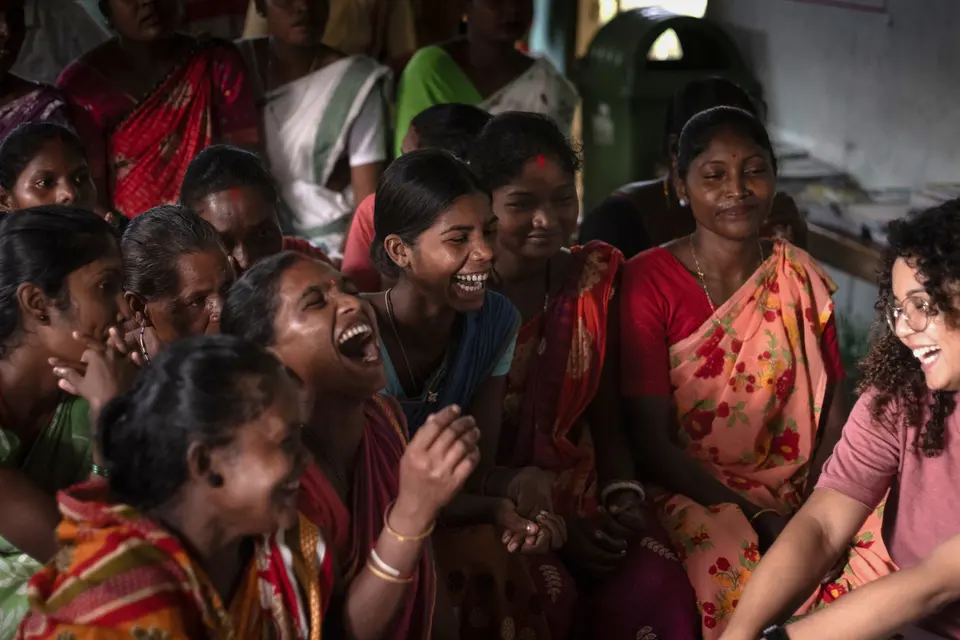
Our mission
To ensure language survival for generations to come
We support speakers who are safeguarding their languages from extinction through activism, education and technology. Our research teams document endangered languages and cultural practices, publish scientific studies, run digital training workshops for language activists, and work with communities to create resources that can serve as a basis for revitalization.
Living Tongues Institute for Endangered Languages is a registered 501(c)(3) non-profit (EIN 41-2183857), founded in 2005 by linguist Dr. Gregory D. S. Anderson. We are funded by grants and donations.
How we work
Linguist-aided, community-driven
Communities lead
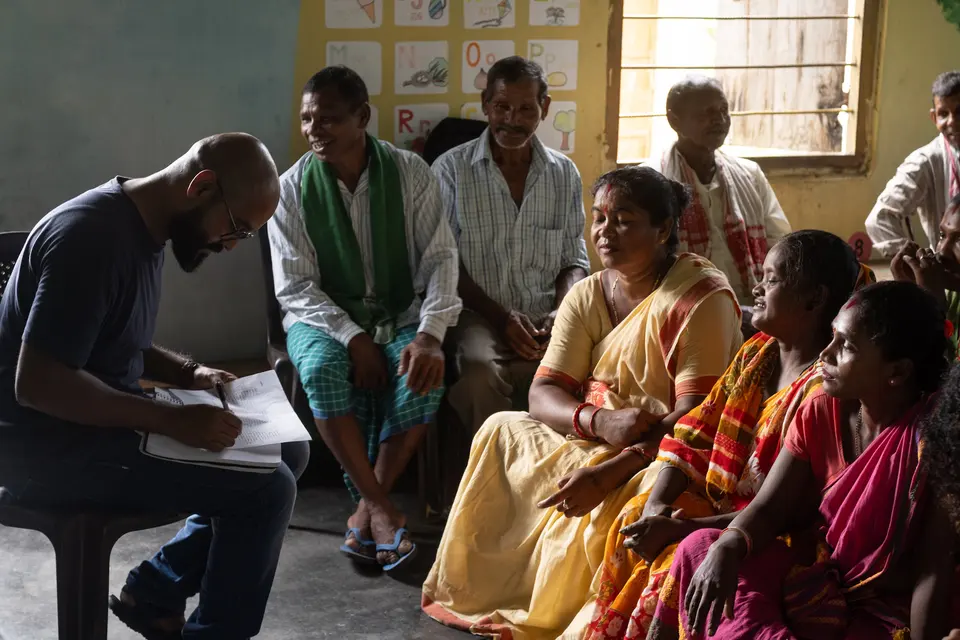
Projects begin with conversations with speakers. We work only with a community’s permission and towards the goals it sets, whether that is maintenance, revitalization, teaching materials or a dictionary.
Communities own their knowledge
Recordings remain under the authority of the language community, which grants permission, individually and collectively, for scholarly use and sharing. Photographs are taken only with consent.
Skills stay behind
We train community members in writing systems, recording and digital tools, so documentation can continue long after a field trip ends.
The public should know
We publish our research, speak at conferences and make our materials freely available, so more people understand what is lost when a language falls silent.
History
Twenty years of documentation
- 2005 Dr. Gregory D. S. Anderson founds the Living Tongues Institute for Endangered Languages in Salem, Oregon.
- 2006 Anderson and Dr. K. David Harrison begin building the Talking Dictionary software.
- 2007 The first Talking Dictionary, for Siletz Dee-ni, goes online with the Confederated Tribes of Siletz Indians.The Enduring Voices Project with the National Geographic Society begins, running until 2013.
- 2008 The documentary The Linguists premieres at Sundance, following Anderson and Harrison to Siberia, India and Bolivia.
- 2009 The Linguists airs nationally on PBS, and Enduring Voices expeditions go to Paraguay, Papua New Guinea and the Wintu of California.
- 2010 Our Enduring Voices team announces Koro, a previously unrecognized language of Arunachal Pradesh, India.Our first National Science Foundation grant funds documentation of the Munda languages Remo and Turi.
- 2011 We hold the first Language Hotspots Workshop in Salem, training ten volunteer researchers.
- 2012 Harrison unveils eight new Talking Dictionaries at the AAAS annual meeting, covered by the BBC, MSNBC and others.Our work in India is featured in National Geographic magazine’s “Vanishing Voices” story.
- 2013 Harrison co-curates “One World, Many Voices” at the Smithsonian Folklife Festival, with 15 language communities on the National Mall.An NEH grant begins full documentation of Gtaʔ, a nearly undocumented Munda language.
- 2014 Workshops in Zimbabwe, Guatemala and Papua New Guinea bring our digital skills workshops to ten in eight countries since 2010.
- 2015 An NSF grant funds documentation of Gutob, an endangered Munda language of India.
- 2017 The Gtaʔ Talking Dictionary goes online with 6,800 entries, and we publish the first dictionaries of Olùkùmi and Owé in Nigeria.
- 2018 A Zegar Family Foundation grant launches our Birhor project, documenting the knowledge of a forest-dwelling people of India.
- 2019 A three-year NSF grant begins our study of Sora, led by Anderson with Dr. Mark Donohue.
- 2020 Talking Dictionaries becomes Living Dictionaries, a rebuilt collaborative web platform with over 120 dictionaries.We release the Language Sustainability Toolkit with Wikitongues.
- 2021 Living Dictionaries passes 200 dictionaries, over a hundred of them built in our online webinars.Paired NSF and NEH grants fund documentation of seven Munda languages and a Munda Virtual Archive.
- 2022 We host ICAAL 10, the International Conference on Austroasiatic Linguistics, and win the first of three Best of Salem awards.The first open-access Living Grammar Sketches are published, for languages of Nigeria, Zimbabwe and Tanzania.
- 2023 Living Dictionaries serves over 400 languages, with 209,000 entries and an interface in 14 languages.
- 2024 Shure features our Santali fieldwork in its No Voice Left Behind campaign.
- 2025 Living Dictionaries user accounts more than double in a single year, to nearly 3,900.
- 2026 Living Dictionaries reaches 580 dictionaries, more than 600,000 entries and over 5,000 visitors a month.
Partners: National Geographic’s Enduring Voices Project, Ironbound Films (The Linguists), La Academia de Lenguas Mayas de Guatemala, 7000 Languages, Shure, and the communities, universities and archives we work with.
Funding
Grants
We gratefully acknowledge the organizations, funding agencies and charitable funds that support our work.
- 2022–2024
Documentation and analysis of seven Munda languages and development of the Munda Virtual Archive
National Endowment for the HumanitiesPD-281083-21
- 2021–2026
Words, phrases, and sentences at the interface of phonology and morphosyntax
National Science Foundation#2041248
- 2021
General support grant
Richard and Mona L. Alonzo Family Fund, via the Community Foundation of Southeast Michigan
- 2019–2022
Sora typological characteristics: towards a re-evaluation of South Asian human history
National Science FoundationBCS #1844532
- 2019–2022
Citizen science and cinematography: documenting stories and technology of the Sora tribe (India)
National Geographic Citizen Science Grant
- 2018–2021
Documenting the fragile knowledge domains of the Birhor people
The Zegar Family Foundation
- 2015–2017
Documentation of Gutob, an endangered Munda language
National Science Foundation / Documenting Endangered Languages#1500092
- 2013–2015
Documentation of Hill Gtaʔ, a seriously endangered Munda language
National Endowment for the Humanities / Documenting Endangered LanguagesPD-50025-13
- 2013–2015
Melanesia Online: ethnobotanical, ethnozoological and ethnogeographic knowledge of "tok ples" in Papua New Guinea
The Christensen Fund
- 2010–2011
Documentation of two endangered Munda languages of India: Turi and Remo
National Science Foundation / Documenting Endangered Languages#0853877
- 2007–2013
Enduring Voices Project
National Geographic Society
Best of Salem Award, Community Service & Non-Profit Organizations — 2022, 2023 and 2024