Newsletter, Fall 2011: our new website, recent fieldwork and talks, and new ways to help
Welcome to the new format for the Living Tongues newsletter!
We hope this message finds you well. We have many announcements to share with you, including news about our updated website, recent activities, as well as ways to contribute to endangered language research.
Updated website
We would like to announce the latest edition of our website. The site now features a section for each of the Language Hotspots where we are currently doing endangered language fieldwork, including many examples of audio and video materials collected during the documentation process.
In the Enduring Voices section of our site, we list all of the latest fieldwork we have undertaken in collaboration with the National Geographic Society, with links to field reports for recent trips taken to Australia, India, Bolivia, Papua New Guinea, Chile and other places. Our YouTube channel also contains many videos from these trips.
Living Tongues is involved in the production of online Talking Dictionaries, digital tools that enable users to listen to audio samples while viewing thousands of lexical entries searchable in the indigenous language as well as English. We invite you to check out the online dictionaries for Tuvan, Ho, Remo, Siletz Dee-ni, Chamacoco (also available in Spanish) and Matukar.
A list of all our current projects is also available on the site, as well as an up-to-date list of the people collaborating in endangered language research, including the Living Tongues officers, language activists from around the world, fellows and associates. Publications by Gregory D.S. Anderson and K. David Harrison as well as media reviews are also available on the site. Also, feel free to check out our new blog, which provides updates on recent events and public outreach efforts.
Recent activities
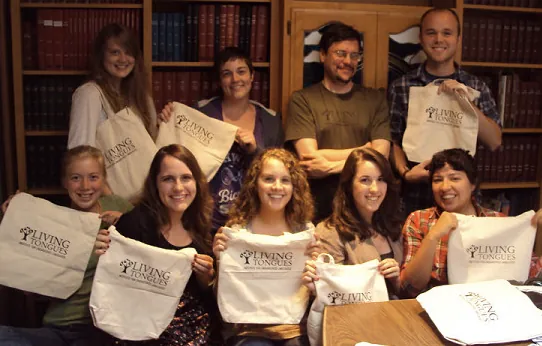
In July 2011, we welcomed some of our volunteers to Salem, Oregon for a four-day Language Hotspots Workshop at the Centre for Ancient Studies at Willamette University. Thanks to our volunteers for doing great work on our database this summer!
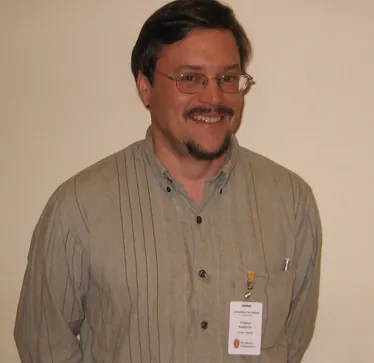
In late August 2011, Living Tongues Founder and Director Gregory D.S. Anderson presented a paper on auxiliary verb constructions at the Variation and Syntax Conference in Helsinki, Finland. In October, Anderson was an invited speaker at the Lule Saami language activist conference in Bodø, Norway, which focused on enhancing Saami documentation and revitalization.
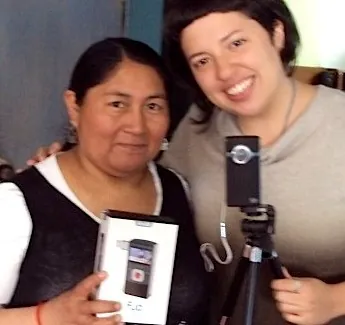
In August – September 2011, Living Tongues Latin American Projects Coordinator Anna Luisa Daigneault did research in South America for the Enduring Voices Project. She traveled to Peru and Chile to work with Language Technology Kit recipients as well as collaborate on several indigenous knowledge archiving projects. Her field report is available here.
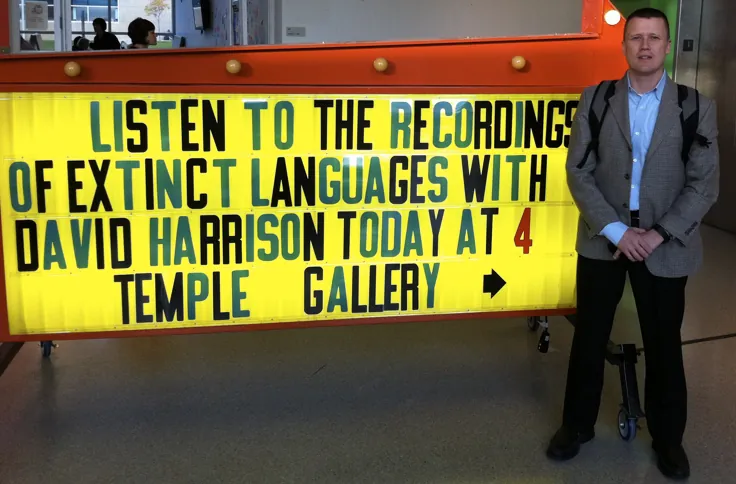
In November 2011, Living Tongues Director of Research K. David Harrison was a guest speaker at the Tyler School of Art at Temple University in Philadelphia, giving a talk entitled “Endangered Languages: Local and Global Trends.” Harrison’s most recent book, The Last Speakers: The Quest to Save the World’s Most Endangered Languages, is available through Random House Books and on Amazon in Kindle edition.
How to contribute
The Living Tongues Institute needs your support. We rely solely on grants and donations to sustain our projects. We would like to announce a new way to contribute to our projects. Adopt-a-language is an innovative donation tool that allows you to donate to the language revitalization program of your choice. In choosing a language to support, you are helping linguists and indigenous language activists document, conserve and maintain a language. You are also helping future generations gain access to printed materials or online resources and tools produced in their own language.
You can choose to donate to any of the following language documentation projects via our website: Koro-Aka, Remo, Gta (Didey), Chulym, Tofa, Matukar Panau, Yokoim, Panim and Yshyr Chamacoco. Please give generously! We appreciate your support.
We have received many requests to volunteer, and we have reached our capacity for volunteers at the moment. Applications for volunteering will be open once more in March 2012 on our volunteering page.
Online store
We are also now launching our new online store, where you can purchase beautiful limited edition screen-printed Living Tongues t-shirts for men and women and book bags. All sales go 100% towards funding endangered language research. All of our products are made with environmentally-friendly materials, such as canvas, cotton and water-based inks, and all of our screen-printing is hand done by our local staff in the United States.
Do you know anyone who is an avid supporter of endangered language research? These items make perfect gifts for the upcoming holiday season. Items are mailed within 2 weeks of online purchase and they are a great way to show your support for the Living Tongues Institute.
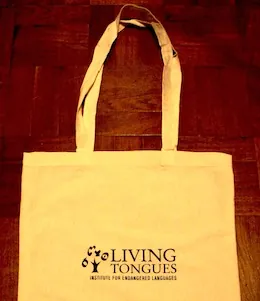
Living Tongues Book Bag. This canvas book bag is environmentally friendly, convenient and supports a good cause. It is a sturdy bag that can hold many library books at one time. A great gift! Size: 14.75" (W) × 16" (H). Material: 100% natural 5 oz cotton fibre.
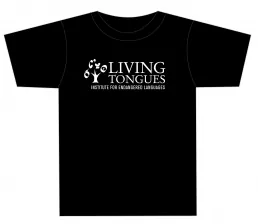
Living Tongues Shirts. Screen-printed by hand with water-based ink by one of our local staff in the USA, these cotton t-shirts are environmentally friendly, sporty and support a good cause. They are available in white and black, in men's sizes S, M, L and XL and in women's tank tops sizes S, M, L and XL.
Thanks for reading! Best wishes from everyone at the Living Tongues Institute.
NewslettersLanguage HotspotsEnduring Voices ProjectSupport Endangered Languages