dAXunhyuuga'
Featured entries


About
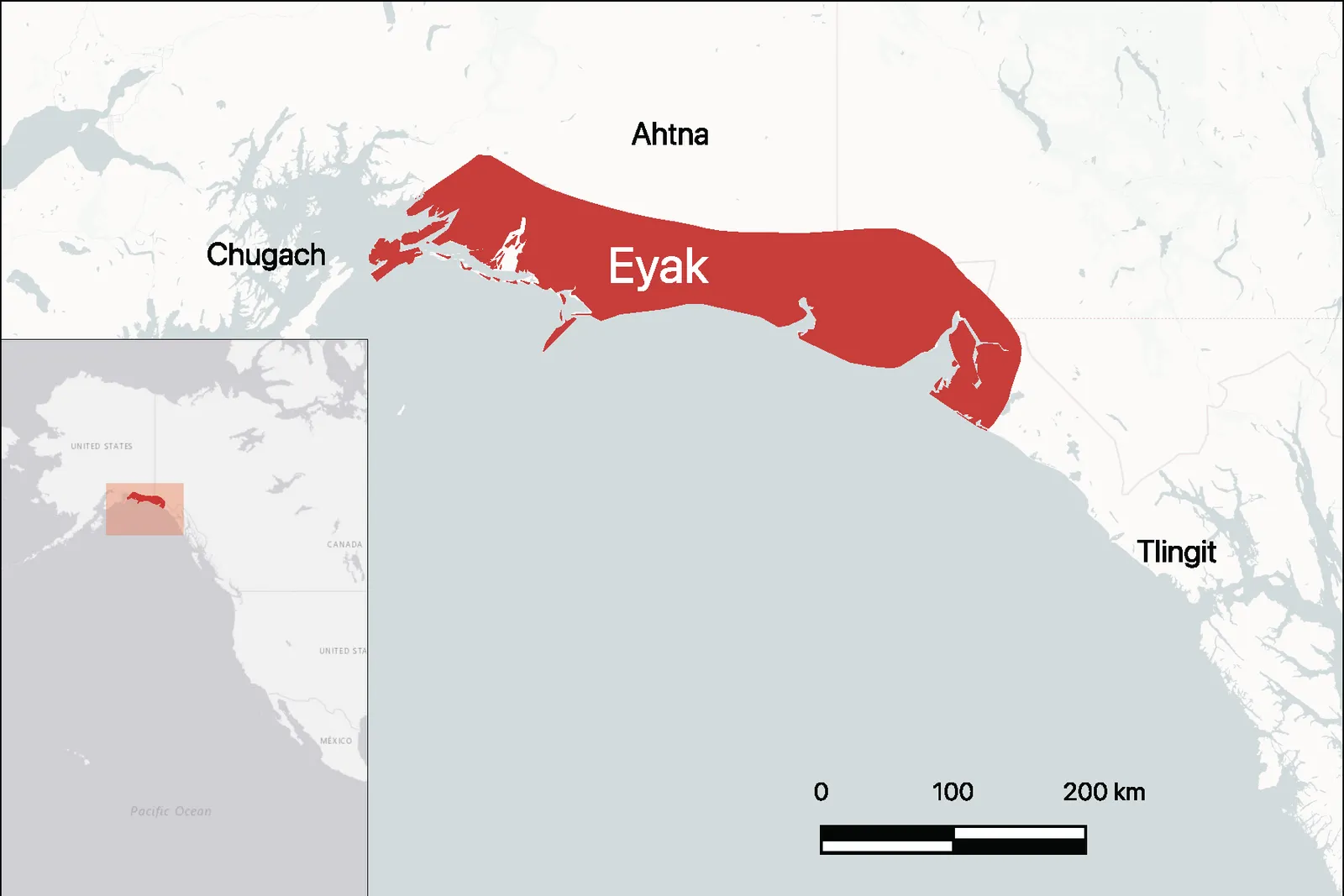
DRAFT - WORK IN PROGRESS Overview dAXunhyuuga‘ is the traditional language of the Gulf Coast of Alaska, spanning the region from present-day Cordova to Yakutat, a distance of some four hundred kilometers. The ecological niche occupied by dAXunhyuuga‘ includes the massive Copper River Delta; the world’s largest piedmont glacier; and some of the highest peaks in North America. dAXunhyuuga‘ is also known as Eyak, a reference to the village of iiyaaG, located where Eyak Lake empties into the Eyak River. dAXunhyuuga‘ is a linguistic "aunt" to the Dene languages, no closer in structure and vocabulary to neighboring Ahtna than it is to distant Navajo. This dictionary draws on numerous sources, especially the 1970 manuscript dictionary compiled by Michael Krauss (Alaska Native Language Archive EY961K1970b) and a wealth of language learning materials produced by the Eyak Language Project and Guillaume Leduey over the past decade. Writing System The writing system used in this dictionary makes use of capitalization to distinguish sounds. The four uppercase letters A G L X represents sounds that are different than their lowercase counterparts a g l x. For this reason, capitalization is not used to indicate the beginning of sentences or proper names.
Read moreGrammar
Verbs Verbs are cited in this dictionary in their basic, underlying form, which usually differs from the form as pronounced. The basic citation form includes root, which occurs on the far right side of the verb, possibly preceded by one or more prefixes, separated by hyphens. In order to form a verb word, the citation form must be inflected for person and conjugated for mode-aspect. Inflection for person is similar to the final -s on the third-person ('he/she/it') forms of English verbs. First-person singular ('I') and second person singular and plural ('you') are indicated via prefixes. First person plural ('we') is indicated via a separate word daa. * There is no verb prefix for third-person ('he/she/it/they'). Instead, third-person is indicated in one or both of two ways: via an independent pronoun anh (literally, 'that one') and/or via a verbal ending inh, referring to one human, or inuu, referring to more than one human. anh tsu‘d s/he/it is sleeping tsu‘dinh. s/he is sleeping tsu‘dinuu. they are sleeping Conjugation indicates the way a verb is carried out across time, similar to English past, present, and future tense, or progressive ('-ing') aspect. There are three basic conjugation classes and six mode-aspects. Conjugation Mode-Aspect Active Inceptive Neuter imperfective perfective conditional imperative optative desiderative. Conjugation is indicated in multiple ways, via prefixes, suffixes, and a sometimes a special form of the verb root involving a modification to the vowel and final consonant of the root. For example, the verb root - da 'sit (one person)' has the form daa in the Inceptive perfective conjugation and the form dah in the Active perfective conjugation. The verb root doesn't always vary, though. For example, the verb root kiinX 'cry' is the same in both Active imperfective and perfective conjugations; the only difference is the presence of the prefix sA- and suffix -L in the perfective: kiinX 's/he is crying', sAkiinXL 's/he cried'. Not all…
Read moreRecently added


Using this dictionary
Eyak Cultural Foundation. 2026. dAXunhyuuga' Living Dictionary. Living Tongues Institute for Endangered Languages, Eyak Cultural Foundation. https://livingdictionaries.app/eyak
Want to reuse this content in an app, course or publication? Ask the dictionary's team first — attribution doesn't replace permission.