rakit
/rakit/
IPA: [ɾaˈkit̚]
Morphological Status: Root lexeme
Word Class: Verb / Noun (contextual nominalization)
Core Meanings
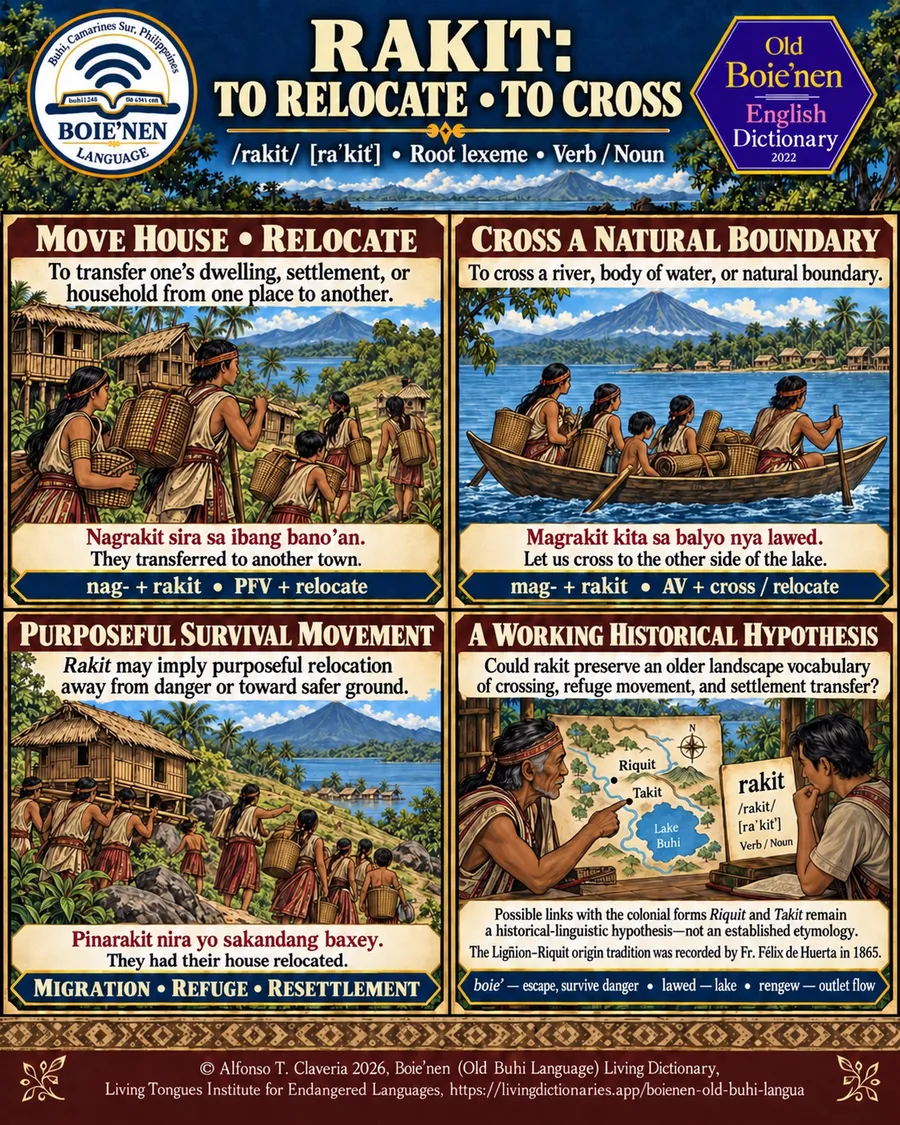
1. To move house; relocate residence.
Refers to transferring one’s dwelling, settlement, or household from one place to another, especially due to necessity, danger, environmental change, or livelihood.
2. To cross a river, body of water, or natural boundary.
Implies physical crossing from one side to another, often involving movement through or across water.
Extended Semantic Notes
The lexeme carries a broader semantic field associated with:
- migration
- displacement
- refuge movement
- crossing terrain or waterways
- settlement transfer
- survival relocation
In traditional usage, the term may imply not merely movement, but:
purposeful relocation away from danger or toward safer ground.
Historical-Landscape Note
Recent historical-linguistic analysis suggests that rakit may preserve an older Boie’nen hydrological and migration-related semantic system associated with:
- inland refuge movement
- volcanic-lake geography
- crossing waterways
- resettlement traditions around the Buhi–Malinao–Polangui region.
The term may be historically connected to colonial spellings such as:
- Riquit
- Takit
appearing in Spanish-era narratives concerning early settlement movements associated with the origin traditions of Buhi.
In Agustín de la Cavada’s Historia geográfica, geológica y estadística de Filipinas (1876), a migration narrative describes survivors fleeing danger and relocating near a lagoon between Malinao and Polangui, possibly preserving a distorted colonial rendering of this lexeme or a related toponym.
This association remains a working historical-linguistic hypothesis.
Examples
Nagrakit sira sa ibang bano’an.
nag- + rakit
PFV + relocate
“They transferred to another town.”
Magrakit kita sa balyo nya lawed.
mag- + rakit
AV + cross/relocate
“Let us cross to the other side of the lake.”
Pinarakit nira an sakandang baxey.
pi- + na- + rakit
CAUS + PFV + move.house
“They had them/it relocated their house.”
Cultural Note
The semantic field of rakit appears deeply tied to:
- Boie’nen settlement patterns
- river and lake crossings
- refuge geography
- and landscape adaptation.
This may reflect historical realities of:
- volcanic disturbance
- hydrological change
- Moro raid-era inland movement
- and resettlement traditions in the Lake Buhi watershed region.
Related Lexemes
- boie’ — escape; survive danger
- lawed — lake; deep inland body of water
- rengew — outlet flow / river outlet (toponymic association)
- kagranew — lake-associated toponymic term
Historical Reference
Cavada y Méndez de Vigo, Agustín de la.
Historia geográfica, geológica y estadística de Filipinas.
Tomo II. Manila: Establecimiento Tipográfico de Chofré y Compañía, 1876. p. 198.
————
inanakit