agiyan
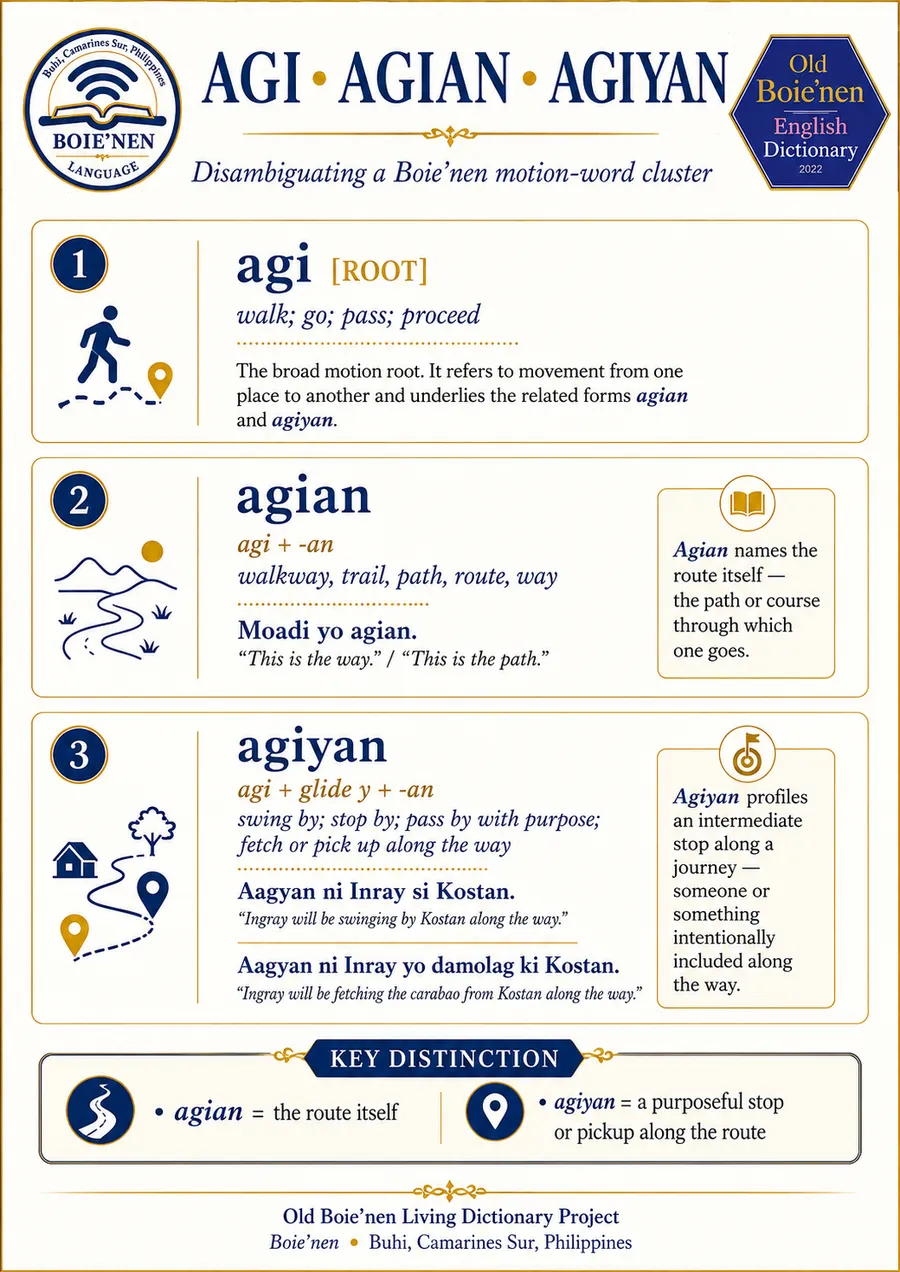
The form profiles a person, place, animal, or object as an intermediate point within a larger journey. The precise English translation depends on what the traveler intends to do at that point.
USAGE
Aagyan ni Ingray si Kostan.
“Ingray will swing by Kostan along the way.”
“Ingray will stop by and see Kostan.”
Aagyan ni Ingray yo damolag ki Kostan.
“Ingray will fetch the carabao from Kostan along the way.”
“Ingray will stop by Kostan’s place to collect the carabao.”
USAGE RATIONALE
The construction does not merely state that Ingray will pass near Kostan. It indicates that Kostan, or something associated with Kostan, will be deliberately included as an intermediate stop or errand during Ingray’s journey.
The object following agiyan determines the contextual interpretation:
- a person — stop by, call on, or visit;
- an animal or movable object — fetch, pick up, or collect along the way;
- a place — stop at, pass by with purpose, or conduct a brief errand there;
- an item for another person — deliver or leave it while passing.
SEMANTIC COMPONENTS
- The actor is already traveling or intends to travel.
- The referenced person, place, or object lies along or near the actor’s route.
- The actor deliberately includes it as an intermediate point.
- The journey normally continues afterward toward another destination.
CONTRAST
Agian refers to the route:
Moadi yo agian.
“This is the path.”
Agiyan refers to an intermediate stop or task along the route:
Aagyan ni Ingray si Kostan.
“Ingray will stop by Kostan along the way.”
A simple passing-through construction with agi does not necessarily imply stopping, visiting, fetching, or completing an errand. Agiyan normally adds this purposive intermediate involvement.
ORTHOGRAPHIC NOTE
The glide y should be preserved because agiyan is functionally and semantically distinct from the locative noun agian. The contrast prevents the two forms from being treated as mere spelling variants.