.(nyo)
nyo
particle
Definition
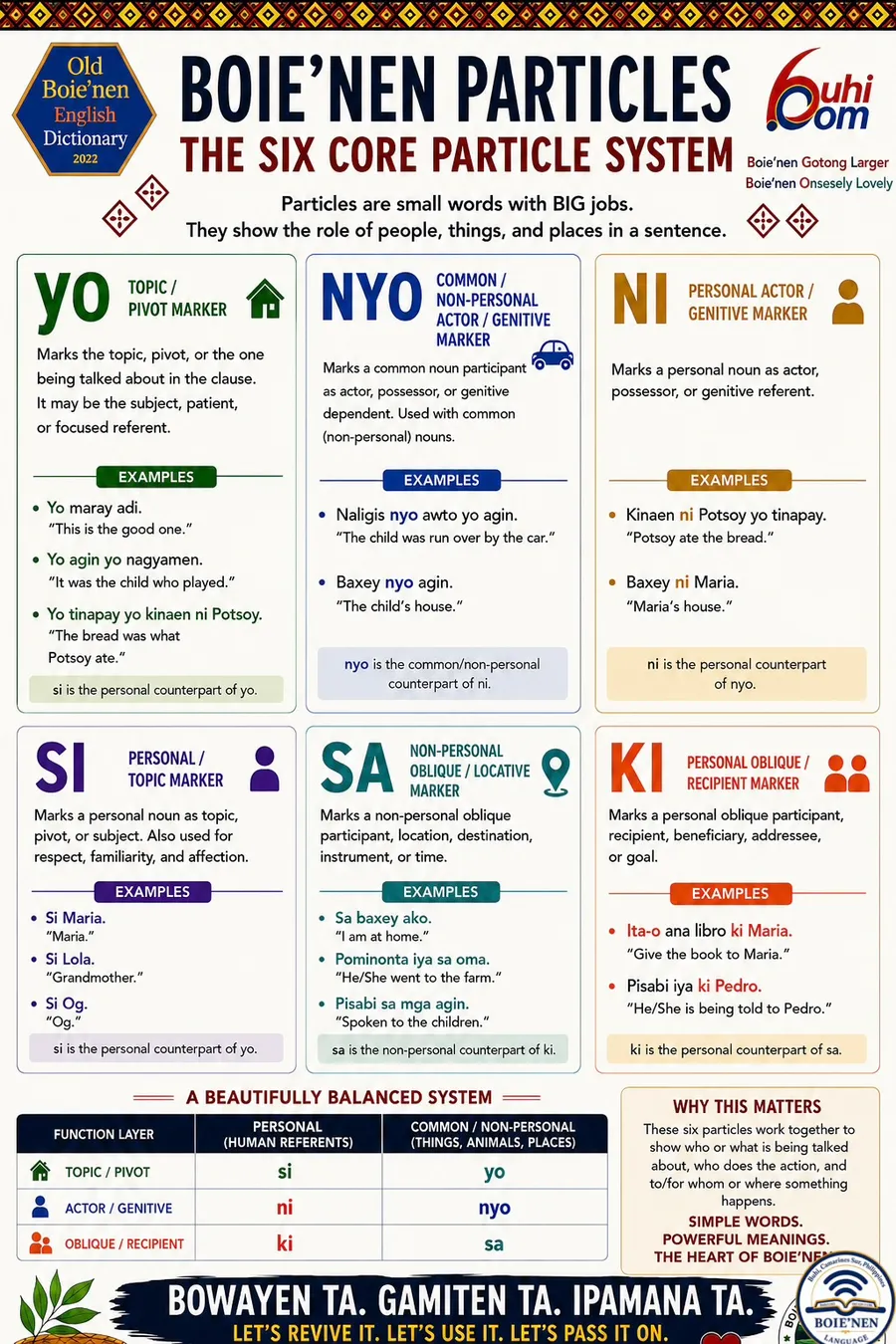
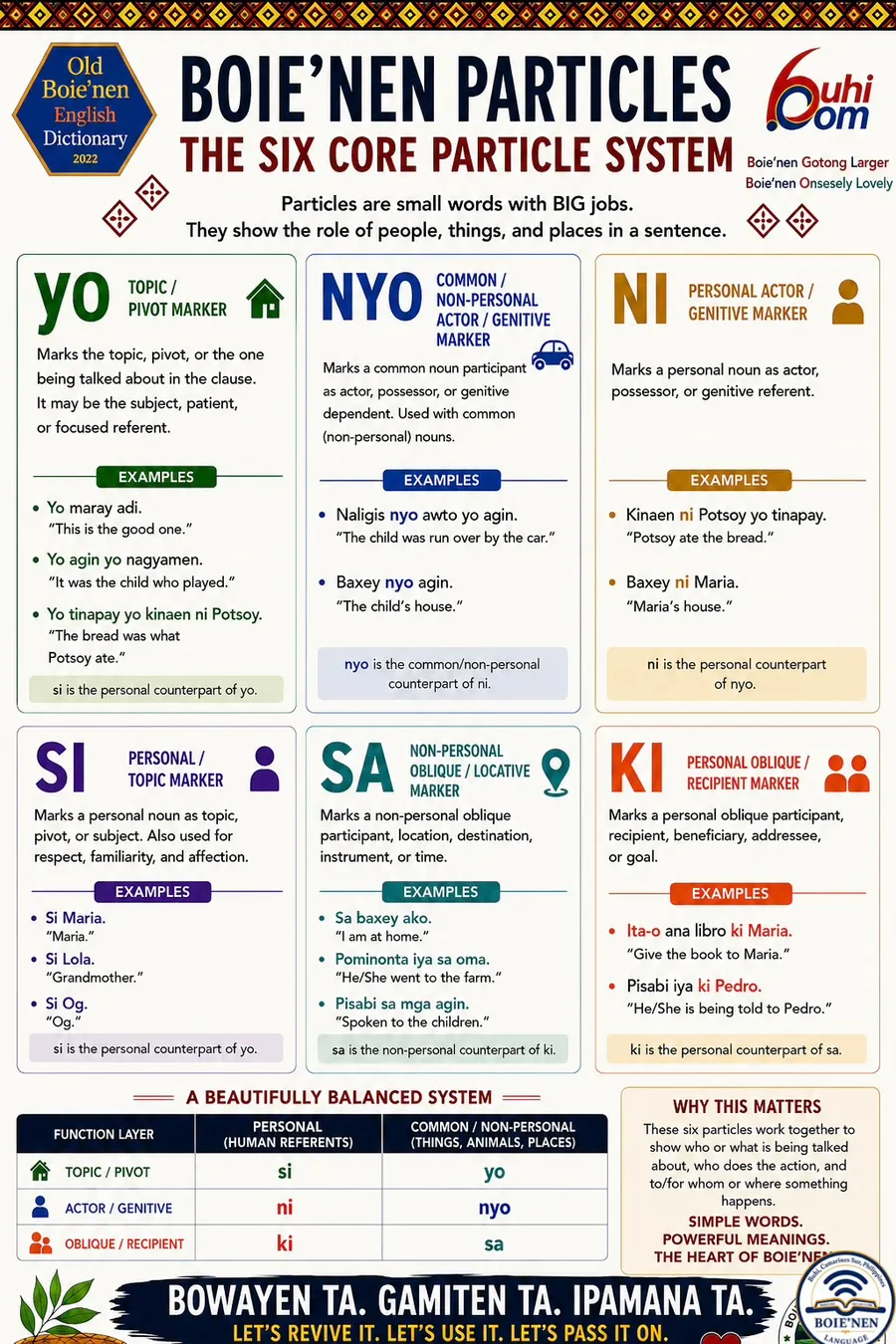
Common/non-personal genitive and non-pivot marker. Marks a common noun phrase functioning as an agent, possessor, cause, or dependent nominal participant.
Functions
- Common/non-personal genitive marker
- Non-pivot agent marker
- Possessor marker
- Cause or source marker
- Marks a dependent common noun phrase within a larger nominal construction
Examples
Baxey nyo agin.
“House of the child.” / “The child’s house.”
Yo baxey nyo agin.
“The house of the child.”
Kina’en nyo agin yo manok.
“The child ate the chicken.”
Kina’en yo agin nyo manok.
“The child that the chicken ate.”
Ongaw nyo agin.
“Cat of the child.” / “The child’s cat.”
Naligis nyo awto yo agin.
“The child was run over by the car.”
Notes
nyo does not simply mean “agent.” Its broader function is to mark a common/non-personal genitive or non-pivot dependent noun phrase.
The interpretation depends on the construction:
- with a noun, nyo commonly marks possession;
- with a patient-pivot verb, nyo commonly marks the agent;
- elsewhere, it may mark a cause, source, or dependent nominal relation.
It contrasts with personal ni:
| Personal | Common / Non-personal |
| ni Potsoy | nyo agin |
| ni Maria | nyo baxey |
Best concise contrast
yo marks the privileged common participant; nyo marks a common genitive or non-pivot dependent participant.
That wording is stronger and more explanatory than:
yo = patient/topic
nyo = agent
because the newer examples show that their grammatical opposition remains stable even when semantic roles and English word order change.
| Personal | Common/non-personal | General relation |
| si | yo | pivot/topic or privileged participant |
| ni | nyo | non-pivot agent, possessor, or genitive participant |
| ki | sa | oblique, recipient, goal, location, or related participant |
————/