Ortograpiyang Boie’nen
This Living Dictionary entry adapts KWF’s publication for digital reference, cross-linking, comparison, and continuing community-based analysis. It is not a reproduction, revised edition, or official digital version of the KWF publication.
The adaptation records KWF’s proposed spelling conventions while distinguishing them from the Portugal–Claveria orthography used by the Boie’nen Living Dictionary. Where the two systems differ, the LD preserves forms supported by the dictionary corpus, speaker knowledge, earlier linguistic documentation, and the principle that independently contrastive Boie’nen phonemes should remain distinguishable in writing.
A major point of divergence concerns KWF’s use of a modified {Gg} to represent the native posterior sound identified by Yamada (1972) as Phoneme X. This notation associates the sound graphically with the voiced velar stop /g/, although Boie’nen /g/ and /X/ contrast phonemically and can distinguish lexical meaning:
- kinabeg — ‘grated or scooped-out coconut meat’
- inabex — ‘loom-woven fabric’
- agas — ‘namby-pamby; excessively timid or delicate’
- axas — ‘snake’
The Living Dictionary therefore represents the posterior phoneme as /X/ and its grapheme as {Xx}, keeping it distinct from /g/ and {Gg}. This treatment follows Yamada’s recognition of a separate Phoneme X and reflects the contrast documented throughout the Boie’nen lexical corpus.
This LD adaptation should consequently be understood as both:
- a documentary record of KWF’s orthographic proposal; and
- a community-based critical adaptation that corrects or supplements that proposal wherever phonemic contrasts or characteristic Boie’nen forms are insufficiently represented.
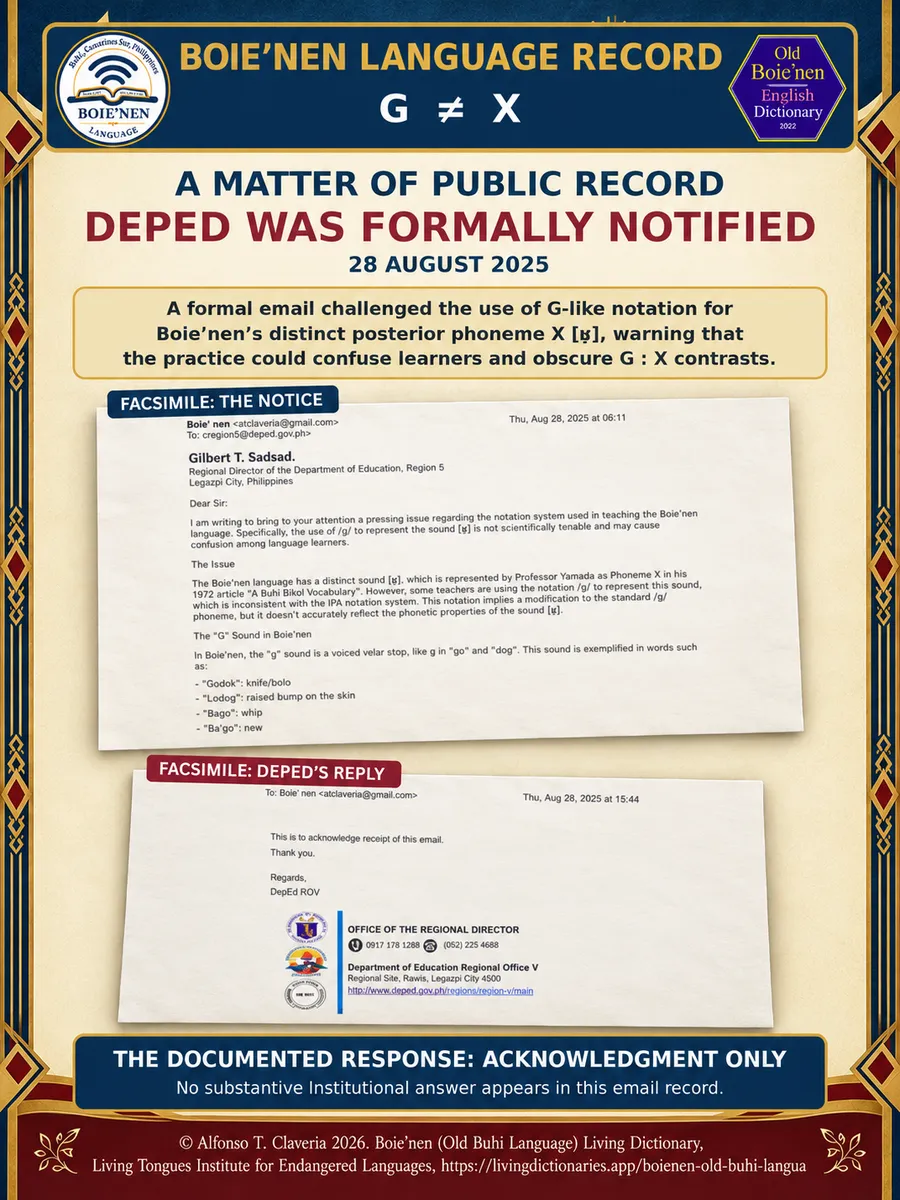
On 28 August 2025, Alfonso T. Claveria formally informed the Department of Education, Region V, that using /ģ/ for the Boie’nen posterior sound [ʁ̞] was linguistically misleading because it suggested a modification of ordinary /g/ rather than a separate phoneme. DepEd Region V acknowledged receipt of the correspondence on the same date; the acknowledgment did not constitute a substantive decision on the orthographic question.
Adaptation statement
Adapted for the Boie’nen Living Dictionary from the Komisyon sa Wikang Filipino’s Ortograpiyang Boie’nen (2023), with community-based annotations, corpus evidence, cross-references, and departures identified where necessary. This adaptation is not issued or endorsed by KWF.
References
Claveria, Alfonso T. 2025. “Concerns Regarding the Notation System Used in Teaching Boie’nen Language.” Correspondence to the Regional Director, Department of Education Region V, 28 August 2025.
Komisyon sa Wikang Filipino. 2023. Ortograpiyang Boie’nen. Manila: Komisyon sa Wikang Filipino.
Portugal, Dominga L. J. 2000. Buhi Dialect (Boînen). San Francisco: D. J. Portugal Publications.
Yamada, Yukihiro. 1972. “A Buhi Bikol Vocabulary.” Bulletin of the Faculty of Education, Kochi University, no. 24, Series I. Kochi: Faculty of Education, Kochi University.
Related entries
KWF; Orthography; Portugal–Claveria Orthography; {Gg}; /g/; {Xx}; /X/; Phonemic Contrast; Orthographic Harmonization; Epistemic Justice