ali-en
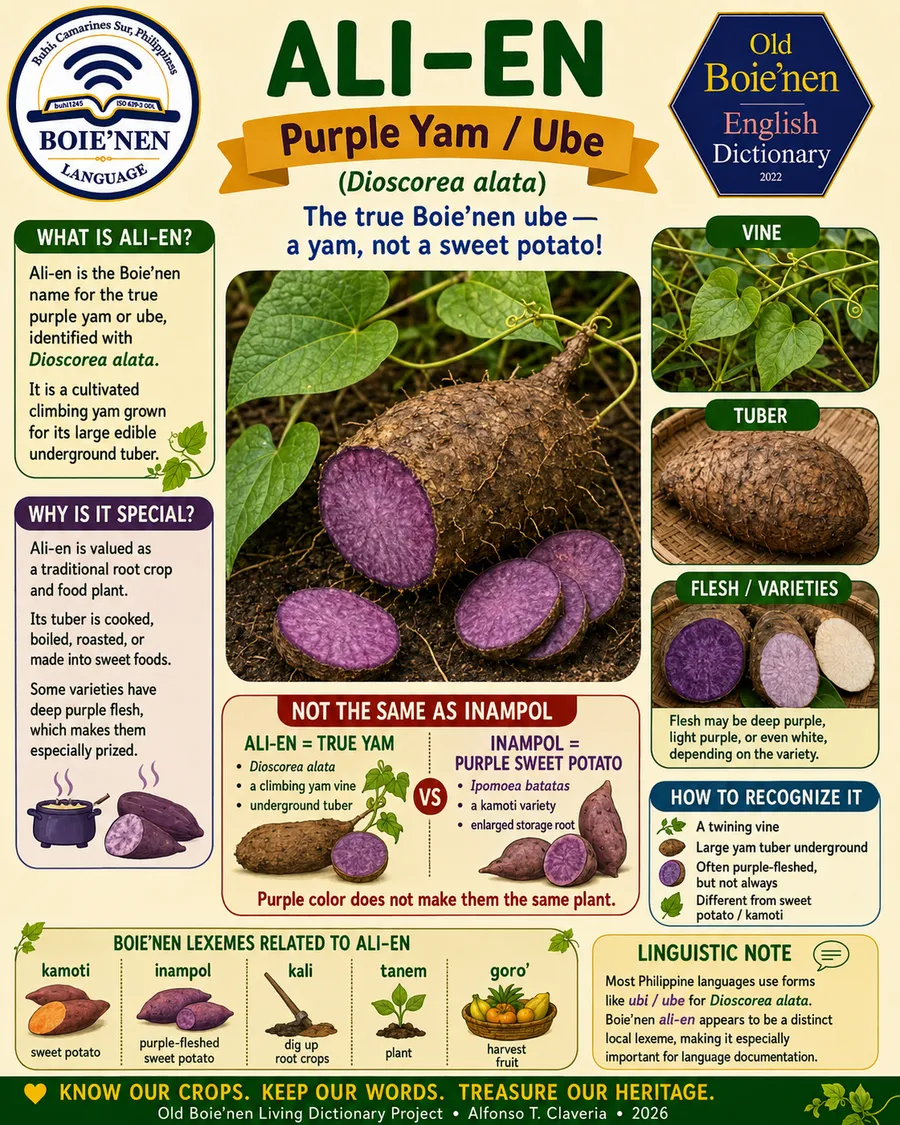
Filipino: Translation: ube; ubi
Bikol: Translation: ubi; ube
Part of Speech: noun
Semantic Domain: Plants; Agriculture; Root crops; Food and foodways
Noun Class: plant
Philippine agricultural references identify Dioscorea alata as ube/ubi and describe it as a twining vine arising from a large underground tuber; its stems characteristically have winged angles, a feature reflected in the species name alata ‘winged.’
Notes
Ali-en is not kamoti. Although some varieties of both plants may have purple flesh and can look similar once cooked or mashed, they belong to entirely different botanical groups.
- ali-en — true yam; Dioscorea alata; family Dioscoreaceae; a climbing vine producing a yam tuber.
- inampol — purple-fleshed sweet potato; Ipomoea batatas; family Convolvulaceae; a creeping or trailing sweet-potato plant producing enlarged storage roots.
Thus, purple color is not sufficient for identifying ali-en. A purple-fleshed inampol remains kamoti, not ali-en. Philippine nutrition sources likewise distinguish sweet potato (Ipomoea batatas) from true yams, while Philippine food-composition data identifies purple yam specifically as Dioscorea alata / ubi / ube.
Compare
inampol — a variety of kamoti with characteristically purple flesh; purple sweet potato (Ipomoea batatas).
kamoti — sweet potato (Ipomoea batatas), including varieties with white, yellow, orange, reddish, or purple flesh.
ngame’ — poisonous/intoxicating wild yam, provisionally identified as Dioscorea hispida; traditionally requiring detoxification before consumption.
Related entries
inampol; kamoti; ngame’; kali; tanem
Lexicographic note
This distinction is worth stating explicitly because English and commercial usage frequently blur “purple yam” and “purple sweet potato.” In Boie’nen the distinction is lexicalized:
ali-en ≠ inampol
ali-en = UBE / TRUE YAM
Dioscorea alata
inampol = PURPLE KAMOTI / SWEET POTATO
Ipomoea batatas