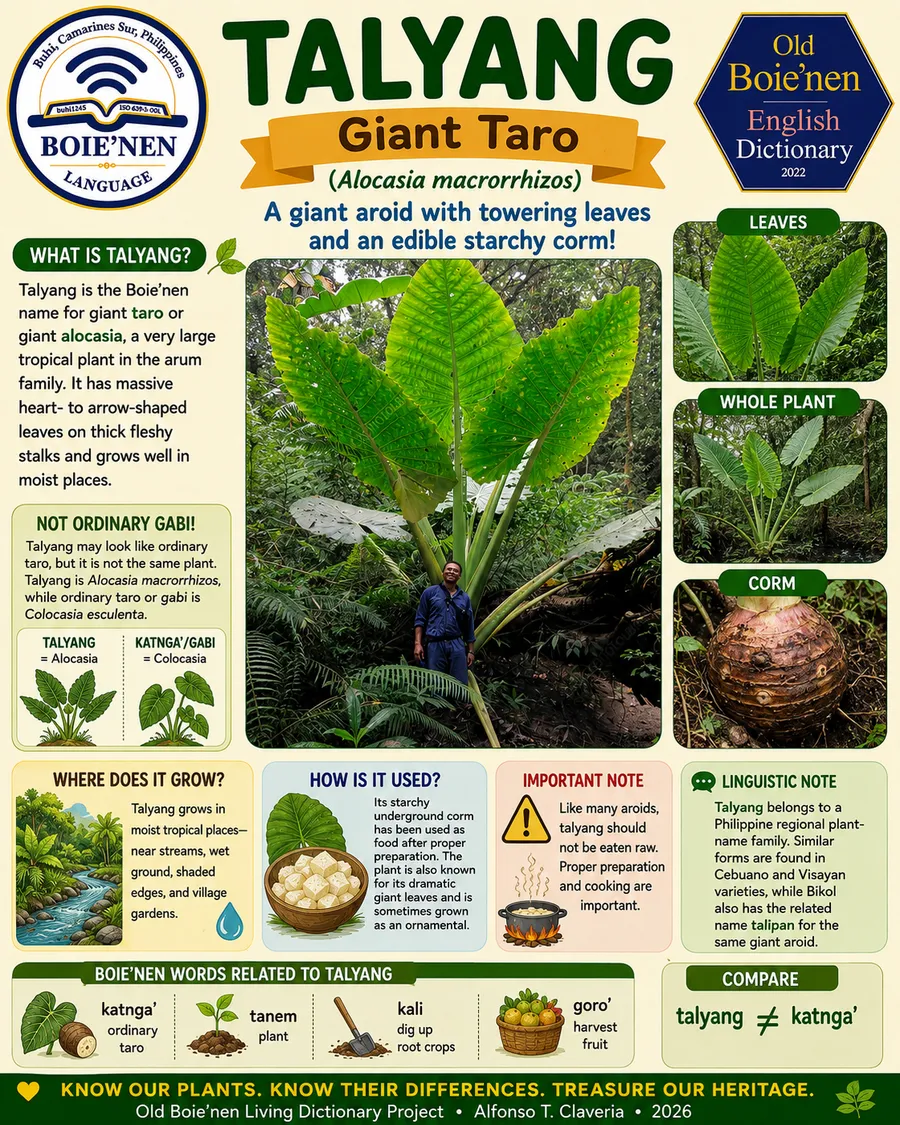
talyang
English: Translation
giant taro; giant alocasia; elephant ear
English: Definition
A very large perennial aroid, Alocasia macrorrhizos, characterized by enormous upright to spreading arrow- or heart-shaped leaves borne on thick, fleshy petioles and arising from a massive basal stem or corm-like underground structure. Talyang commonly grows in moist tropical places and may reach several meters in height. The plant belongs to the same family as ordinary gabi but is botanically distinct from true taro, Colocasia esculenta. Its underground starchy portion has traditionally been used as food in some Philippine communities after careful processing and thorough cooking.
Semantic Domain
Plants, trees and other vegetation
Scientific Name
Alocasia macrorrhizos
Notes
BIKOL: TRANSLATION
talipan; giant taro
FILIPINO: TRANSLATION
biga; badiang; gabing San Fernando
ENGLISH: DEFINITION
PART OF SPEECH
noun
SEMANTIC DOMAIN
Plants; Root crops; Traditional foodways; Wild and cultivated plants
NOUN CLASS
plant
SCIENTIFIC NAME
Alocasia macrorrhizos (L.) G.Don
NOTES
Despite the English name giant taro, talyang is not the same species as ordinary taro or gabi.
talyang
→ Alocasia macrorrhizos
→ giant alocasia / giant taro
gabi / taro
→ Colocasia esculenta
→ ordinary taro
Both belong to Araceae, which explains their superficially similar large leaves and starchy underground structures, but they belong to different genera.
Linguistic History
Talyang belongs to a Philippine vernacular name complex for Alocasia macrorrhizos. Close forms include Cebuano talyang / taliang, Eastern Visayan talyan, and related regional forms galiang / galyang. Central Bikol talipan designates the same species and may be historically related, but the phonological relationship has not yet been established. A separate ancient Austronesian name for Alocasia is reconstructed as Proto-Austronesian *biRaq ‘wild taro; elephant-ear; Alocasia spp.’, reflected in forms such as Ilokano bira and Filipino biga. Boie’nen talyang cannot presently be derived regularly from *biRaq and therefore appears to belong to a distinct Philippine lexical lineage. Further comparative research required.