Buhi
Buhi
Exolingual Toponym
Buhi is the exolingual toponym imposed and gradually standardized by Spanish colonial authorities in the Philippines without full regard for the indigenous phonology, prosody, and ethnolinguistic identity of the native Boie’nen [bɔ̆ɪ̆ɛ̋’n̆ɜ̆n] people and their settlement, Boie’ [bɔ̆ɪ̆ɛ̋’].
The currently dominant official form Buhi appears to represent the final stage of a long colonial orthographic adaptation process reflected in earlier Spanish spellings such as:
- Buy (17th century)
- Buji (18th–19th century)
- Buji ó Buhi (mid-19th century)
- modern Buhi
These spellings likely preserve successive Spanish attempts to approximate a non-Spanish indigenous sound structure containing diphthongal complexity, glottal timing, and posterior articulations unfamiliar to Spanish phonology.
Historical Orthographic Evolution
| Period | Form | Approximate IPA | Notes |
| precolonial | Boie’ | [bɔ̆ɪ̆ɛ̋ʔː] | Indigenous Boie’nen form |
| 1628–1649 | Buy | [ˈbui̯] | Early Franciscan rendering |
| 1700s–1800s | Buji | [ˈbuxi] | Spanish guttural orthography |
| 1850 | Buji ó Buhi | [ˈbuxi ~ ˈbuhi] | Dual accepted colonial spellings |
| modern | Buhi | [ˈbuhi] | Standardized Philippine form |
Spanish Phonotactic Adaptation
The evolution:
Boie’ → Buy → Buji → Buhi
appears consistent with Spanish colonial orthographic behavior:
1. Simplification of indigenous diphthongs and glottals
Spanish lacked:
- moraic glottal stops
- Boie’nen prosodic timing
- posterior continuants similar to the Boie’nen Phoneme-X system
Thus:
/boie’/
was likely simplified into:
Buy [bui̯]
by early missionaries writing what they heard.
2. Use of Spanish ⟨j⟩ for posterior/guttural sounds
In historical Spanish orthography:
⟨j⟩ ≈ [x]
(a velar/posterior fricative)
Thus:
Buy → Buji
may reflect later reinterpretation of posterior or glottalized acoustic features perceived by Spanish scribes.
3. Later Philippine orthographic normalization
Under later Hispanicized and eventually American-influenced Philippine spelling conventions:
j → h
became increasingly common in localized pronunciation and spelling stabilization, resulting in:
Buhi
Historical-Linguistic Context
Earliest missionary contact
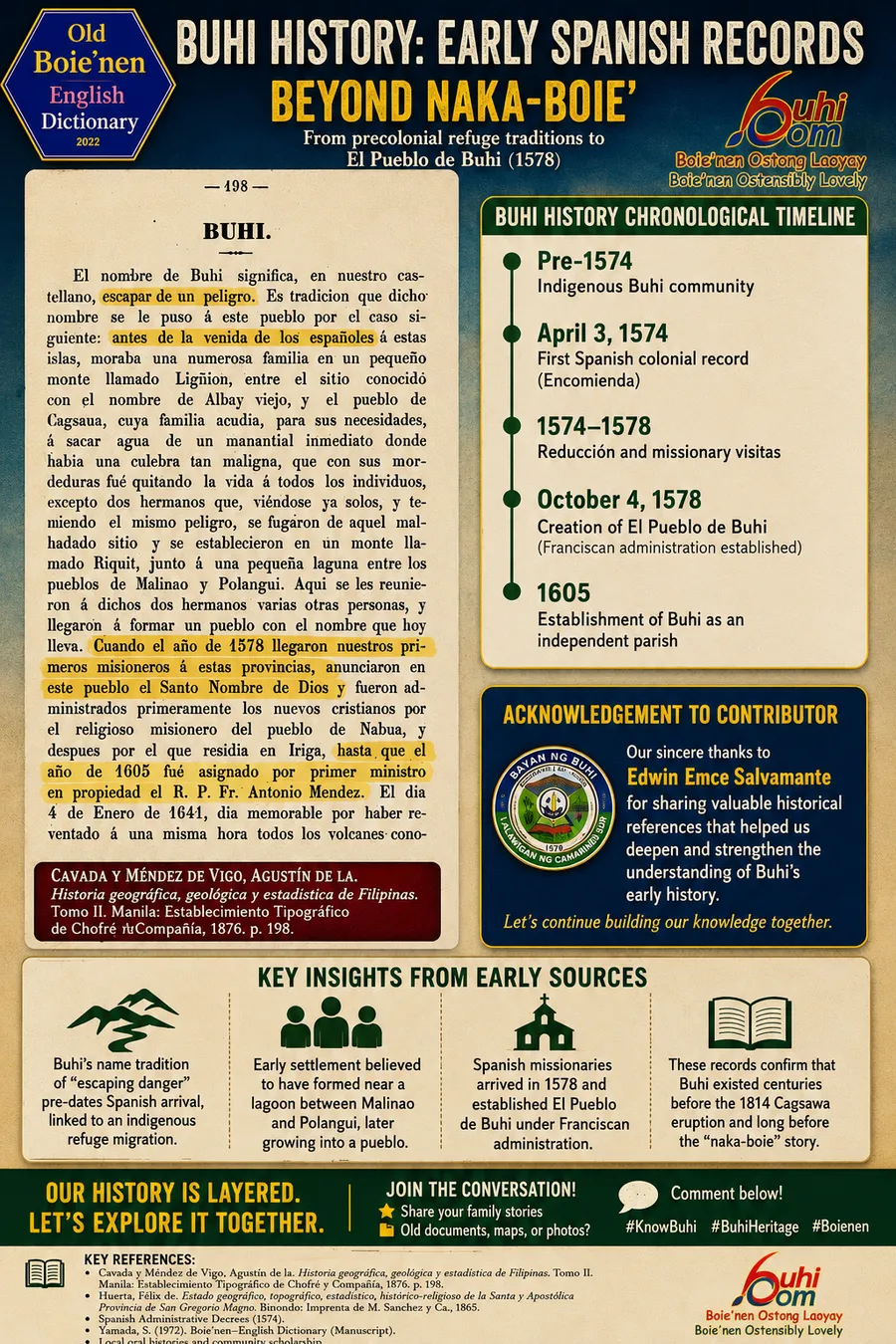
Local and ecclesiastical traditions place Franciscan evangelization in Buhi around:
1578
with Buhi later becoming a:
visita of Nabua
before more formal parish establishment in:
1605
Pre-1814 existence
The town already existed centuries before the:
1814 eruption of Mayon Volcano
which destroyed Cagsawa.
Therefore, the popular explanation that:
survivors supposedly said “naka-boie’ kami”
cannot adequately explain the original origin of the town name itself, since Buhi predated the disaster by more than two centuries.
The “naka-boie’” explanation is therefore better understood as:
a later folk-etymological reinterpretation of an already existing toponym.
Tiwi–Malinao–Monte Buhi Hypothesis
Emerging archival and geographic evidence suggests that:
“Buhi/Buji”
may originally have referred not merely to the present municipality but to a broader inland volcanic-watershed region associated with:
- Tiwi
- Mount Malinao
- Monte Buhi
- Lake Buhi basin
- inland refuge systems
The 1850 Spanish gazetteer itself mentions:
- “r. de Buji”
- “monte de Buji ó Buhi”
- “lago de su propio nombre”
suggesting the toponym applied to an entire geographic system rather than solely the town proper.
Colonial Corridor & Cultural Reorientation
By the Spanish colonial period, Buhi had become integrated into an inland communication corridor linking:
- Albay
- Polangui
- Buhi
- Partido
- Nueva Cáceres
The 1850 gazetteer explicitly states that Buhi:
“Se comunica por medio de un buen camino con Polangui é Iriga… recibe el correo semanal establecido en la isla.”
(“It communicates by means of a good road with Polangui and Iriga… it receives the weekly mail established in the island.”)
This corridor likely intensified:
- Albay influence
- church-building labor movement
- missionary contact
- refugee movement after the 1814 eruption
thereby strengthening the later “naka-buhi” interpretation while gradually overshadowing older Tiwi–Malinao historical connections.
Characteristics of the Exolingual Toponym
Imposed nomenclature
The name reflects colonial administrative and ecclesiastical naming practices rather than indigenous self-designation.
Disregard for native phonology
The modern form Buhi does not fully preserve:
- Boie’nen glottal timing
- diphthongal structure
- posterior continuants
- moraic prosody
associated with the native form:
Boie’
Orthographic fossilization
The sequence:
Buy → Buji → Buhi
preserves layers of colonial auditory approximation across centuries.
Impact
Cultural displacement
Colonial exonyms often obscure:
- older indigenous place identities
- ethnolinguistic continuity
- precolonial geographic systems
Linguistic disruption
Foreign spellings can sever the historical relationship between:
- land
- language
- oral memory
- and indigenous pronunciation.
Preservation & Recognition
Recognition of:
- Boie’
- Boie’nen
- and indigenous historical phonology
helps preserve:
- linguistic diversity
- historical continuity
- and cultural memory.
Current efforts toward Boie’nen language documentation, orthographic clarification, and historical reconstruction aim to restore awareness of these deeper indigenous layers beneath the colonial exonym:
Buhi
References
Buzeta, Manuel & Bravo, Felipe.
1850–1851.
Diccionario geográfico-estadístico-histórico de las Islas Filipinas.
Madrid: Imprenta de José C. de la Peña.
Relevant entry:
“BUJI ó BUHI: pueblo con cura y gobernadorcillo, en la isla de Luzón, prov. de Camarines-Sur, dióc. de Nueva-Cáceres…”
Huerta, Félix de.
Estado geográfico, topográfico, estadístico, histórico-religioso de la Santa y Apostólica Provincia de San Gregorio Magno.
Binondo: Imprenta de M. Sanchez y Ca.
Princeton University Digital Archive.
“Harvested by Decree (1704 route references).”
Princeton 1762 Archive
Municipality of Buhi Official Profile
Municipality of Buhi Official Website
Parish history references
Parokya ni San Francisco de Asis (Buhi)
Claveria, Alfonso T.
Working notes on Boie’nen phonology, exolingual toponyms, and historical orthography. Unpublished research compilation.
- \