ngani’
PART OF SPEECH
particle; enclitic discourse particle
EXAMPLE SENTENCES
Amongani’. “Yes indeed.”
Magigit ngani’ a-an. “It really might shart.”
Tomora’yog ngani’ a-an. “Oh—he might urinate.” or “Look out—he might squirt.”
Kinkaya’ngani’. “If that is indeed the case.”
MORPHOLOGY
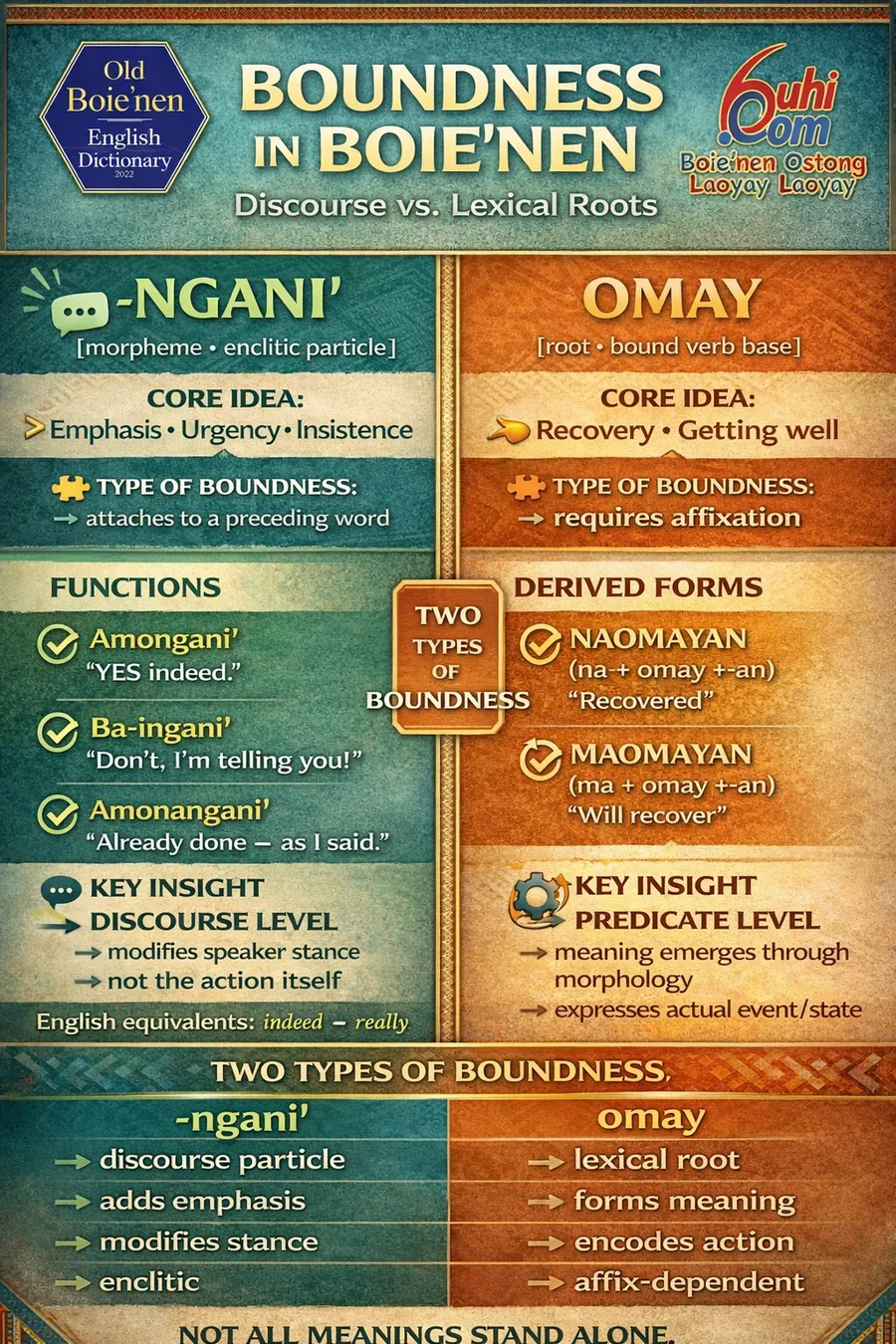
A clitic-like discourse particle that normally follows the word, predicate, or proposition it modifies.
It may be written as a separate word:
tomo-od + ngani’ + ika
→ Tomo-od ngani’ ika.
It may fuse with its host in established combinations:
amo + ngani’
→ amongani’ “yes indeed”
kaya’ + ngani’
→ kaya’ngani’ “indeed; that being the case”
kin + kaya’ + ngani’
→ kinkaya’ngani’ “if that is indeed the case”
The final okina (’) is part of the Boie’nen form and represents its moraic glottal.
USAGE NOTES
Ngani’ operates over the meaning and communicative force of an utterance rather than deriving a new noun, verb, or adjective. It should therefore be classified as a discourse particle or enclitic, not merely as a suffix.
Its precise interpretation depends on context and intonation:
• confirmation — “indeed; exactly”
• strengthened assertion — “really; certainly”
• insistent or moderated directive — “just; go on; please, then”
• warning or realization — “oh; look out”
• concession — “granted; if that is indeed so”
• relief — “fortunately; it is good that”
In a directive such as Tomo-od ngani’ ika, ngani’ may combine insistence with an appeal to something the speaker considers already evident or mutually understood.
LINGUISTIC HISTORY
Probably inherited from Proto-Philippine *ŋani, reconstructed as a discourse particle expressing emphasis, affirmation, solidarity, concession, or qualification.
Probable cognates include:
• Central Bikol nganì /ŋaniʔ/ — affirmation; command-softening; relief
• older and Southern Tagalog nganì /ŋaniʔ/ — “indeed; really; truly”
• Hanunó’o ngani — “indeed”
• Cebuano and other Visayan gani — affirmation or insistence
The wide geographic distribution and closely corresponding discourse functions support common inheritance rather than recent borrowing into Boie’nen. The Boie’nen final okina agrees particularly closely with the final glottal closure documented in Central Bikol and Tagalog.
EDITORIAL NOTE
Earlier treatment as [-ngani’] “an emphasis suffix” is too restrictive. The corpus contains independent postposed occurrences after verbs and directives, demonstrating that ngani’ has utterance-level scope. Joined forms such as amongani’ and kaya’ngani’ are better understood as encliticized or conventionalized combinations.
Do not derive tanganing “so that” from ngani’ solely on the basis of resemblance. That form requires a separate historical analysis.
RELATED ENTRIES
amo
amongani’
kaya’
kaya’ngani’
kinkaya’ngani’
kin
to-od
————-
The verb root "omay" require affixation to form a usable verb in Boie’nen.
Examples:
Naomayan: na- (completion prefix) + omay (root) + -an (suffix)
Meaning: recovered or got well
Maomayan: ma- (future or consequence marker) + omay (root) + -an (suffix)
Meaning: will recover
The suffix "-an" might indicate:
1. Locative or directional focus
2. Benefactive or applicative function
3. Aspectual or completive aspect
The "omay" root seems to convey the core meaning of "recovery" or "getting well." The affixes modify this meaning to indicate:
1. Completion (na-)
2. Future or potential consequence (ma-)
This phenomenon illustrates the importance of morphology in Boie’nen, where verb roots require specific affixes to convey meaningful expressions. Further research on Boie’nen's grammatical structure and affixation patterns would provide more insight into this verb root phenomenon.