{Oo}
DRAFT ——-DRAFT ——/DRAFT
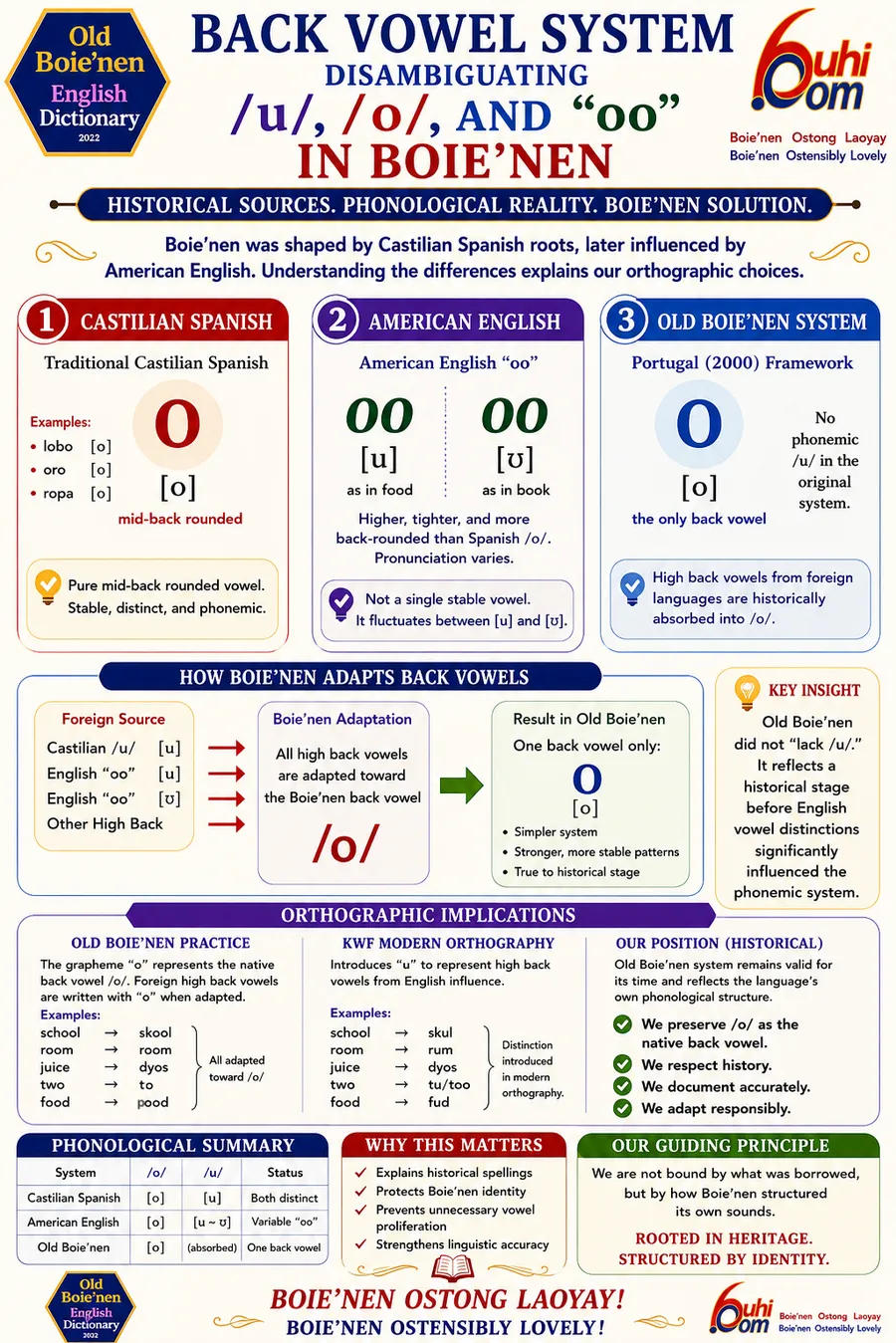
The Boie’nen Phoneme /Oo/ [o] is realized as an unstressed monophthong, a single vowel sound
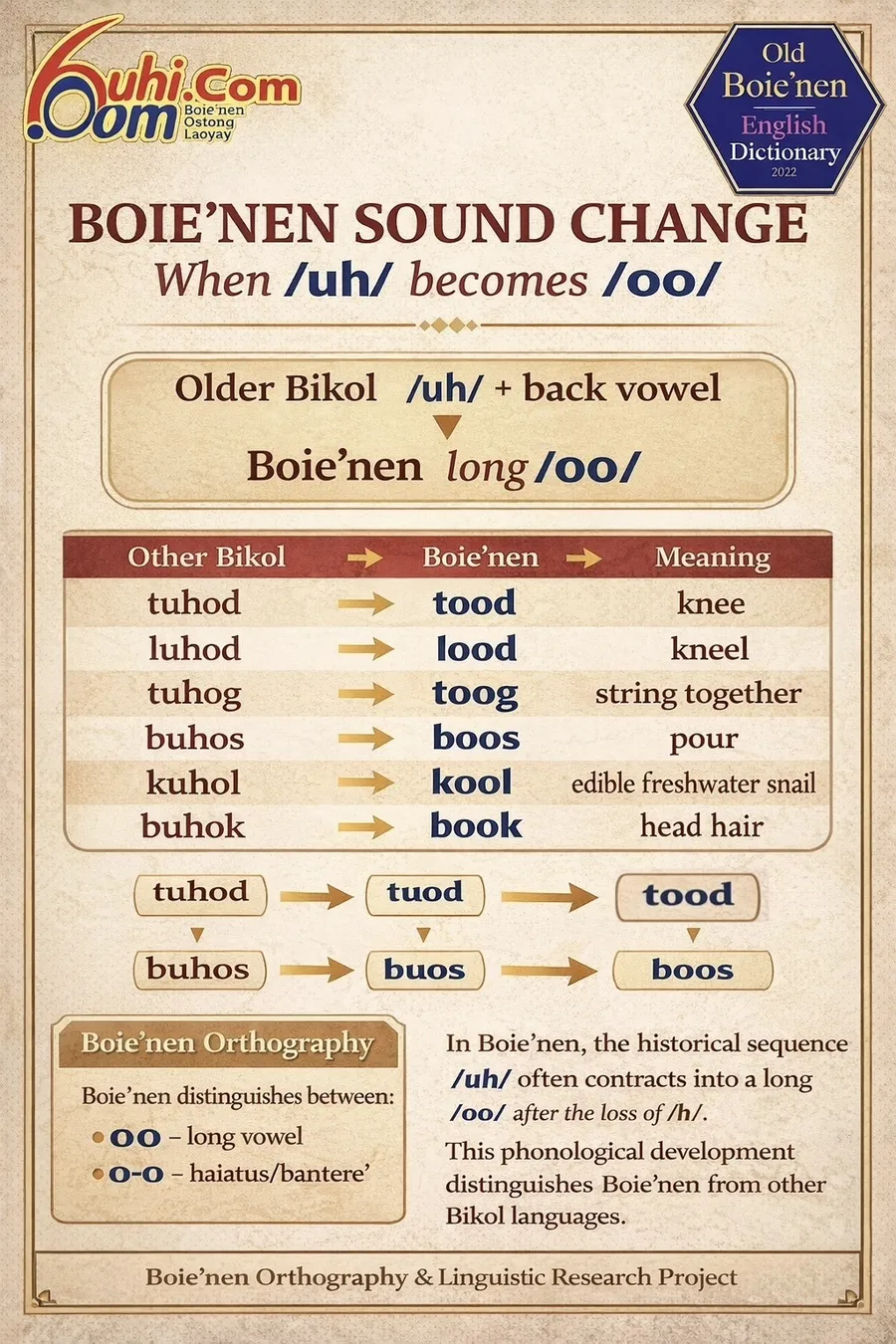
The double “oo” such as in “book /bʊk/“ as in the Boie’nen “toog /tʊ:g/ (skewer) is the realization of “double-o Boie’nen words-
\
- *[oʊ]* is a diphthong, a gliding vowel sound, as in "over" and "both." This diphthong is often represented by the phoneme /o/ in American English.
Additionally, the realization of /o/ can vary depending on regional accents and individual speech patterns.
Minimal Pairs
pokpok (laundry-washing technique) vs pekpek (whack)
pagokpok (corn cob) vs pagekpek (loud hammering sound)
ok-ok (gag) vs ek-ek (shear short)
toktok (knocking sound) vs. tektek (chop finely)
leklek (abode) vs liklik (avoid)
ke’ke’ (chin) vs ko’ko’ (gouge)
ki’ki’ (one-leg hop) vs. koko (fingernail)
Allophones?
yo [j̆’ʊ̈̚] (topic marker)
soso [s̠oʊ:ʔsŏʊ̆˩] (woman’s breast)
so’so’ [s̠oʊ̈̚z’ʊ̈̋ʔ] (nose blow/pour)
a’wo [ɶ̞̝̝̝̚.wːːo] (pestle)
awo [œ.wʊ̈] (shoo]
lolokaden [loːːlo.kɑ̆dɜːːn] (coconut meat stage)
balyo [b̪’ɐl̆ʎ̟jʊ] (opposite side/barter)