angkag
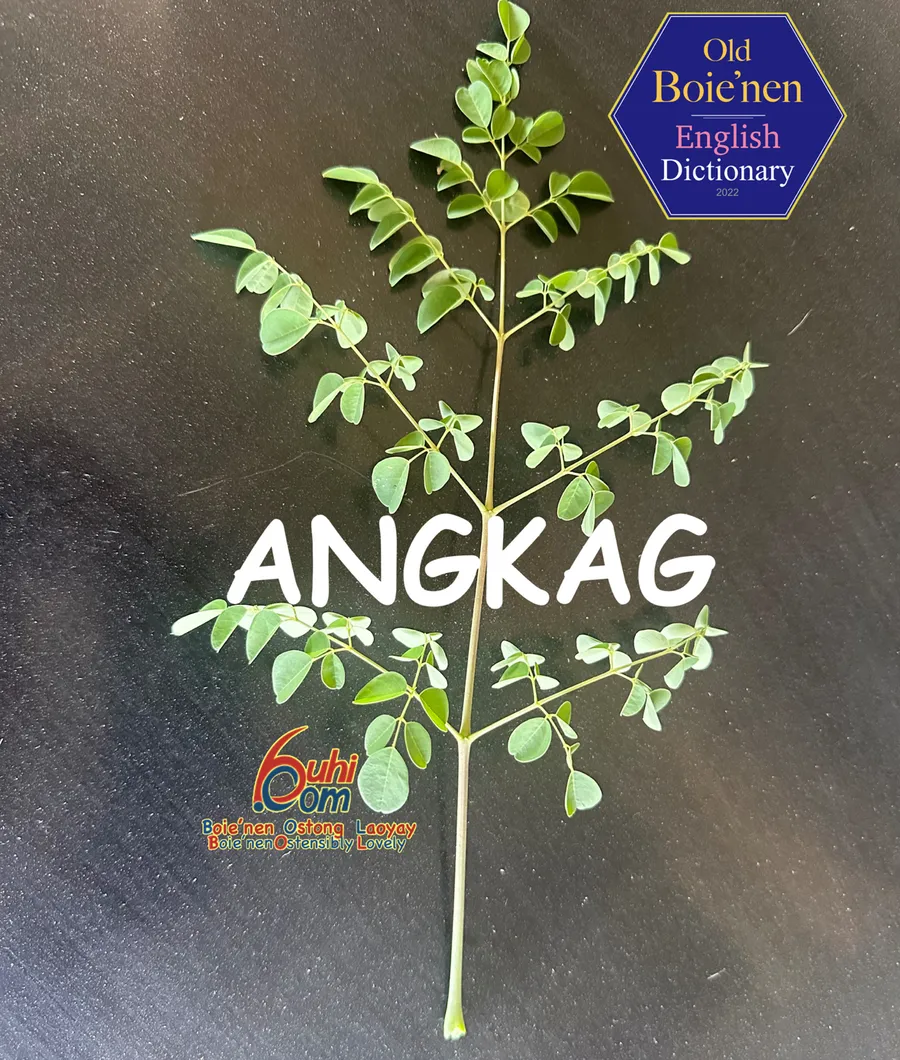
English: Translation
the stem (rachis) of the moringa plant that attaches the many small leaflets to the main stem, forming the tripinnate structure.
Part of Speech
noun
Semantic Domain
Plants, trees and other vegetation
Scientific Name
Moringa oleifera
Notes
The KALONGAY (Moringa oleifera) plant consists of several parts, including:
- *Leaves*: These are tripinnately compound, meaning they're divided into three sets of leaflets. Each leaf can grow 30-50 cm long and has small, opposite, elliptic to obovate leaflets with entire margins.\
- *Stem*: The stem has a thick, corky, whitish-brown bark that's fissured vertically.\
- *Flowers*: Moringa plants produce flowers, which are part of their reproductive cycle.\
- *Pods*: The plant produces pods, which contain seeds.\
- *Seeds*: Moringa seeds are found in the pods and can be used for various purposes, including oil extraction and water purification.\
- *Roots*: The roots of the Moringa plant have medicinal properties and contain compounds like benzyl glucosinolate, quercetin, and isorhamnetin.\
- *Bark*: The bark of the Moringa plant has a corky texture and is whitish-gray in color.
The leaf system of Moringa oleifera is notable for its complexity, with:
- *Tripinnate structure*: Each leaf is divided into three sets of leaflets, which are further divided into smaller leaflets.\
- *Rachis*: The rachis is the stem that attaches the leaflets to the main stem, and it's thickened and articulated at the base.\
- *Leaflets*: The leaflets are small, opposite, and elliptic to obovate in shape, with entire margins and mucronate or obtuse apices.¹