ngame’
FILIPINO: TRANSLATION
nami; makamandag na ligaw na ubi
BIKOL: TRANSLATION
mamo; makamandag na layas na ubi
PART OF SPEECH
noun
SEMANTIC DOMAIN
Plants; Root crops; Food; Traditional foodways; Famine and survival foods; Toxic plants
NOUN CLASS
plant; food plant
SCIENTIFIC NAME
Dioscorea cf. hispida Dennst.
Use cf. for the present entry until identification from a photographed or collected Boie’nen ngame’ plant is botanically confirmed.
NOTES
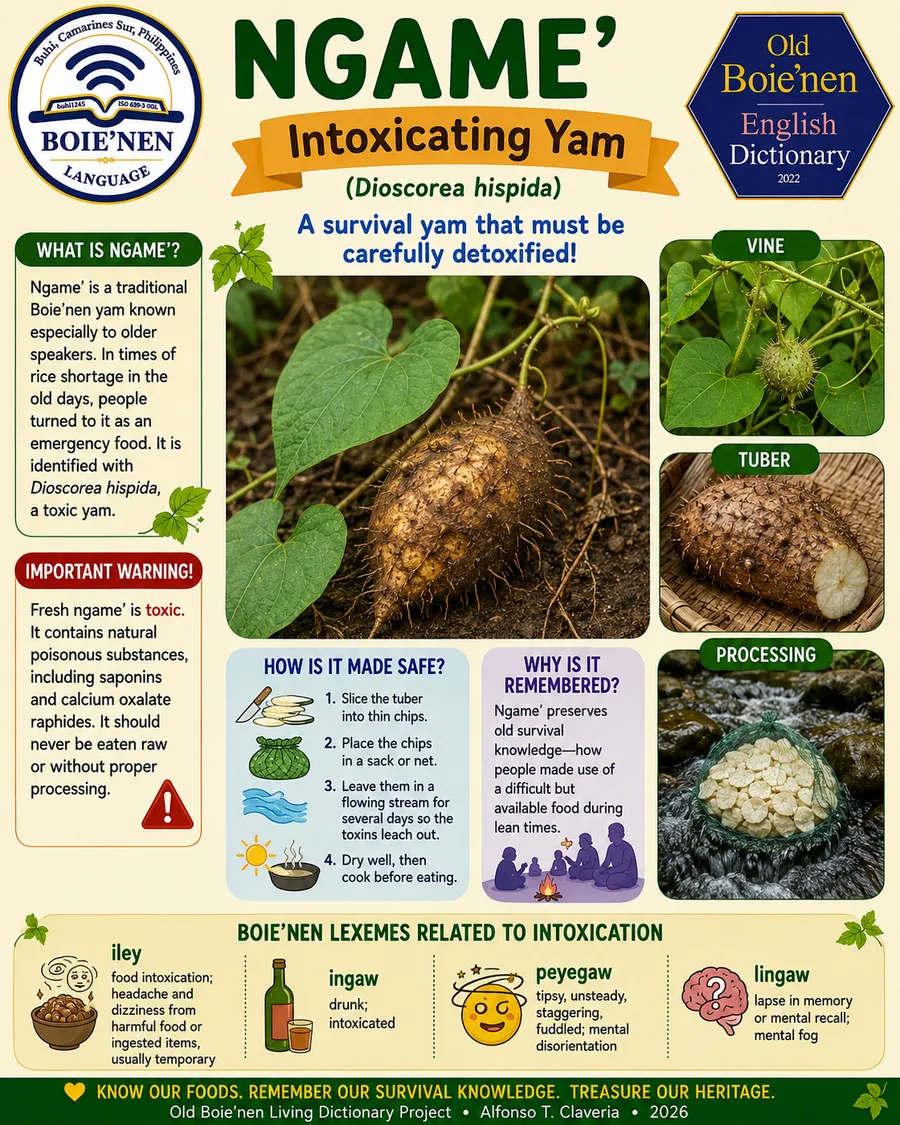
Ethnobotanical significance. Older Boie’nen speakers remember ngame’ particularly as a food resorted to during periods of rice shortage. The word therefore encodes more than the botanical species itself: it preserves knowledge of an older scarcity-food and survival-food tradition.
The fresh tuber should not be treated as an ordinary edible yam. Dioscorea hispida is documented as poisonous before detoxification. Traditional communities process it extensively before consumption, commonly involving prolonged washing or leaching. Historical knowledge of such processing should be documented ethnographically rather than interpreted as a modern food-safety guarantee. Philippine traditional-knowledge sources likewise warn that the unprocessed tuber is poisonous.
CULTURAL NOTE
In earlier Boie’nen life, ngame’ belonged to the category of plants that could sustain people when preferred staples—particularly rice—were scarce. The lexical item therefore preserves traditional ecological knowledge, food-security practice, and intergenerational knowledge of poisonous plants and their treatment.
This makes ngame’ especially valuable lexicographically: its definition should not be reduced simply to “yam.”
RELATED ENTRIES
iley — adverse or intoxicating effect from ingested food or another substance, typically involving such symptoms as headache or dizziness.
ingaw — drunk; intoxicated.
peyegaw — tipsy, fuddled, unsteady or staggering; by extension, mentally disoriented or confused.
lingaw — lapse of memory; failure of mental recall; forgetfulness or mental fog.
kali — dig up or harvest an underground root crop/tuber.
The intoxication cluster
| Boie’nen | Semantic center |
| ngame’ | source — a particular potentially intoxicating/toxic yam |
| iley | physiological effect — becoming temporarily ill/dizzy from something ingested |
| ingaw | intoxicated state — drunk/intoxicated, especially in the ordinary intoxicant sense |
| peyegaw | behavioral/neurological manifestation — tipsy, staggering, fuddled, disoriented |
| lingaw | cognitive effect — forgetting, lapse of recall, mental fog |
That is a much more interesting Boie’nen semantic field than simply translating all of them as “poisoned / drunk / dizzy.”
Conceptually:
harmful/intoxicating ingestion → iley → ingaw / peyegaw → possible lingaw
but lingaw also exists independently as ordinary forgetting and therefore should only be cross-referenced, not defined as intoxication.
LINGUISTIC HISTORY
The identification of ngame’ with Dioscorea hispida is presently based on the remembered Boie’nen description of a poisonous yam used as scarcity food and its close ethnobotanical correspondence with the Philippine nami / intoxicating yam. This identification should remain provisional pending direct botanical confirmation.
The Filipino nami and reported Bikol mamo may be included as comparative vernacular names for the same proposed species, but there is presently no evidence establishing either as an etymological cognate of Boie’nen ngame’. Philippine agricultural documentation independently recognizes D. hispida as nami/karot.
CUSTOM TAGS
botanical; cultural; traditional-food; survival-food; toxic-plant; ethnobotanical; needs-photo; needs-botanical-verification; poster-ready
EVIDENCE STATUS
Verified lexical/cultural meaning; provisional botanical identification.