KWF
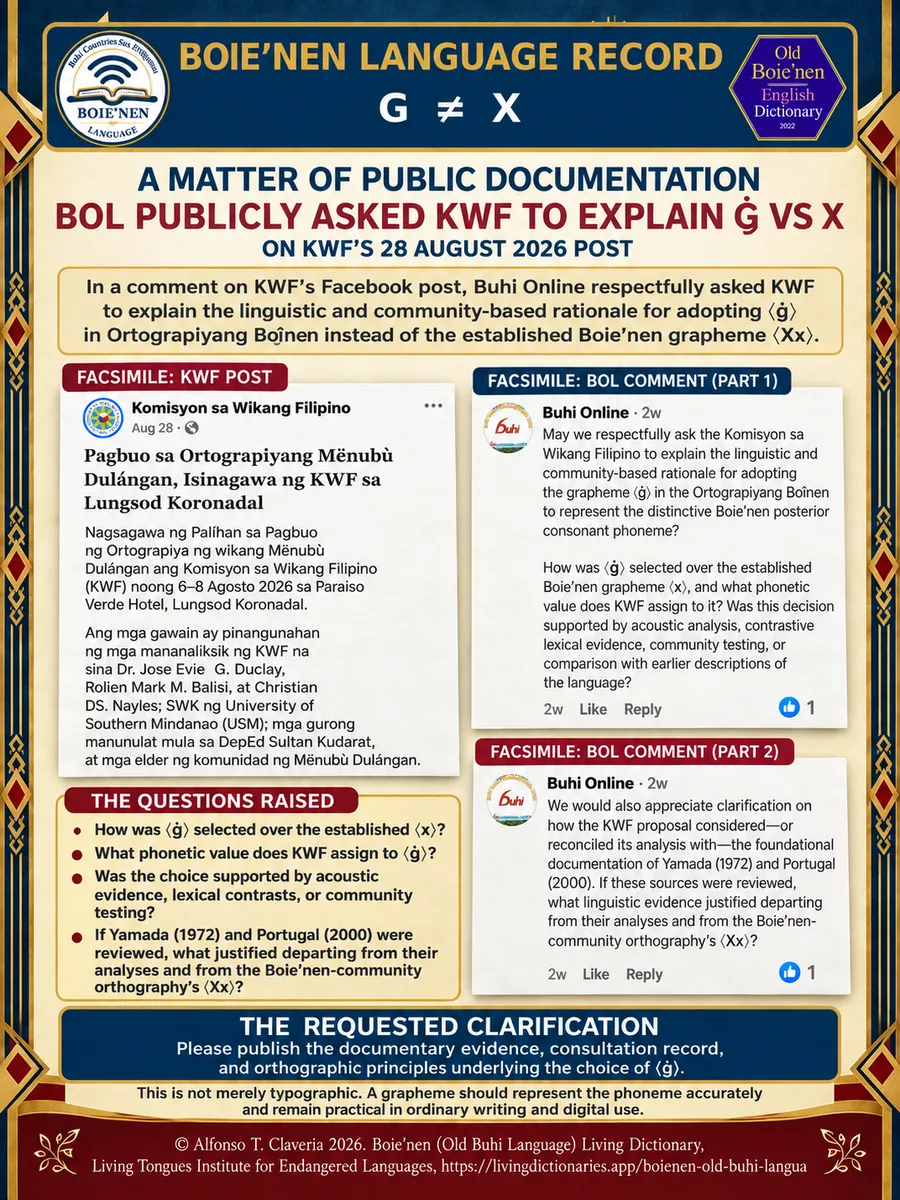
KWF’s statutory authority derives from Republic Act No. 7104 (1991). The law authorizes the Commission to formulate linguistic policies and standards and to conduct research toward the “eventual standardization of Filipino and other Philippine languages.” The same law, however, also expressly requires the preservation of those languages and representation of the country’s ethnolinguistic communities.
KWF has promoted the standardization and harmonization of Philippine-language orthographies, partly to facilitate literacy and instruction across languages. The available evidence does not establish an explicit KWF policy requiring every Philippine language to conform to Filipino phonotactics. Nevertheless, a harmonization-first approach can function as though Filipino-centered sound–letter conventions were normative whenever it fails to represent a language’s independently contrastive phonemes.
This problem is evident in the KWF-associated orthography prepared for Boie’nen. Its treatment of the native posterior phoneme /X/ through a modified {Gg} notation collapses or obscures the Boie’nen contrast between the voiced velar stop /g/ and the posterior continuant /X/. Compare:
- kinabeg ‘grated or scooped out coconut meat’ vs. inabex ‘loom-woven fabric’
- agas ‘namby-pamby; excessively timid or delicate’ vs. axas ‘snake’
These forms demonstrate that /g/ and /X/ can distinguish lexical meaning. Representing both through {Gg}, even when one form carries a diacritic, misleadingly presents /X/ as a modified variety of /g/ rather than as an independently contrastive Boie’nen phoneme. The issue therefore concerns more than spelling preference: it concerns phonemic fidelity, linguistic preservation, and the Boie’nen community’s right to have its sound system represented on its own terms.
On 28 August 2025, Alfonso T. Claveria formally brought the use of /ģ/ for the Boie’nen posterior sound to the attention of the Department of Education, Region V. The correspondence argued that this notation inaccurately associates the sound with ordinary Boie’nen /g/ and cited Yamada’s earlier identification of a separate Phoneme X. DepEd Region V acknowledged receipt of the communication on the same date. The acknowledgment documented receipt but did not constitute a substantive ruling on the linguistic question.
References
Claveria, Alfonso T. 2025. “Concerns Regarding the Notation System Used in Teaching Boie’nen Language.” Email correspondence to the Regional Director, Department of Education Region V, 28 August 2025; receipt acknowledged by DepEd Region V on the same date.
Komisyon sa Wikang Filipino. 2023. Ortograpiyang Boie’nen. Manila: Komisyon sa Wikang Filipino.
Portugal, Dominga L. J. 2000. Buhi Dialect (Boînen). San Francisco: D. J. Portugal Publications.
Republic of the Philippines. 1991. Republic Act No. 7104: Commission on the Filipino Language Act. Sections 4 and 14. Lawphil.
Yamada, Yukihiro. 1972. “A Buhi Bikol Vocabulary.” Bulletin of the Faculty of Education, Kochi University, no. 24, Series I. Kochi: Faculty of Education, Kochi University.
Related entries
{Gg}; /g/; {Xx}; /X/; Orthography; Orthographic harmonization; Phonemic contrast; Epistemic justice