/X/
/X/
English: posterior continuant
Part of Speech
Phoneme
Semantic Domain
Phonology; Language and Communication
Definition
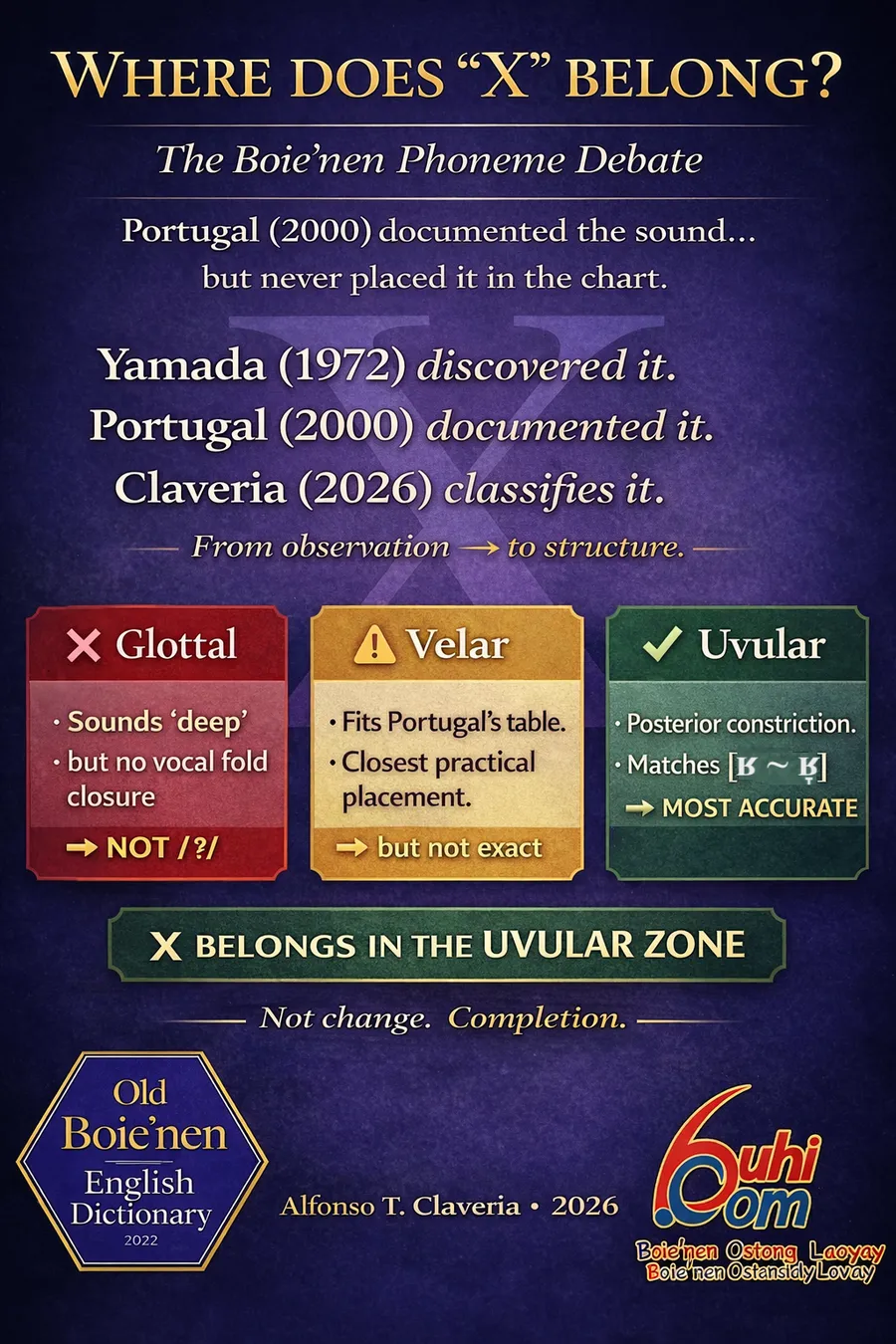
/X/ is a distinctive Boie’nen consonant phoneme characterized as a posterior continuant, typically realized as a voiced dorsal fricative or approximant with articulations ranging from velar to uvular depending on speaker and phonetic environment.
It is one of the defining phonological features of Boie’nen and distinguishes the language from neighboring Philippine languages, whose native consonant inventories generally lack a comparable posterior continuant phoneme.
IPA
[ɣ ~ ɣ̞ ~ ʁ̞ ~ ʁ]
The phonetic realization varies among speakers and environments while maintaining a single phonemic identity.
Phoneme Class
Consonant
Voiced posterior continuant
Articulation
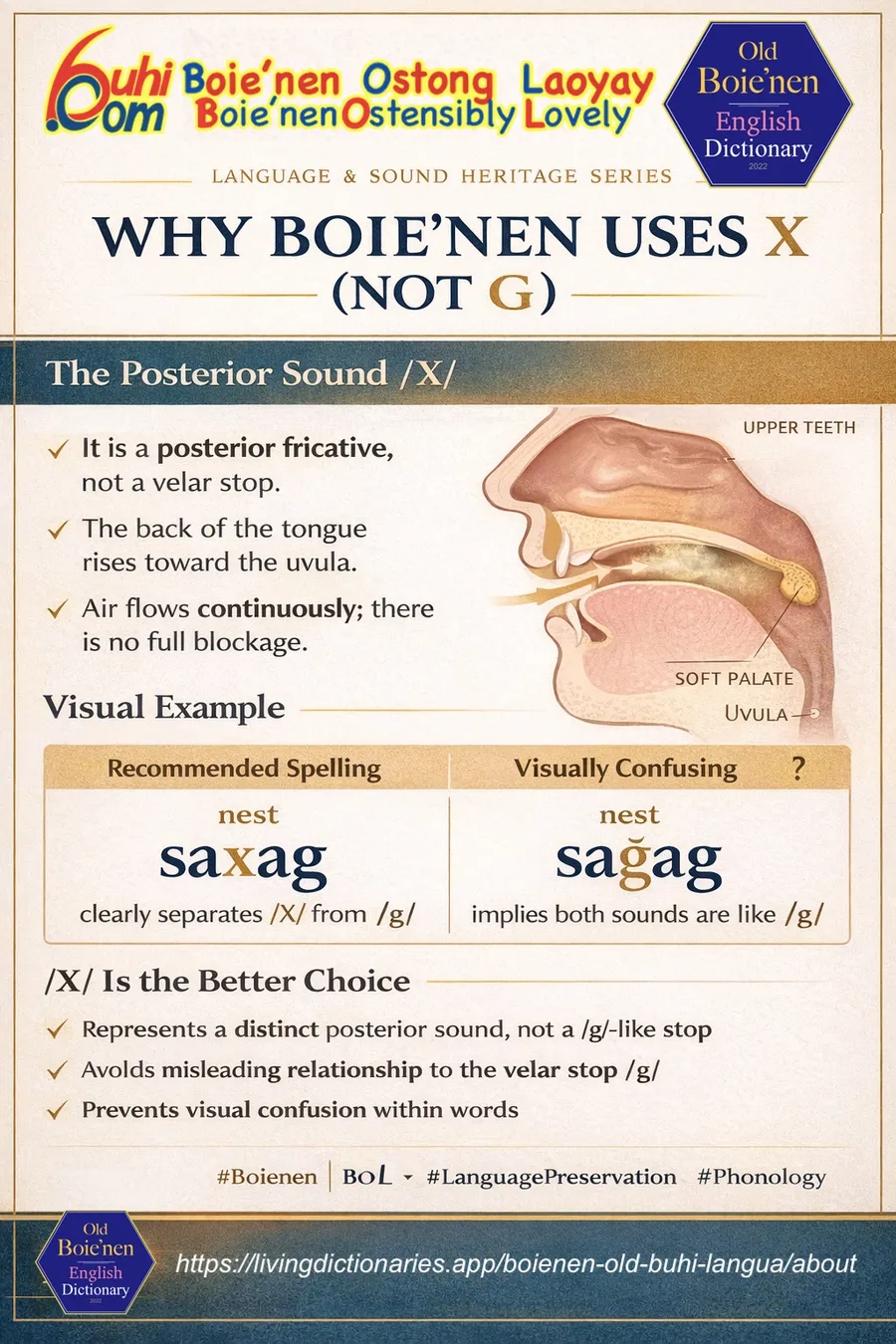
The phoneme is produced by:
- raising the back of the tongue toward the posterior oral cavity;
- forming a narrow constriction without complete closure;
- allowing continuous voiced airflow through the constriction.
Unlike /k/ and /g/, the airflow is not completely interrupted.
Phonological Status
/X/ is a fully contrastive phoneme in Boie’nen.
It cannot be analyzed as an allophone, variant, or weakened pronunciation of /G/. It participates directly in lexical contrasts and occupies the same phonological status as the other consonant phonemes of the language.
Distribution
The phoneme occurs throughout the lexicon.
Word-initial
xata’ — purplish pallor
Word-medial
saxag — bird’s nest
Word-final
gatex — itch
Reduplicated
exex — muscle malaise
Adjacent to Okina
dakexe’ — big
Short lexical forms
e’xi — sit on
exe’ — yes
Consonant clusters
axdat — smarting pain
taxpan — to winnow
Phonemic Contrast
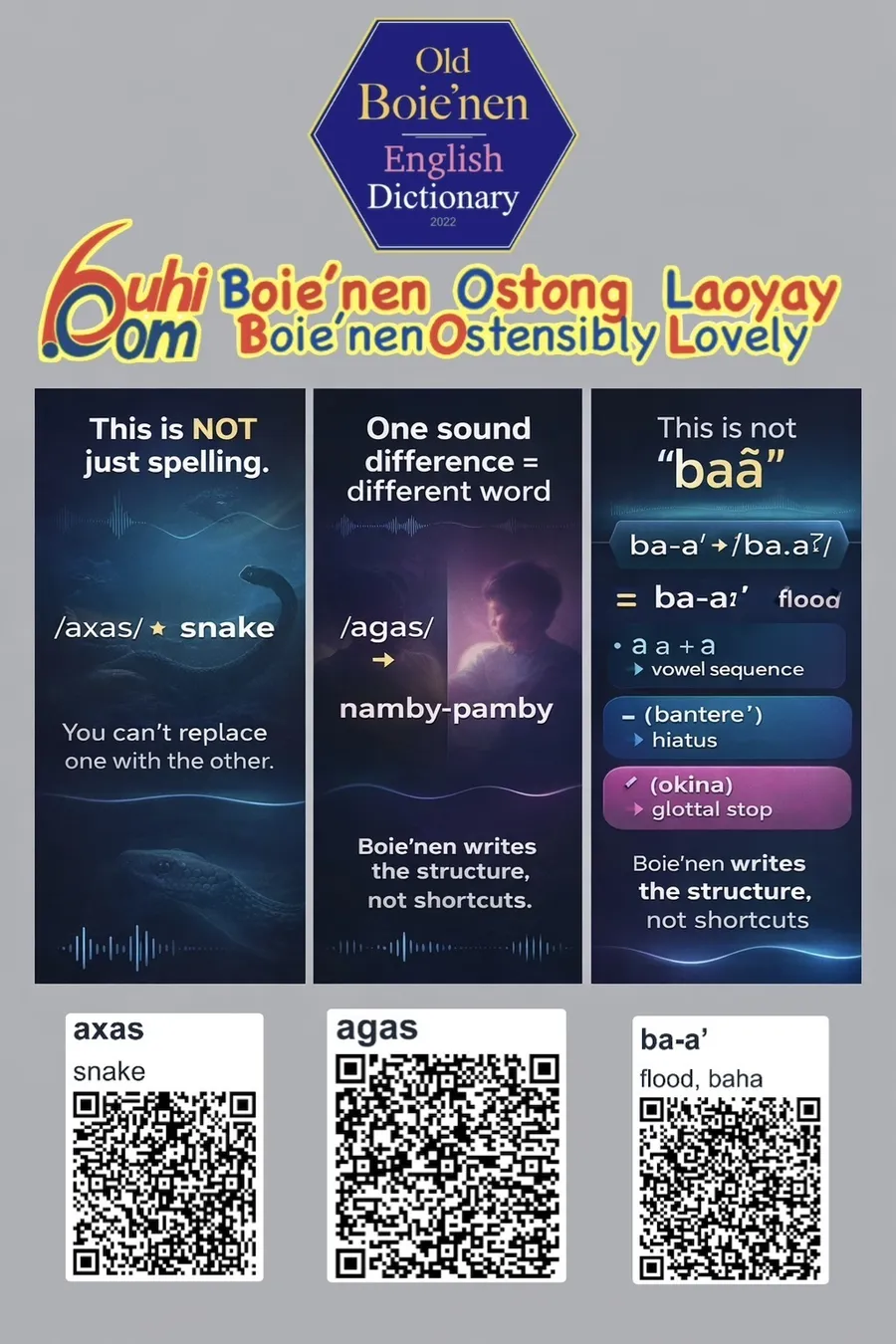
Minimal and near-minimal pairs demonstrate the phonemic independence of /X/.
| /X/ | /G/ |
| axas “snake” | agas “namby-pamby” |
angngex “breath odor” axnas “slipperiness” | angngeg “forehead” agnas “decomposing flesh” |
These lexical contrasts establish that /X/ and /G/ are separate phonemes.
Contrast with /G/
| Feature | /G/ | /X/ |
| Manner | stop | continuant |
| Airflow | interrupted | continuous |
| Oral closure | complete | incomplete |
| Primary articulation | velar | posterior (velar–uvular) |
| Example | gogon | saxag |
Historical Development
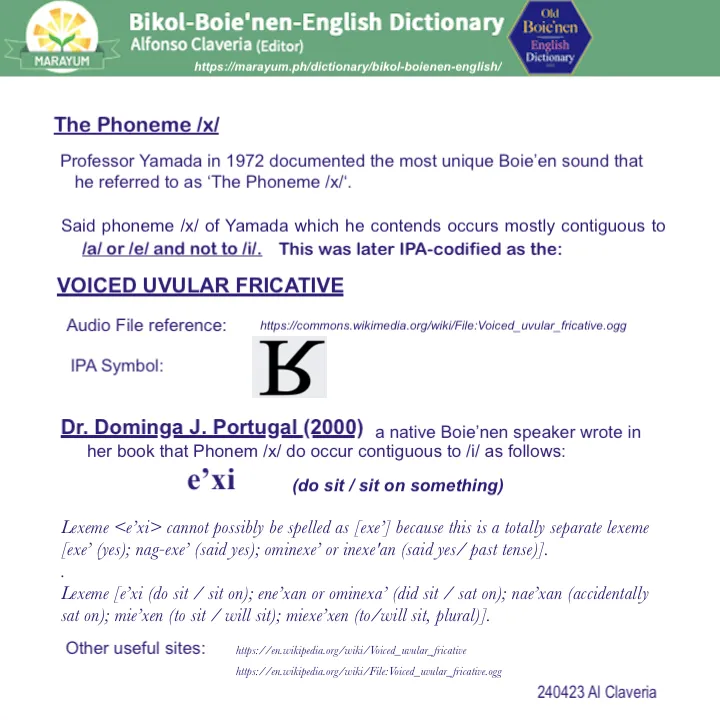
The posterior continuant was first explicitly identified as a distinct Boie’nen phoneme by Yukihiro Yamada (1972), who described it as a voiced velar–uvular fricative and analyzed its historical distribution within the language.
Working independently, Dominga L. J. Portugal (2000) recognized the same distinctive sound while developing a practical writing system for Boie’nen. She documented its unusual articulatory characteristics and sought advice from several phoneticians concerning its orthographic representation. Her published work contains no apparent reference to Yamada’s earlier study.
The present dictionary synthesizes these independent traditions and adopts the phoneme symbol /X/ together with the grapheme {Xx} as part of a transparent one-phoneme–one-grapheme orthography.
Orthographic Representation
The phoneme is represented in this dictionary by the grapheme:
{Xx} → /X/
This representation is an orthographic convention and should not be confused with the pronunciation of the English letter X (eks) or the Spanish equis. In Boie’nen, {Xx} represents only the posterior continuant phoneme.
Linguistic Significance
The existence of /X/ expands the Boie’nen consonant inventory beyond the canonical Philippine velar system and contributes to the language’s distinct phonological identity.
Together with the four-vowel system and the two phonemic glottals (Okina and Bantere’), /X/ forms one of the defining structural characteristics of Boie’nen phonology.
See Also
{Xx}
/G/
Okina (’)
Bantere’ (-)
References
Yamada, Y. (1972). The Buhi Dialect (Bikol): Phonology, Morphology and Vocabulary.
Portugal, D. L. J. (2000). Buhi Dialect (Boînən).
KWF. (2023). Ortograpiyang Boinen.
Claveria, A. T. (2026). Boie’nen (Old Buhi Language) Living Dictionary Project.