logod
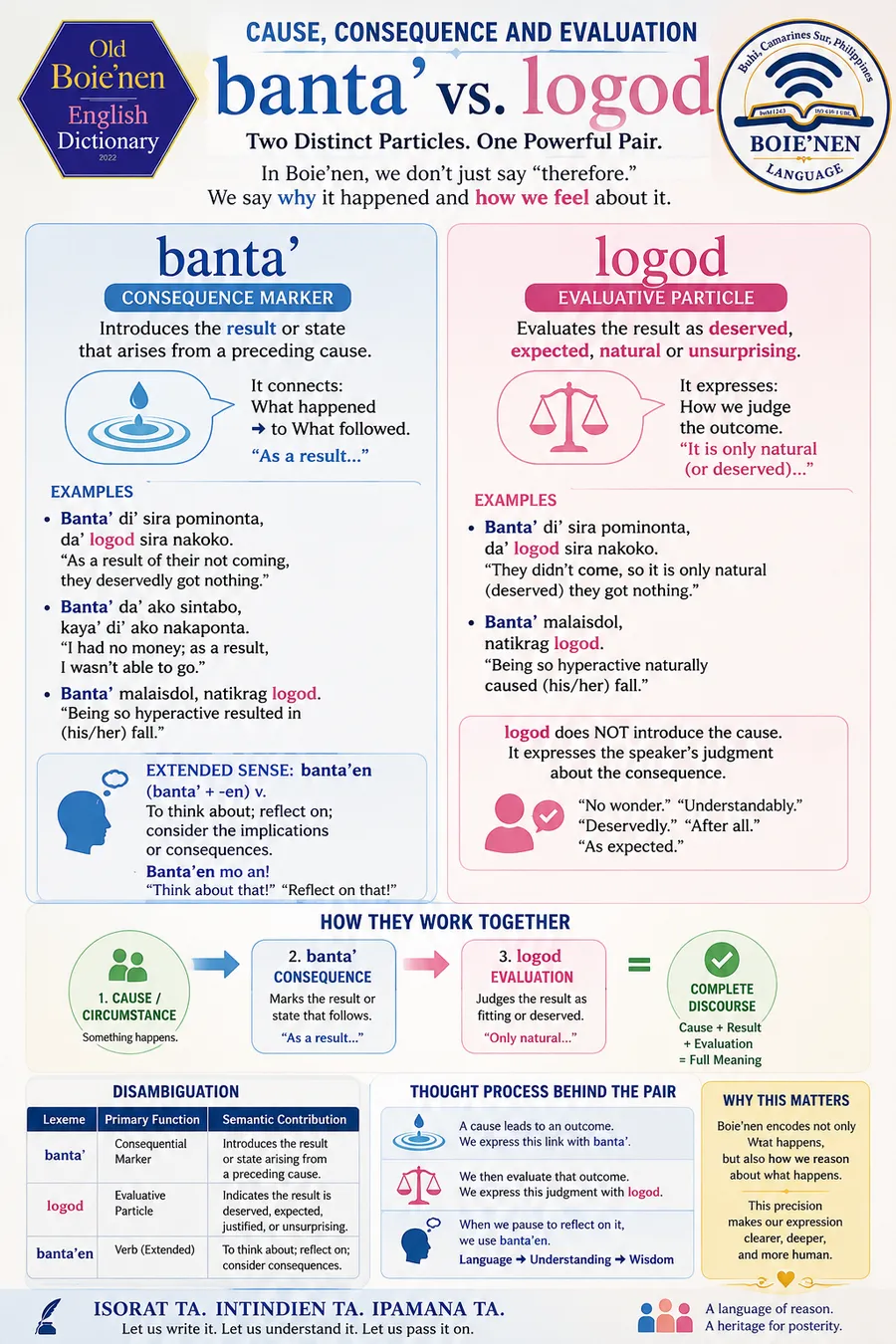
logod
particle; discourse marker
Depending on context, it may be translated as:
- naturally
- deservedly
- no wonder
- understandably
- after all
- as expected
Usage
Banta’ di’ sira pominonta, da’ logod sira nakoko.
“Because they did not come, they quite deservedly received nothing.”
Banta’ malaisdol, natikrag logod.
“Being so hyperactive naturally caused the person to fall.”
Semantic Note
Logod does not introduce the cause. Instead, it evaluates the consequence as reasonable, deserved, or unsurprising. It frequently follows statements introduced by banta’, creating a discourse sequence:
Cause → Consequence (banta’) → Evaluation (logod)
For example:
Banta’ di’ sira pominonta
“Since they did not come…”
da’ logod sira nakoko.
“…it is only natural (or deserved) that they got nothing.”
This pairing is highly expressive because it separates two semantic functions:
- banta’ establishes the causal relationship.
- logod expresses the speaker’s judgment about the appropriateness or inevitability of the resulting state.
Compare
- banta’ — marks the resulting consequence.
- logod — evaluates that consequence as deserved, expected, or unsurprising.
Semantic Disambiguation
| Lexeme | Primary Function | Semantic Contribution |
| banta’ | Consequential marker | Introduces the result or state arising from a preceding cause. |
| logod | Evaluative particle | Indicates that the result is viewed as deserved, expected, justified, or unsurprising. |