Boie’
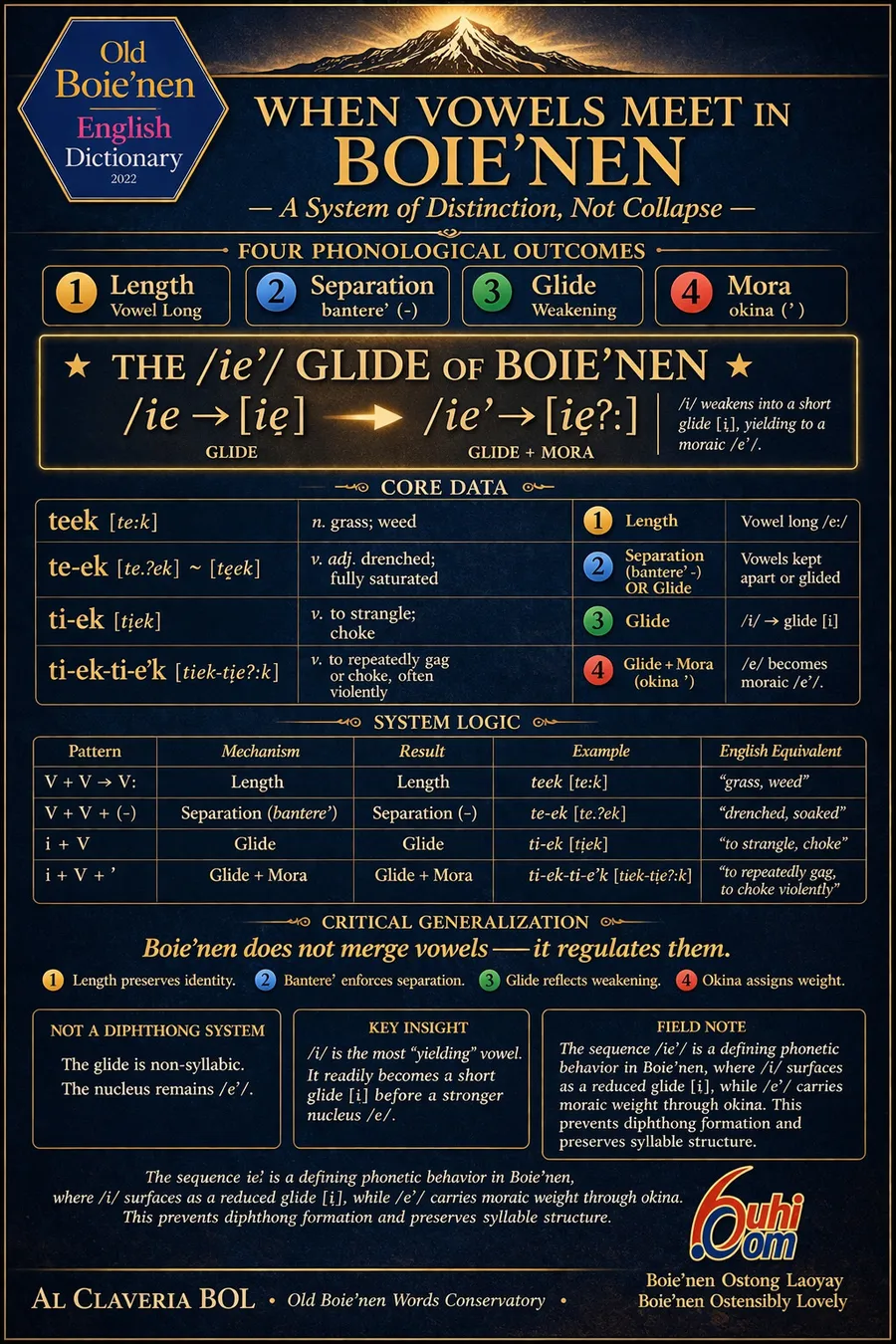


Boie’
n.; top. /ˈbɔ̆ɪ̆ɛ̋ʔː/
1. An indigenous Boie’nen toponym associated with the ancient volcanic massif now known as Mt. Buhi or Mt. Malinao in Buhi, Camarines Sur, Philippines.
2. (Proposed historical etymology.) Literally, “alive; living”, referring to the mountain’s continuing geothermal activity, particularly the hot springs and warm groundwater that emerge from its slopes. In this interpretation, the mountain was perceived by early inhabitants as a living mountain—one that continually “breathes,” “bubbles,” or gives forth warm water from within the earth.
ETYMOLOGICAL NOTE
This entry represents a proposed indigenous interpretation of the place name Buhi, suggesting that the older Boie’nen form Boie’ (“living; alive”) underlies the later Spanish spelling Buhi. The interpretation is motivated by the volcanic and geothermal landscape surrounding Mt. Buhi (Mt. Malinao), where numerous hot springs and thermal seepages have long been known to local communities.
Rather than describing biological life, boie’ expresses the idea of continuous internal activity. The mountain was understood as being “alive” because it remained active beneath the surface, releasing heat and mineral-rich water through springs along its flanks.
This interpretation offers an alternative to folk explanations that derive the name solely from the ordinary adjective meaning “alive.” Instead, it situates the toponym within the environmental knowledge and landscape perception of the Boie’nen people.
CULTURAL NOTE
Throughout the Austronesian world, mountains, springs, rivers, and lakes are frequently named according to distinctive natural characteristics observed by local communities. Under this interpretation, Boie’ belongs to that tradition, preserving an indigenous description of a mountain recognized for its enduring geothermal vitality.
DERIVED FORMS
Boie’nen /ˈbɔ̆ɪ̆ɛ̋ʔː.n̆ɜ̆n/ — the people and language of Boie’; literally, “those of Boie’” or “the people of Boie’.”
RELATED
Boie’nen, Buhi, Mt. Buhi, Mt. Malinao, hot spring, toponym, geothermal, volcanic landscape.