sarap

/sa.rap/
noun
1. Push-net fishing implement used for harvesting
sinarapan
A traditional Boie’nen push-net made from two slim bamboo poles (approx. 12 ft long). The thicker basal ends are doweled and securely lashed together so the poles open in a wide V-shaped frame. A fine-mesh rectangular net of abaca fiber (poraw), measuring about 8 feet across at the top corners, is attached to the upper tips of the poles. The lower tapered edge of the net is folded inward and stitched at the center to form a catch-bag, fastened at the intersection of the poles.
This implement is specifically used to scoop the world’s smallest commercially harvested fish, scientifically identified as Mistichthys luzonensis (locally sinarapan).
Ethnolinguistic Note
The sarap is not a generic fishing net but a specialized implement designed for extremely fine harvest. Its structure reflects the sieving principle embedded in its root meaning. The fishing practice is culturally associated with lake and riverine micro-fish harvesting traditions of the Buhi area.
Morphological Sketch
Root: sara’
“to sieve; to strain; to separate fine particles by filtration”
The glottal stop in sara’ signals the verbal root.
Derivational Pathway
/sa.rap/
noun
1. Push-net fishing implement used for harvesting
sinarapan
A traditional Boie’nen push-net made from two slim bamboo poles (approx. 12 ft long). The thicker basal ends are doweled and securely lashed together so the poles open in a wide V-shaped frame. A fine-mesh rectangular net of abaca fiber (poraw), measuring about 8 feet across at the top corners, is attached to the upper tips of the poles. The lower tapered edge of the net is folded inward and stitched at the center to form a catch-bag, fastened at the intersection of the poles.
This implement is specifically used to scoop the world’s smallest commercially harvested fish, scientifically identified as Mistichthys luzonensis (locally sinarapan).
Ethnolinguistic Note
The sarap is not a generic fishing net but a specialized implement designed for extremely fine harvest. Its structure reflects the sieving principle embedded in its root meaning. The fishing practice is culturally associated with lake Buhi’s micro-fish harvesting traditions.
Morphological Sketch
Root: sara’
“to sieve; to strain; to separate fine particles by filtration”
The glottal stop in sara’ signals the verbal root.
Derivational Pathway
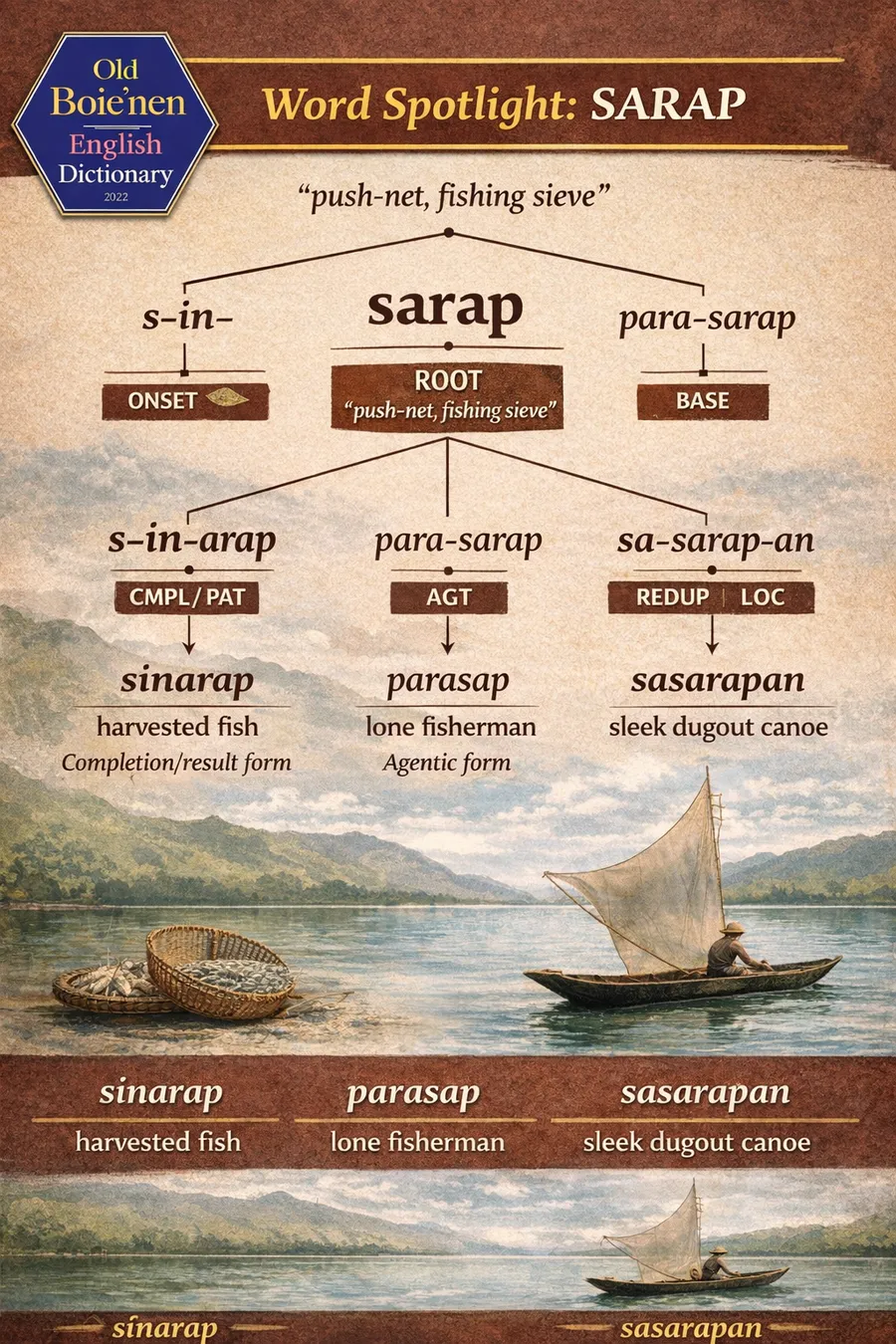
sarap (instrumental nominalization)
“that which is used for sieving” → push-net implement
Likely phonological adaptation from sara’ → sarap (final moraic-glottal shift or okina to /p/ in nominalized form; possible historical instrumental extension).
- sinarapan
si- + -in- + sarap + -an
“that which has been sieved/harvested by sarap”
→ the tiny fish yield
→ the species Mistichthys luzonensis
(Lexicalized ethnospecies term.) - parasarap
para- + sarap
“one who uses the sarap”
→ sinarapan fisherman
Semantic Field
filtration / sieving
- fine harvest
- micro-fish ecology
- lake subsistence technology
- occupational terminology
(instrumental nominalization)
“that which is used for sieving” → push-net implement
Likely phonological adaptation from sara’ → sarap (final glottal shift to /p/ in nominalized form; possible historical instrumental extension).
- sinarapan
si- + -in- + sarap + -an
“that which has been sieved/harvested by sarap”
→ the tiny fish yield
→ the species Mistichthys luzonensis
(Lexicalized ethnospecies term.) - parasarap
para- + sarap
“one who uses the sarap”
→ sinarapan fisherman
Semantic Field
filtration / sieving
- fine harvest
- micro-fish ecology
- lake subsistence technology
- occupational terminology