tobli
Sense 1
English: Translation
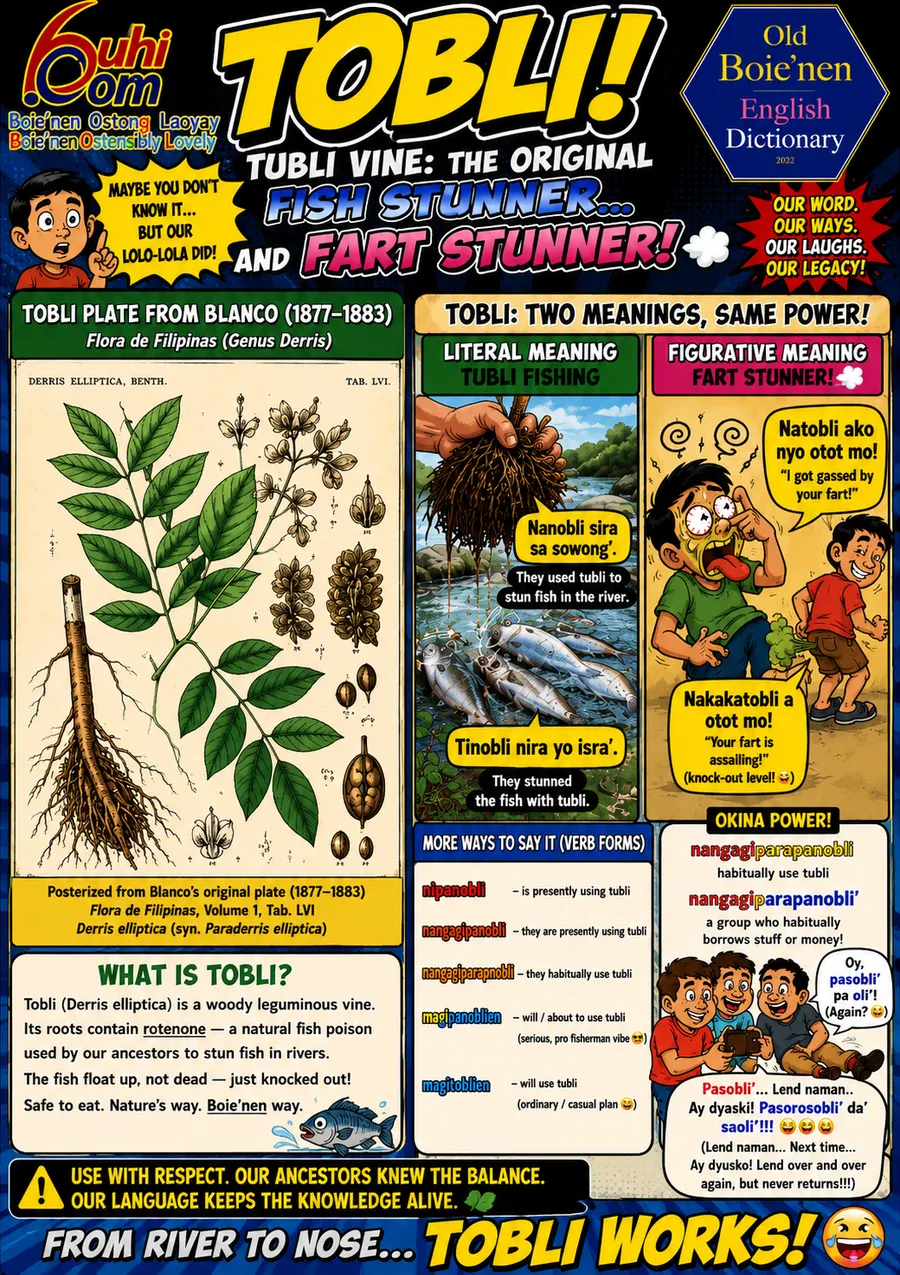
Tobli; the large woody leguminous vine traditionally used by the Boie’nen as a natural fish poison. Although commonly referred to locally as a “tree,” it is botanically a robust climbing vine.** **Its roots contain rotenone, a naturally occurring compound traditionally used to stun fish and as a botanical insecticide.
Part of Speech
noun
Sense 2
English: Translation
To stun or poison fish by applying crushed tubli roots to a body of water, causing the fish to become temporarily incapacitated and float to the surface for easy collection.** **Traditionally practiced in rivers, streams, and other inland waters. Fish collected in this manner are generally considered safe for consumption after normal preparation.
Part of Speech
verb
Scientific Name
Derris elliptica (now often Paraderris elliptica) or Derris philippinensis
Notes
USAGE
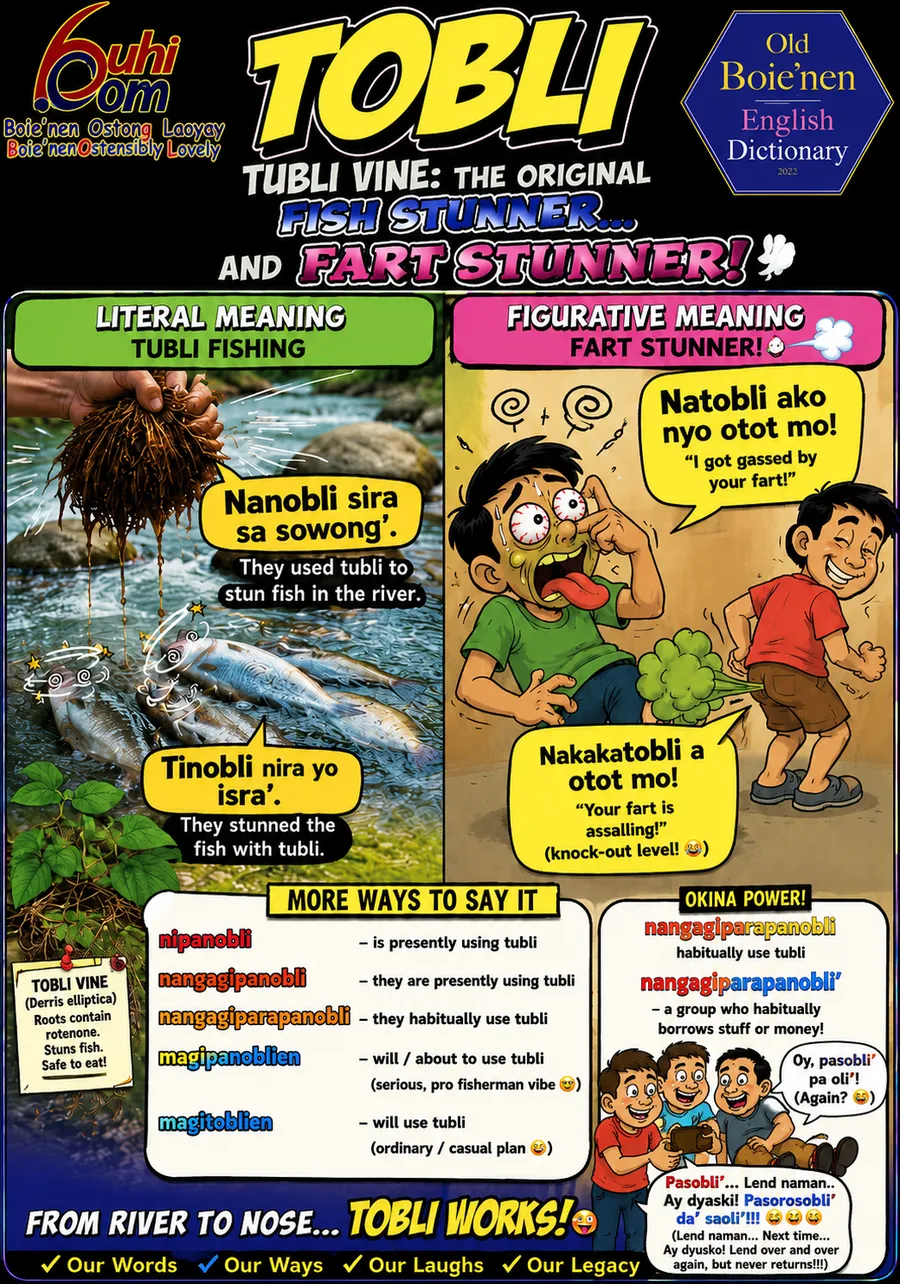
Nanobli sira sa sowong’.
“They used tubli to stun fish in the river.”
Tinobli nira yo isra’.
“They stunned the fish with tubli.”
⸻
By semantic extension, tobli also refers to anything so overpowering that it figuratively “stuns” or incapacitates a person.
Natobli ako nyo otot mo.
“I got gassed by your fart.”
Nakakatobli a otot mo.
“Your fart is enough to knock someone out!”
TOBLI Verbal Paradigm
| Form | Morphological Formula | Function | Meaning |
| nanobli | naN- + tobli | AF Perfective | deliberately used tubli to stun fish |
| nangagpanobli | nangag- + panobli | AF Plural Perfective | the actors deliberately used tubli to stun fish |
| nipanobli | ni- + panobli | AF Progressive | is presently using tubli to stun fish |
| nangagipanobli | nangagi- + panobli | AF Plural Progressive | the actors are presently using tubli to stun fish |
| magipanoblien | magi- + panobli + -en | AF Contemplated | will or are about to use tubli to stun fish |
| magitoblien | magi- + tobli + -en | AF Contemplated | will use tubli to stun fish; usually a simpler or more casual expression |
| nangagiparapanobli | nangagi- + para- + panobli | AF Progressive Habitual | are habitually or customarily using tubli to stun fish |
| nangagiparapatobli | nangagi- + para- + pa- + tobli | AF Progressive Habitual Causative | are habitually causing others to use tubli to stun fish |
Linguistic History
MORPHOLOGICAL OBSERVATION The tobli family illustrates a productive characteristic of Boie’nen verbal morphology whereby a derived Actor Focus stem (panobli) functions as a new lexical base for further derivation. Consequently, higher-order aspectual, plural, habitual, and contemplated forms may be built either directly from the lexical root (tobli) or from the derived stem (panobli), with subtle semantic differences. Forms derived from panobli generally denote the established activity or practice of traditional tubli fishing, whereas forms derived directly from tobli tend to emphasize the individual act of applying tubli.