balaigang
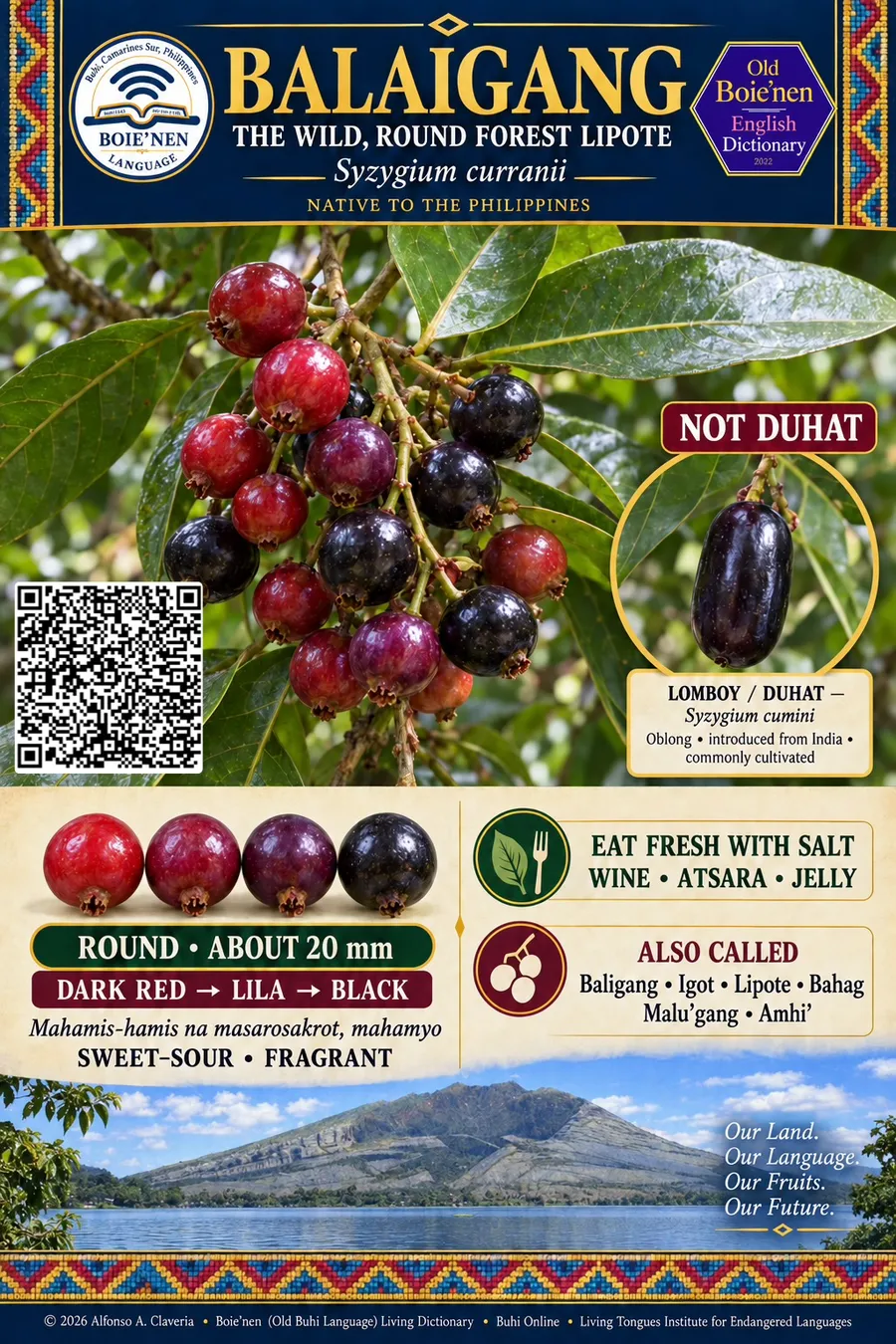
Semantic domain: Plants • Trees • Wild fruits
Regional equivalents:
Bicol: igot; lipote; bahag; malu’gang; amhi’
Usage note:
Among older Boie’nen speakers, balaigang refers specifically to the wild, round forest fruit Syzygium curranii. It should not be confused with lomboy ‘duhat’ (Syzygium cumini), an introduced and commonly cultivated species whose fruit is larger and oblong.
Distinct from:
lomboy — duhat; Java plum (Syzygium cumini). Its fruit is oblong, usually sweeter at first, and strongly astringent afterward.
Encyclopedic note:
Balaigang represents an indigenous forest-fruit tradition in Buhi and the wider Bicol region. Unlike the market-associated lomboy, it is remembered as a wild tree whose fragrant fruit was gathered locally and eaten or preserved in several ways.
Verses:
Balaigang
Inasnan
Dangan sa
Dowang
Pinggan
LINOROLO’GO!
Santangsiram!
———•———
BALAIGANG
Balaigang—
salted,
then between
two dinner plates,
ROLLED AND TOSSED ABOUT! —
oh, how delicious!
———•———