{Ee}
grapheme
Alphabet Position
Fifth letter
Aa
Ee
Ii
Oo
Xx
…
Sound Value
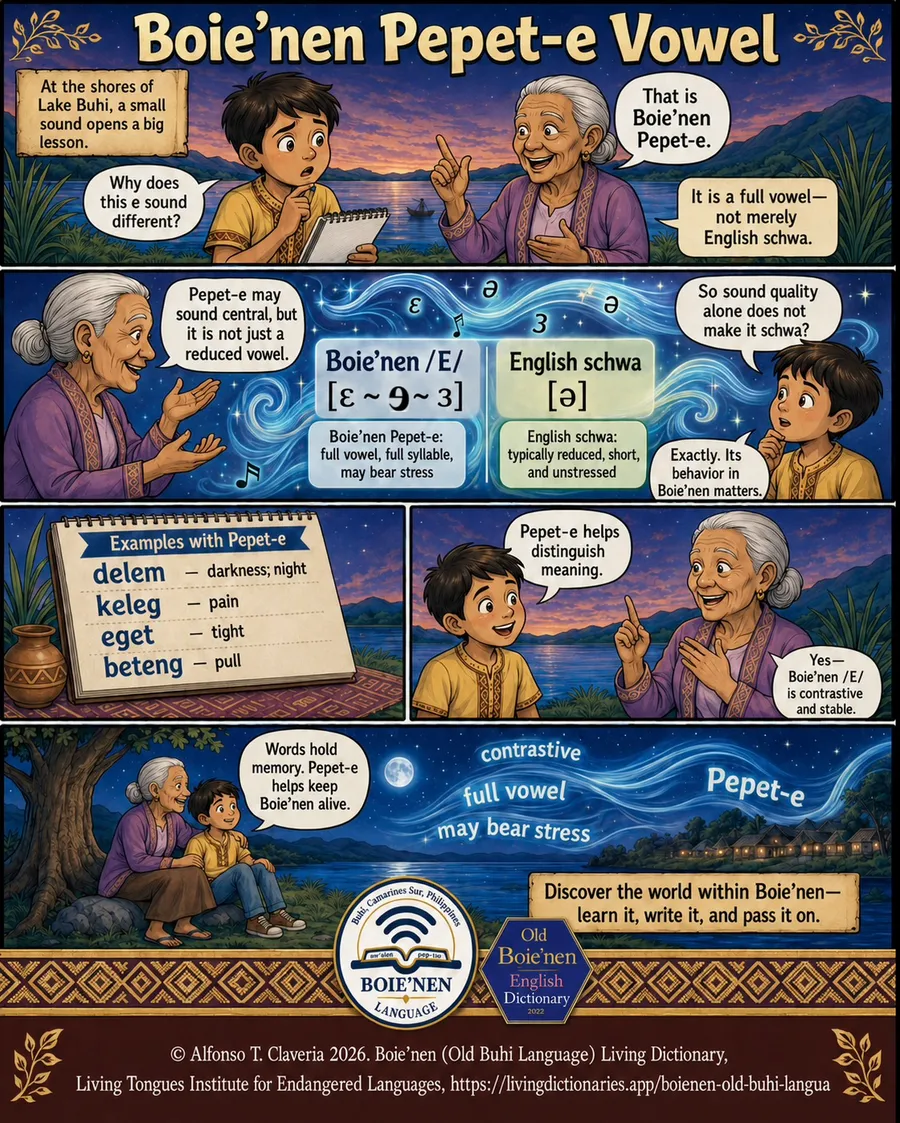
Ee represents the Boie’nen phoneme /E/.
Its principal phonetic realizations include:
- [ɛ]
- [ɘ]
- [ɜ]
The precise realization varies with phonetic environment and speaker, but these differences do not require separate spellings.
Orthographic Function
Boie’nen uses a single grapheme E e for the phoneme /E/.
Unlike orthographies that distinguish e taling from e pepet, Boie’nen does not assign separate letters to the more front and more central realizations of this vowel. They belong to the same phoneme and are therefore written consistently as E e.
The spelling is consequently phonemic rather than narrowly phonetic.
Ee and the Pepet Vowel
The Boie’nen grapheme Ee represents the vowel traditionally associated with the Austronesian pepet.
In Boie’nen, however, this vowel should not be equated automatically with the canonical English schwa [ə]. Its central realizations are better represented within the phonetic range [ɘ ~ ɜ], alongside the more front realization [ɛ].
The vowel may bear lexical stress, has full syllabic value, and participates in lexical contrasts. It is therefore represented by a full alphabetic grapheme rather than treated as merely a reduced or epenthetic vowel.
Lexicographic Distinction
/E/ — phoneme entry: phonological identity, phonetic realizations, stress behavior, contrasts, and analysis.
{Ee} — grapheme entry: alphabetic letter, spelling conventions, and its correspondence to phoneme /E/.
See: /E/
Linguistic History
Boie’nen Ee continues the orthographic representation of the vowel commonly identified in Austronesian linguistic literature as pepet.
Earlier and broader descriptions sometimes identify central realizations of pepet as “schwa.” In the Boie’nen Living Dictionary, Ee is instead treated as the grapheme of an independent full vowel phoneme /E/, whose observed phonetic range includes approximately [ɛ ~ ɘ ~ ɜ].