kyaxa
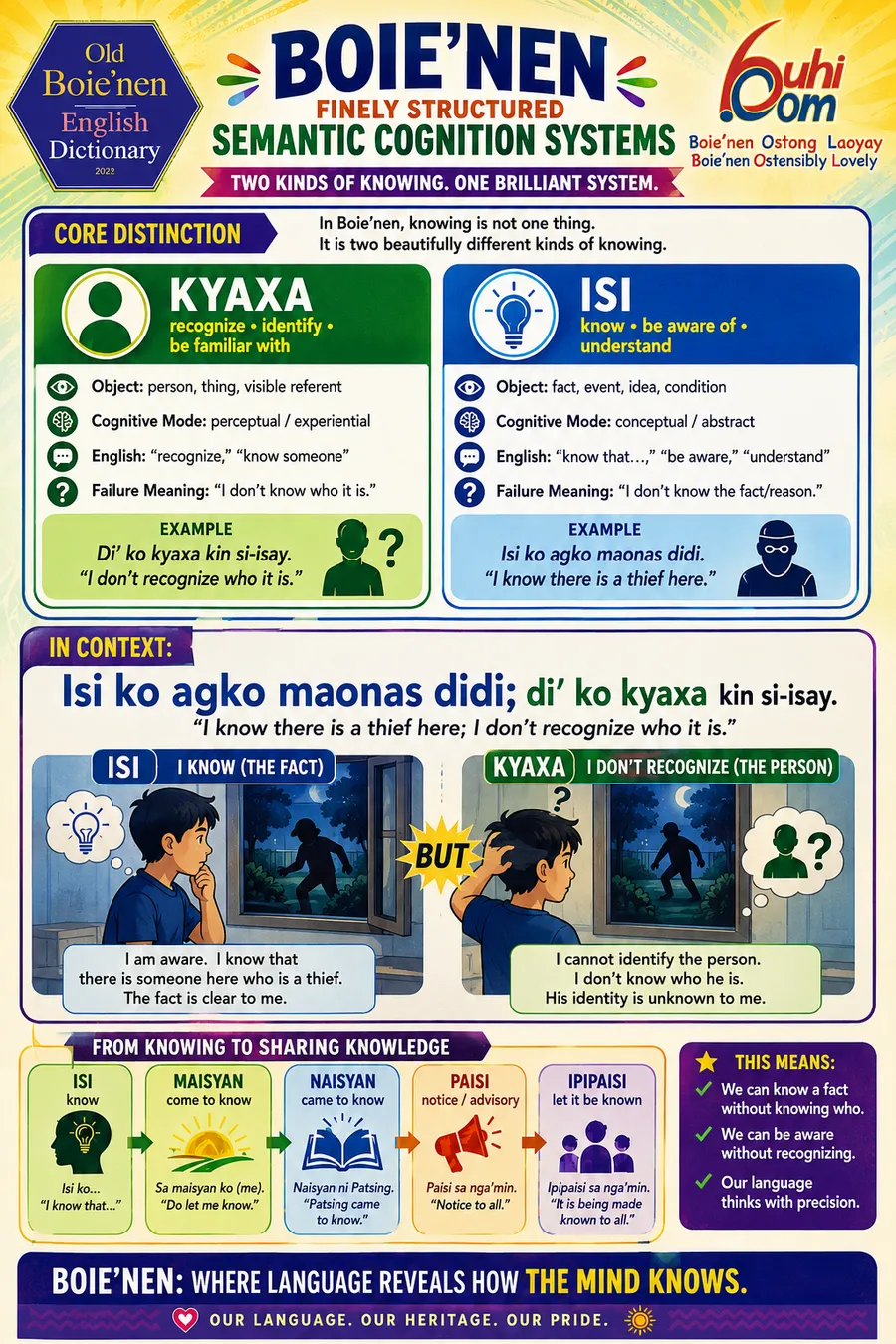
kyaxa v.
- To recognize; to identify a person, thing, or referent.
- To know someone or something through familiarity, encounter, perception, or experience.
- To distinguish or determine who or what something is.
Core Semantic Sense
👉 recognition / referent-bound knowledge
Unlike isi, which concerns awareness of facts or situations, kyaxa centers on identifying or being familiar with an entity.
Semantic Profile
Cognitive Domain
kyaxa belongs primarily to the domain of:
- recognition
- identification
- familiarity
- perceptual knowledge
- experiential acquaintance
- referent tracking
The lexeme presupposes the existence of a recognizable entity, whether:
- person
- object
- voice
- face
- animal
- place
- visible or socially identifiable referent
Core Distinction from
isi
| Domain | KYAXA | ISI |
| Core meaning | recognize, identify, be familiar with | know, understand, be aware |
| Knowledge type | referent-bound | propositional |
| Cognitive mode | perceptual / experiential | conceptual / abstract |
| Primary question | “Who/what is it?” | “Is it true?” |
| Typical object | person, thing, visible referent | fact, condition, event |
| English equivalent | recognize; know someone | know that; understand |
| Failure meaning | identity unknown | fact/reason unknown |
Core Examples
Kyaxa ko adi.
“I recognize this.”
“I know what this is.”
Kyaxa ko iya.
“I know him/her.”
“I recognize him/her.”
Kyaxa ako nira.
“They know/recognize me.”
Kya’xen mo adi.
“Know/recognize this.”
Naky’xan ko ika.
“I recognized you.”
Makya’xan mo kaya’ adi?
“Will you be able to recognize this?”
Semantic Scope
Used for:
Persons
- knowing someone personally
- recognizing identity
Objects
- identifying visible things
Sensory Recognition
- face
- voice
- appearance
- pattern
Familiarity
- acquaintance through repeated exposure or experience
Contrastive Example with
isi
Isi ko agko maonas didi.
“I know there is a thief here.”
Di’ ko kyaxa kin si-isay.
“I don’t recognize who it is.”
Semantic Analysis
| Form | Knowledge Type |
| isi | awareness of the fact |
| kyaxa | recognition of identity |
This distinction reveals a highly structured Boie’nen separation between:
- propositional awareness
and - referential identification
Typological Note
The distinction parallels:
| Language | Recognition Knowledge | Propositional Knowledge |
| Spanish | conocer | saber |
| English | know/recognize someone | know that… |
| Boie’nen | kyaxa | isi |
However, Boie’nen preserves the contrast more systematically in ordinary discourse.
Morphological Notes
kya’xen
(kyaxa + -en)
Object-focused or imperative recognition form.
Example
Kya’xen mo adi.
“Recognize this.”
“Know this.”
naky’xan
(na- + kyaxa + -an)
Completed or realized recognition.
Example
Naky’xan ko ika.
“I recognized you.”
Semantic Nuance
Implies:
- successful identification
- moment of recognition
- perceptual realization
makya’xan
(ma- + kyaxa + -an)
Potential or ability-oriented recognition.
Example
Makya’xan mo kaya’ adi?
“Will you be able to recognize this?”
Cognitive-Semantic Characterization
The lexeme kyaxa encodes:
- entity recognition
- familiarity mapping
- perceptual confirmation
- identity resolution
It answers the cognitive question:
👉 “Who or what is this?”
rather than:
👉 “What is true?”
Note
Boie’nen distinguishes two fundamentally different cognitive modes of knowing:
| Lexeme | Cognitive Orientation |
| kyaxa | recognition of entities |
| isi | awareness of propositions |
Thus:
- one may isi a situation without being able to kyaxa the referent involved.
This distinction forms part of a finely structured semantic cognition system embedded within the Boie’nen language.