koto
English: Translation
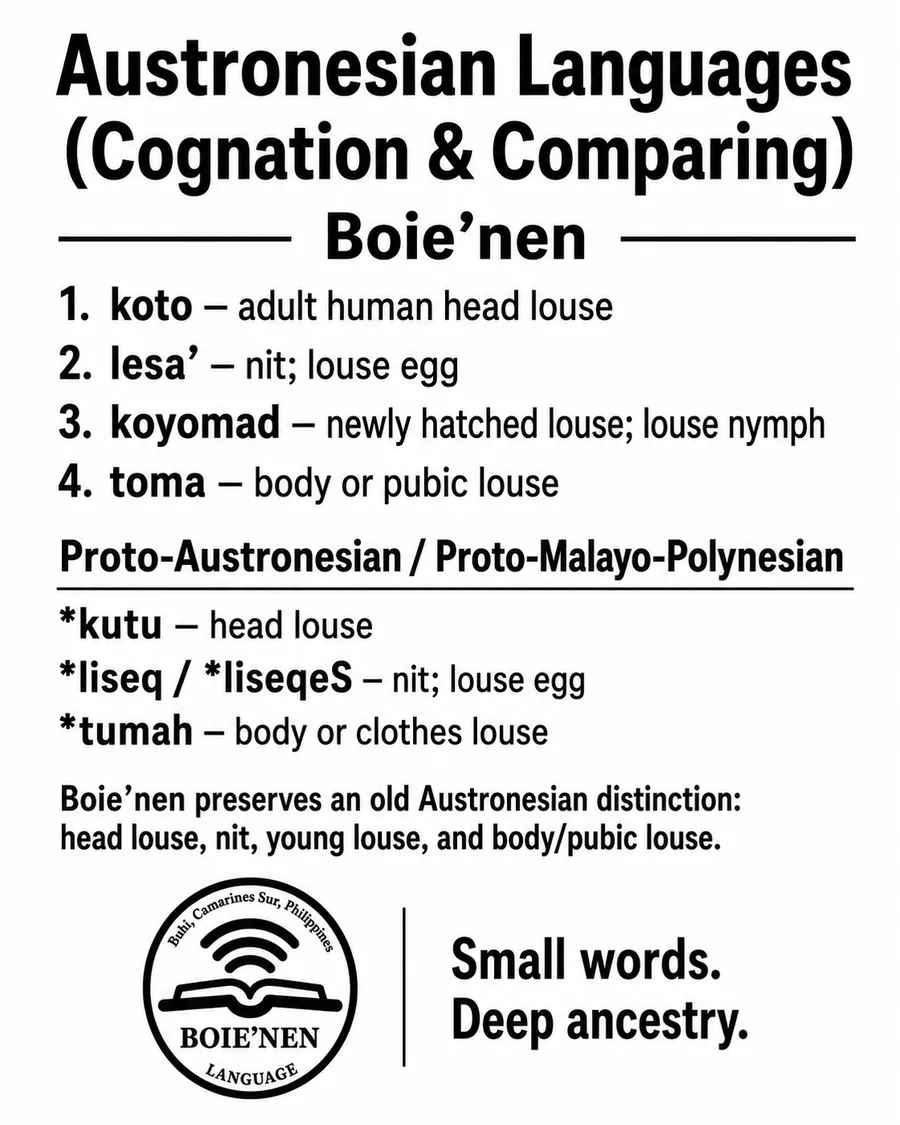
An adult human head louse; a mature parasitic insect that lives among the hair of the human scalp and feeds on blood. More broadly in ordinary speech, a human head louse without explicit reference to its developmental stage.
Part of Speech
noun
Semantic Domain
Universe and the natural world
Insects and small creatures
Notes
Semantic note
In the strict life-cycle distinction:
- lesa’ — the egg or nit;
- koyomad — the newly hatched or immature louse;
- koto — the mature or adult louse.
Compare
| Boie’nen | Referent |
| lesa’ | nit; egg of the head louse ttached to a strand of hair |
| koyomad | young or immature head louse |
| koto | adult head louse |
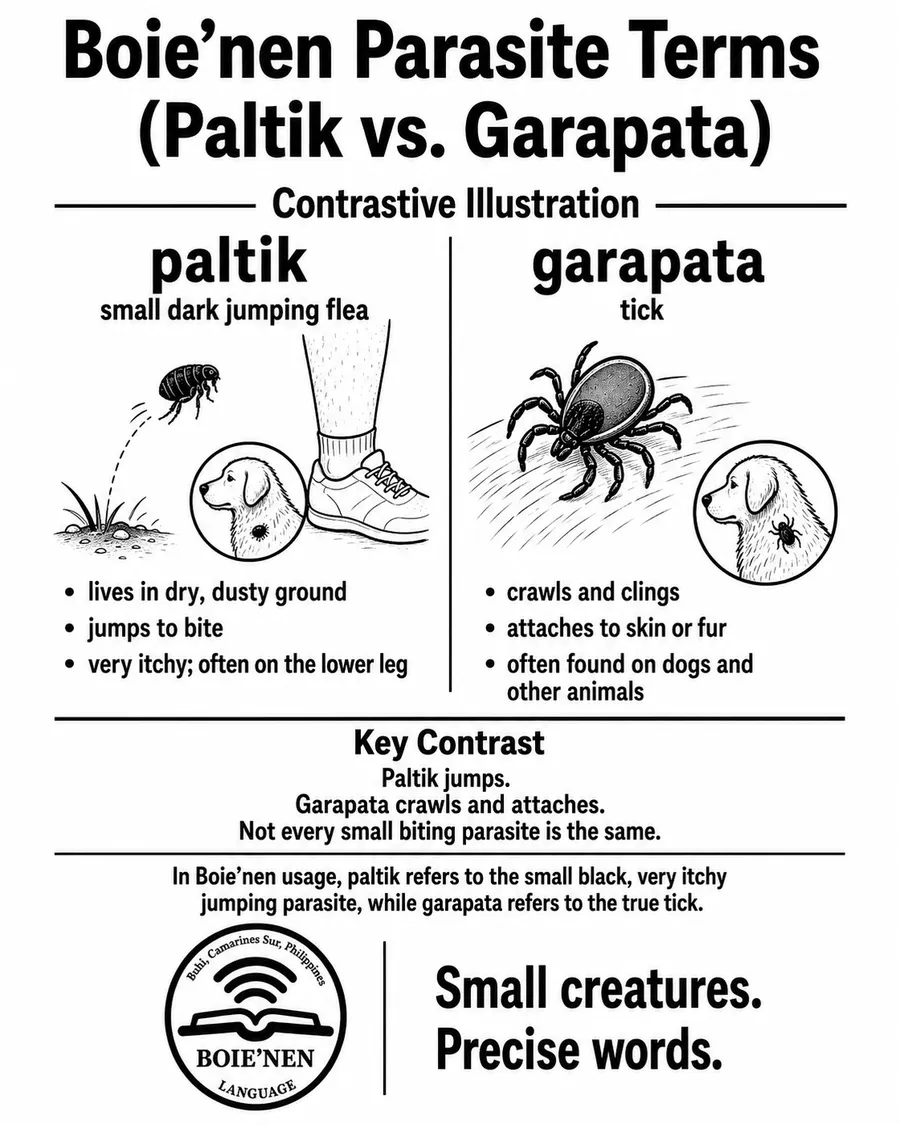
| toma | body/pubic louse; traditionally also a tick-like ectoparasite |
| garapata | true tick, particularly on animals |
Linguistic History
Etymological note; Koto is an inherited Austronesian word. The Austronesian Comparative Dictionary reconstructs Proto-Austronesian /kuCux/ head louse’ and Proto-Malayo-Polynesian /kutu/. Boie’nen /koto/ regularly reflects the widespread Malayo-Polynesian form, with /o/ corresponding to /u/ under the Boie’nen four-vowel system. Cognates include Tagalog and Pangasinan /kuto/, Malay/Indonesian and many Oceanic forms /kutu/, Māori /kutu/, and related forms throughout the family.