isi
isi
v. [Boie’nen]
1. To know; to be aware of a fact, idea, or situation.
2. To understand or possess knowledge of something abstract or unseen.
Core sense:
👉 propositional / conceptual knowledge
🔹 Examples
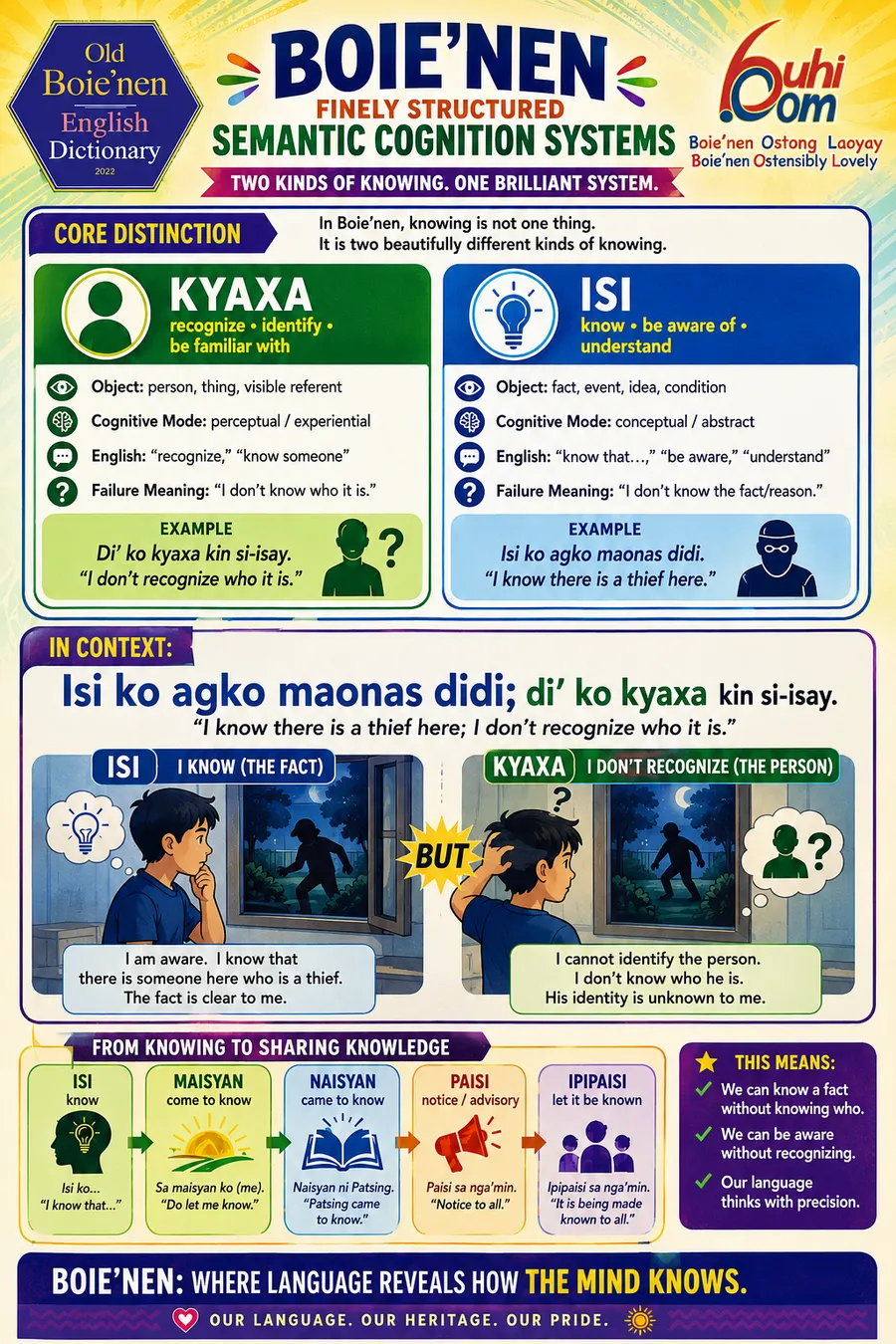
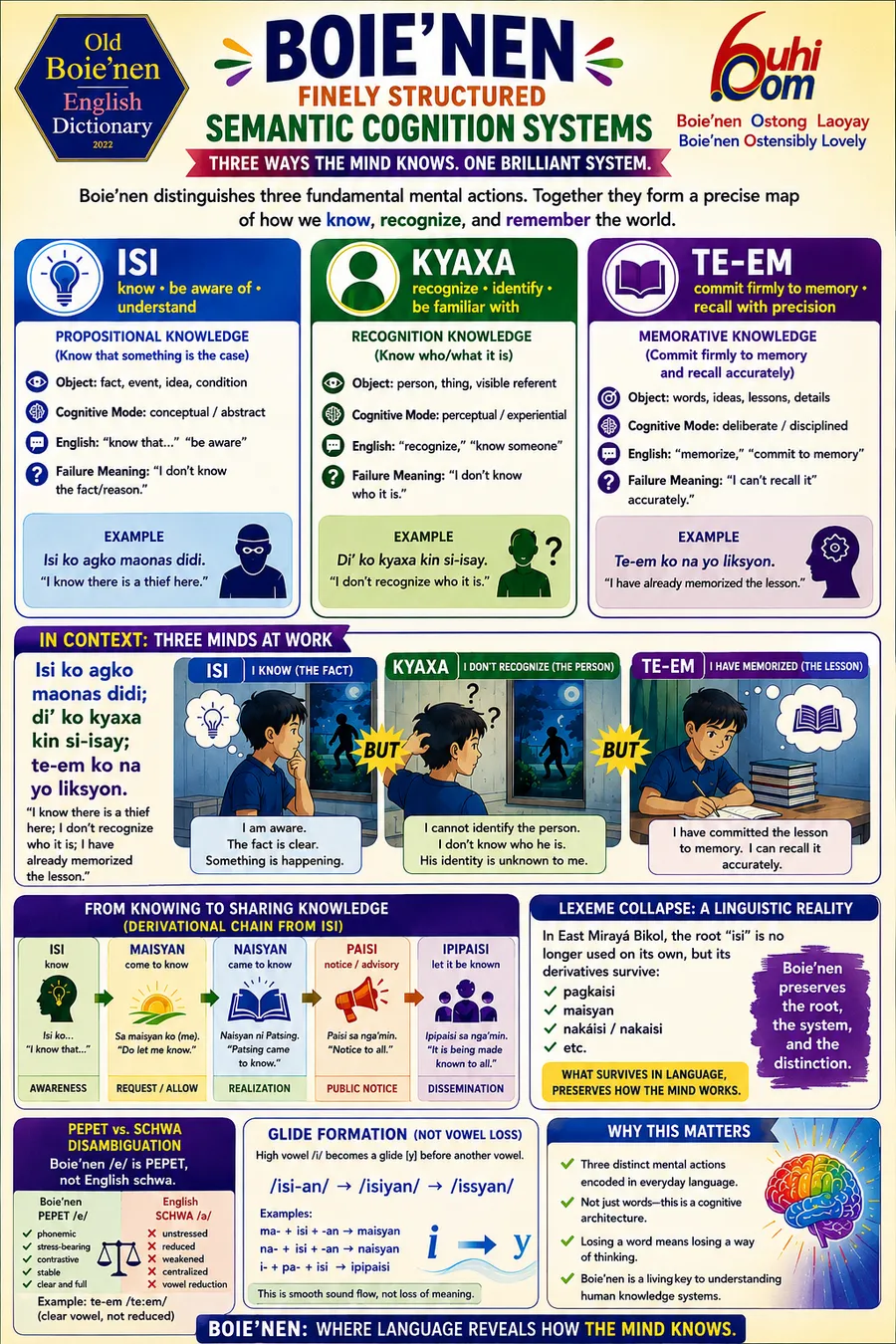
- Isi kong agko maonas didi, kaya’ sana di’ ko kyaxa.
“I know there’s a thief here, but I don’t know who it is.”
🔹 Semantic Scope
Used for:
- facts → isi ko… “I know that…”
- situations → presence, events
- ideas → explanations, reasons
- unseen agents → when identity is unknown
🔹 Contrastive Pair
- Isi ko agko maonas didi.
“I know there is a thief here.” (fact known) - Di’ ko kyaxa kin si-isay.
“I don’t recognize who it is.” (identity unknown)
🔥
Core Distinction Note;
Boie’nen distinguishes two types of knowledge:
- kyaxa — recognition knowledge (who/what it is)
- isi — propositional knowledge (that something is the case)
This aligns with a deep cognitive split:
- kyaxa → referent-bound (entity recognition)
- isi → statement-bound (truth knowledge)
🧠
Typological Insight (Grammar Panel)
This is equivalent to:
- English: know (a person) vs. know that…
- Spanish: conocer vs. saber
- but in Boie’nen, the boundary is even cleaner and more systematic.
| Domain | KYAXA | ISI |
| Core meaning | recognize, identify, be familiar with | know (a fact, idea, situation) |
| Object type | person, thing, visible referent | idea, event, condition |
| Cognitive mode | perceptual / experiential | abstract / propositional |
| Typical translation | “recognize,†“know (someone)†| “know that,†“be aware,†“understand†|
| Failure meaning | “I don’t know who it is†| “I don’t know (the fact/reason)†|
Semantic Structure of the Derivational Chain
| Form | Core Meaning |
| isi | know |
| maisyan | come to know |
| naisyan | came to know |
| paisi | notice/advisory |
| ipipaisi | disseminate publicly |
This chain demonstrates how Boie’nen morphology systematically expands a cognitive root into:
- realization
- transmission
- public dissemination
- informational state change
without losing semantic coherence.
Note
The lexeme isi belongs to a highly developed cognitive-semantic subsystem in Boie’nen.
The language distinguishes:
- knowing that something is true (isi)
from - knowing what/who something is (kyaxa)
This distinction is not merely lexical, but reflects a deeper Boie’nen orientation toward:
- informational awareness
- referential recognition
- experiential familiarity
- epistemic state tracking
Such distinctions are characteristic of languages with finely structured semantic cognition systems.