{‘} Moraic Okina
{’}
grapheme
Name
moraic okina
Definition
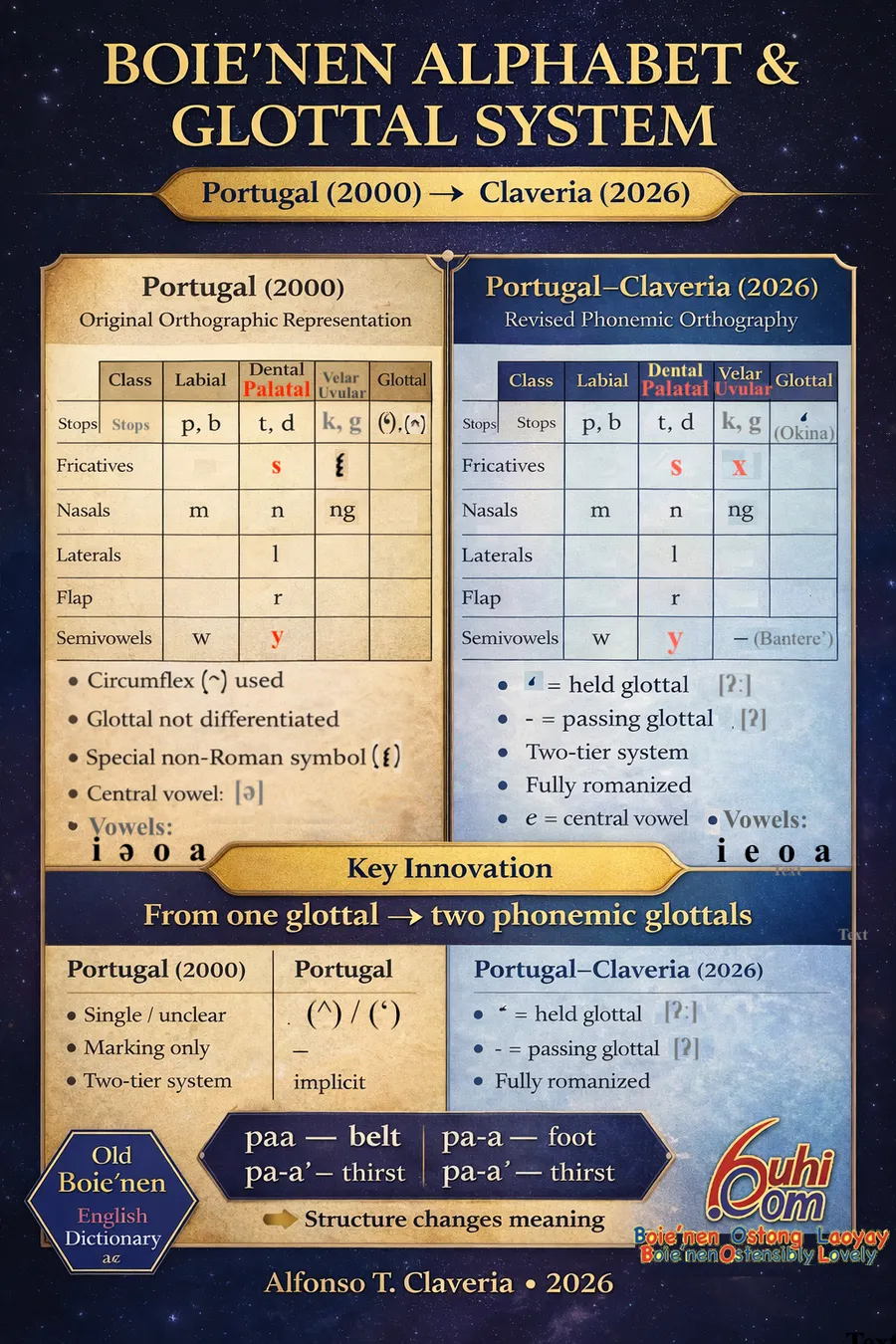
The Boie’nen grapheme representing the moraic glottal phoneme /ʔː/.
It marks a lexically contrastive and prosodically weighted glottal closure. It is an integral letter of the Boie’nen writing system, not an apostrophe, punctuation mark, decorative accent, or optional indication of vowel separation.
Graphemic function
The moraic okina {’}:
- represents the phoneme /ʔː/;
- marks moraic glottal weight within a word;
- preserves lexical and rhythmic contrasts;
- indicates where the voice undergoes a weighted glottal closure or constriction;
- distinguishes forms that would otherwise appear identical or be mispronounced.
Because it represents a phoneme, its omission may change meaning, erase a lexical contrast, or distort native Boie’nen cadence.
Orthographic status
Alphabetic: functions as an independent grapheme in the Boie’nen alphabet.
Phonemic: corresponds to a contrastive sound category.
Moraic: signals that the represented glottal contributes phonological weight.
Obligatory: must be written wherever the phoneme /ʔː/ occurs in the lexical form.
Non-punctuational: must not be interpreted as an English apostrophe, quotation mark, possessive marker, or contraction symbol.
The okina therefore counts as a letter when determining the orthographic composition or length of a Boie’nen word.
Contrast with {-}
{’} moraic okina
represents /ʔː/
weighted glottal closure
lexically and prosodically contrastive
{-} bantere’
represents /ʔ/
non-moraic glottal interruption
principally separates vowels or syllabic domains without adding moraic weight
Example:
po’ot
weighted internal glottal closure
“suffocate; choke”
po-ot
non-moraic interruption between vowels
“sticky sap”
Orthographic contrasts
po’ot “suffocate; choke”
≠ po-ot “sticky sap”
be’gat “weight; heaviness”
≠ begat “relapse”
ra’ra’ “drink by dipping or using the beak”
≠ rara “venom”
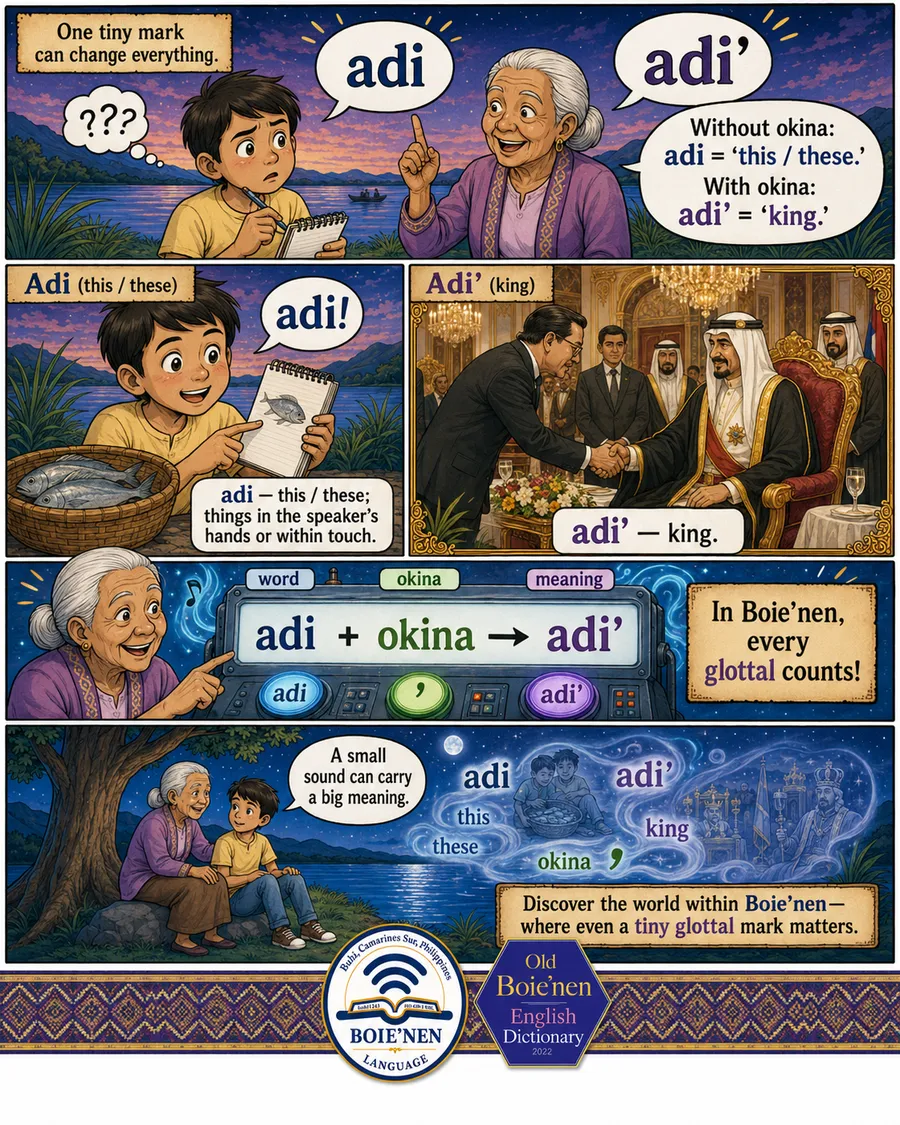
adi’ “king”
≠ adi “this”
paa’ “thirst”
≠ pa-a “foot”
ko’ko’ “gouge; scoop out”
≠ koko “fingernail”
Position
The grapheme may occur:
Medially:
be’gat, po’ot, Boie’nen
Finally:
adi’, ina’, indi’, rogo’
More than once within a word:
ra’ra’, ko’ko’
Its written position corresponds to the location of the moraic glottal in the phonological form.
Orthographic note
A circumflex accent, as in Boînen, is inadequate as a substitute because a circumflex normally modifies a vowel or indicates stress, tone, length, or vowel quality. The Boie’nen okina instead represents an independently contrastive glottal phoneme with moraic and prosodic value.
The forms {’} and /ʔː/ must therefore not be conflated:
- {’} is the written grapheme.
- /ʔː/ is the phoneme represented by that grapheme.
- [ʔː] is its principal phonetic realization.
Glottonym example
BOIE’NEN
The okina is an essential part of the language name. Spellings such as Boienen, Buhinon, Boînen, and Boîñen fail to represent the native moraic glottal contrast.
See also: /ʔː/ moraic glottal phoneme; {-} bantere’; /ʔ/ non-moraic glottal; pali-ek