/E/
Grammar
phoneme
Definition
The Boie’nen vowel phoneme /e/, conventionally represented in this dictionary as /E/ to distinguish the phoneme entry from the grapheme {Ee}.
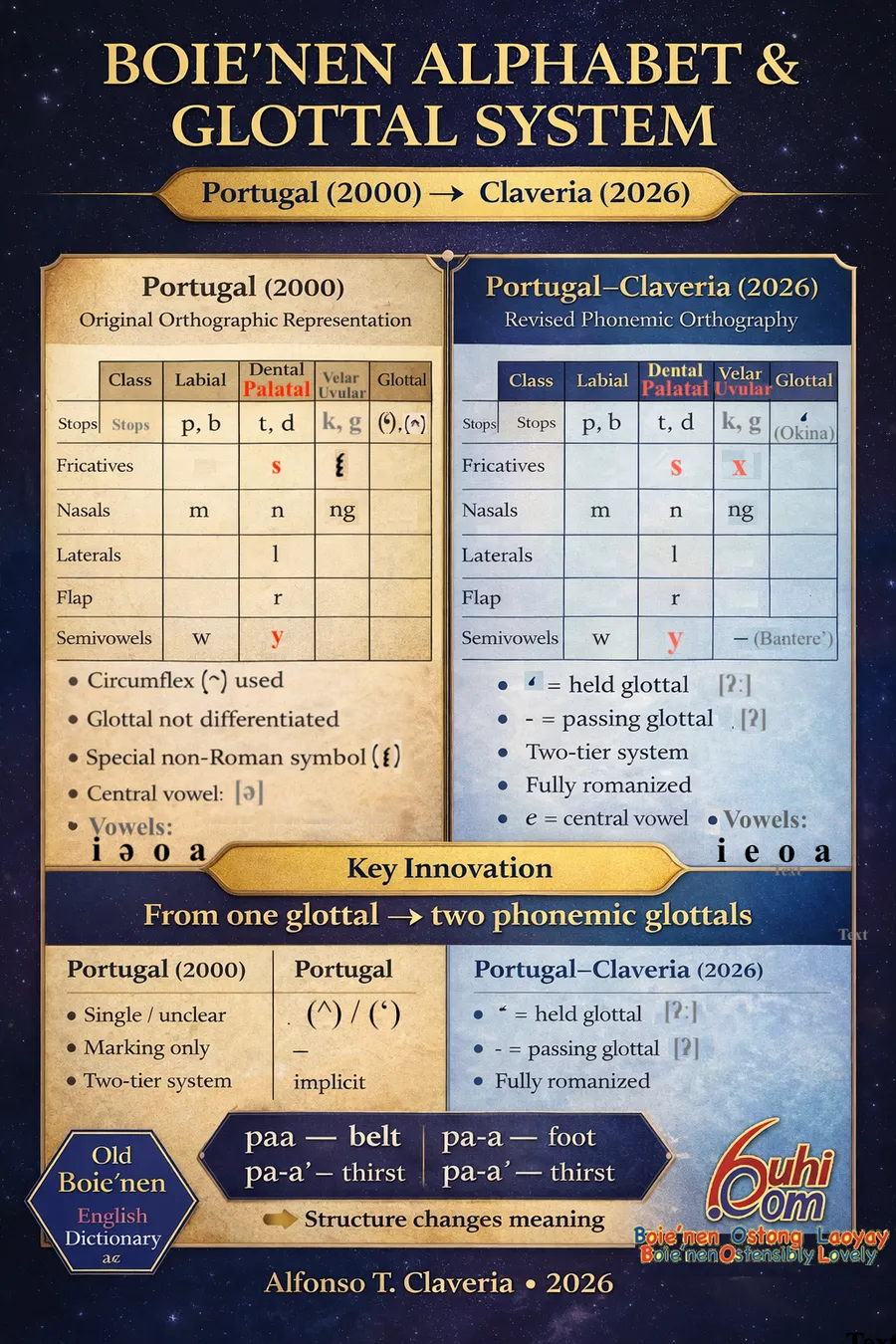
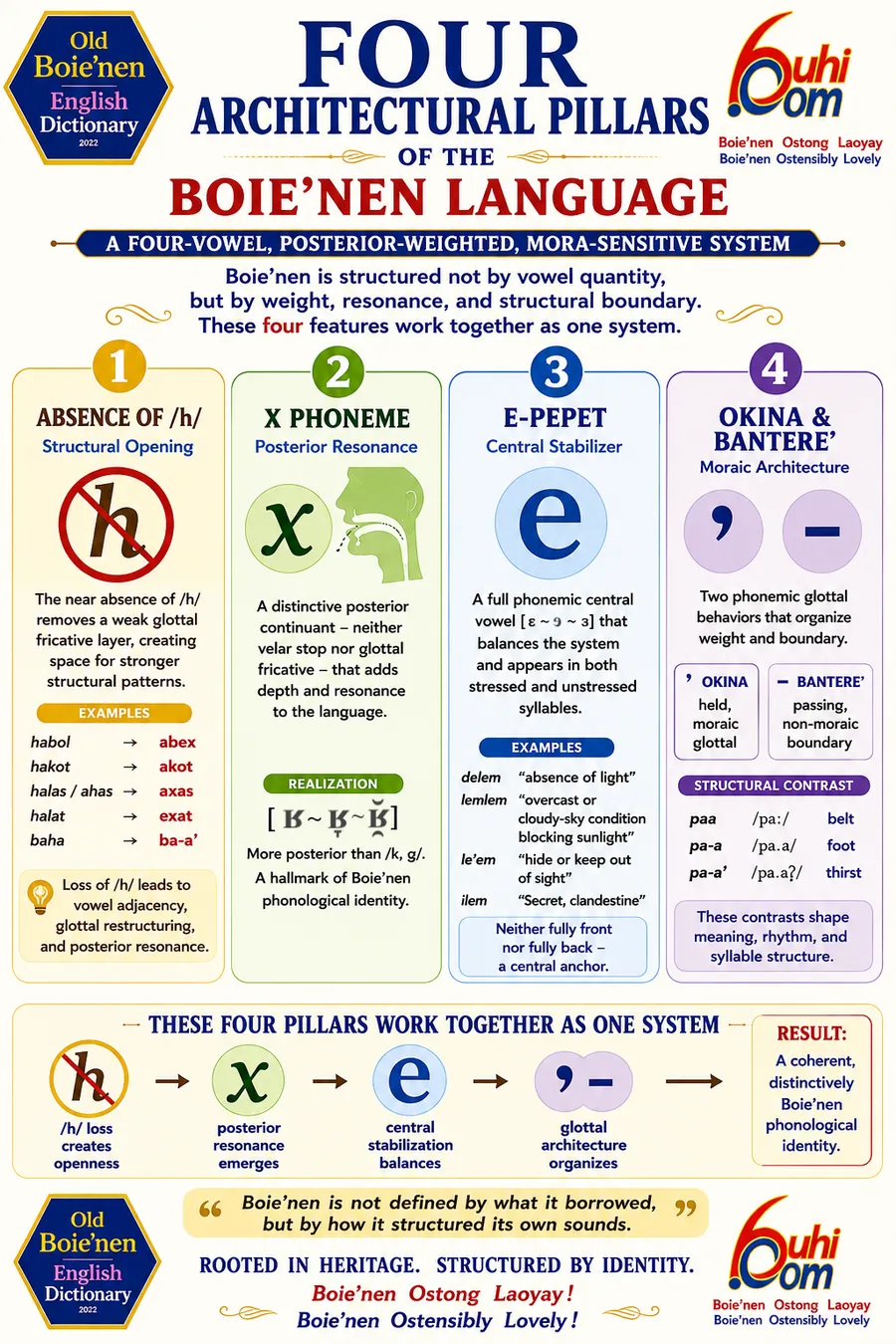
It is a full phonemic vowel whose pronunciation ranges from an open-mid front realization [ɛ] through a close-mid central realization [ɘ] to an open-mid central realization [ɜ], depending on lexical item, surrounding sounds, stress, and prosody.
Boie’nen /e/ should not be identified automatically with English schwa [ə]. It functions as an independent vowel phoneme, may bear stress, forms a full syllable nucleus, and is not predictably produced through unstressed-vowel reduction.
IPA
Underlying phoneme
/e/
Common phonetic realizations
[ɛ] — open-mid front unrounded vowel
Example: beteng “pull”
[ɘ] — close-mid central unrounded vowel
Common centralized realization
[ɜ] — open-mid central unrounded vowel
Common lower-central realization, especially in natural connected speech
The notation [ə] is not adopted here as the principal representation of Boie’nen Pepet because central vowel quality alone does not establish schwa-like phonological reduction.
Phonological Status
• independent vowel phoneme
• occurs in stressed and unstressed syllables
• capable of carrying lexical/prosodic prominence
• constitutes a full syllable nucleus
• does not undergo obligatory vowel reduction
• participates in lexical contrasts with the other Boie’nen vowels
• central realizations are allophonic or phonetic variants of /e/, not separate phonemes
Phonetic Variation
The exact realization of /e/ varies according to the surrounding consonants, stress, speech rate, and prosodic environment.
The principal range presently documented is:
/e/ → [ɛ ~ ɘ ~ ɜ]
This range should be understood as phonetic variation within one phoneme, rather than as three separate vowel phonemes.
Minimal / Near-Minimal Contrasts
kalag “soul”
vs.
keleg “pain”
banig “mat”
vs.
baneg “maul”
kiskis “fish scale”
vs.
keskes “roll up a trouser leg or sleeve”
po’son “groin”
vs.
pe’sen “shatter”
ogot “monitor lizard”
vs.
eget “tight”
ko’ko’ “gouge”
vs.
ke’ke’ “chin”
These contrasts support the status of /e/ as an independent member of the Boie’nen vowel system rather than a predictable reduced realization of another vowel.
Pepet vs. Schwa
The traditional term pepet should not be treated as automatically synonymous with schwa.
In phonetic terminology, [ə] designates a specific mid-central vowel quality. In English pronunciation teaching, schwa also commonly refers to a short, unstressed, reduced vowel. Boie’nen /e/ behaves differently: it is contrastive, syllabically full, may bear stress, and remains lexically stable.
Accordingly, the central pronunciations of Boie’nen Pepet are better represented within the range:
[ɛ ~ ɘ ~ ɜ]
rather than treating [ə] as its defining realization.
See also
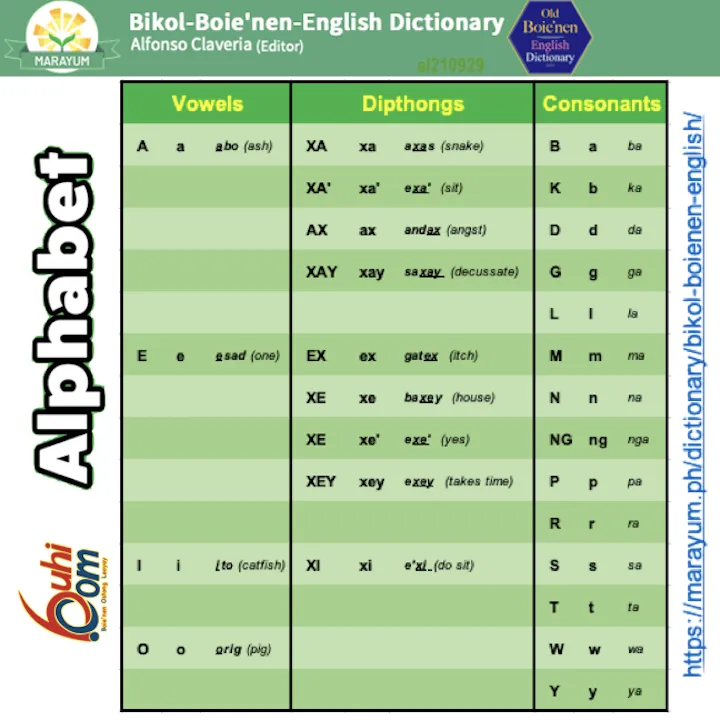
{Ee} — grapheme used to represent phoneme /e/
/I/ — contrasting vowel phoneme
Pepet — terminology and comparative discussion
Schwa — phonetic/phonological comparison, separate LD entry
Disambiguating schwa vs. [ɜ]:
https://youtu.be/ubAeYNeQUiA?is=W2gXWjwhtfbz-oTs