{Xx}
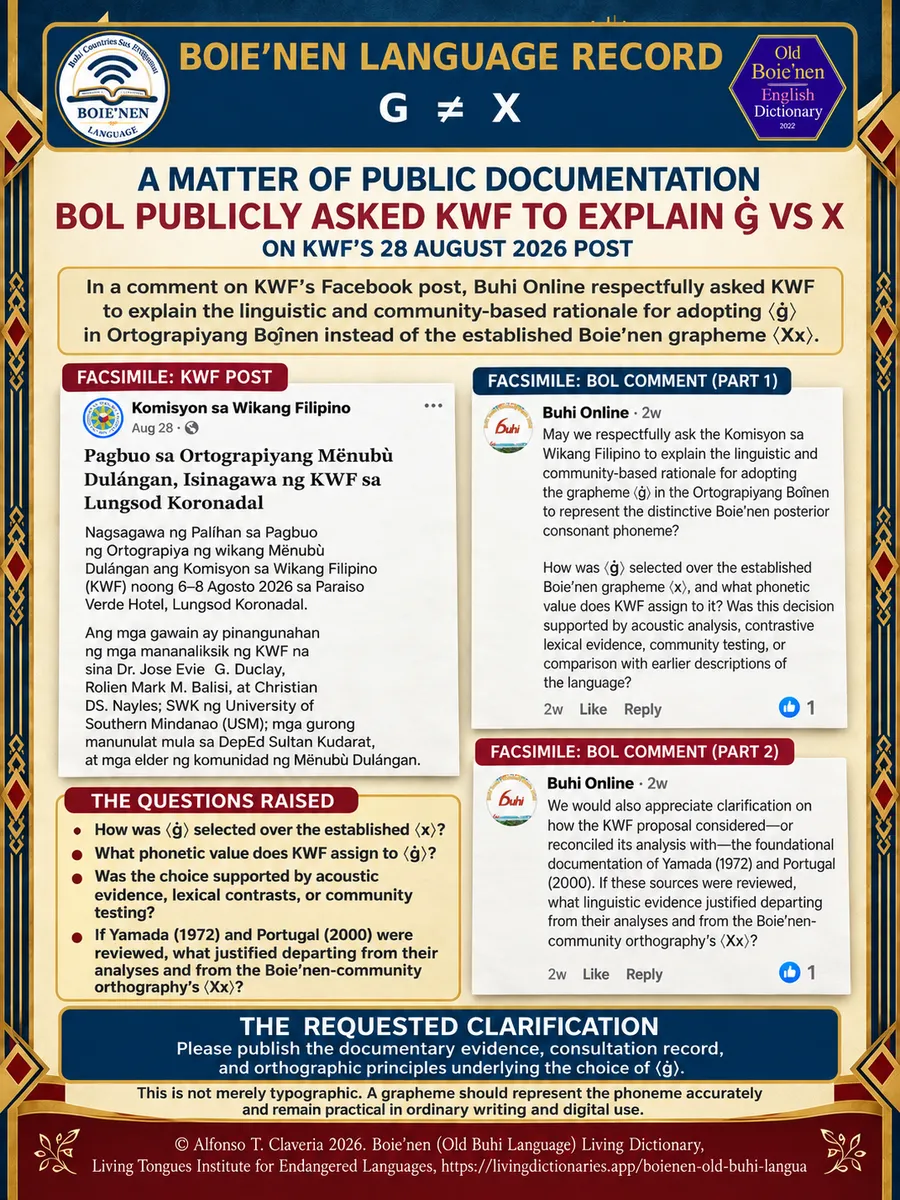
{Xx}
English: letter X
Part of Speech
Grapheme
Semantic Domain
Orthography; Writing System
Definition
{Xx} is the official grapheme adopted in the Portugal–Claveria orthography to represent the Boie’nen phoneme /X/, a distinct posterior continuant typically realized phonetically as [ʁ ~ ʁ̞ ~ ɣ ~ ɣ̞], with variation among speakers and phonetic environments.
The grapheme itself is conventional; the phoneme it represents is an inherent feature of the Boie’nen sound system.
Alphabet Position
Xx follows Ww and precedes Yy in the Boie’nen alphabet.
Orthographic Value
{Xx} → /X/
Phoneme /X/: pronunciation
The Boie’nen phoneme /X/ is not pronounced like the English letter-name ex or the Spanish equis. Nor does it represent the consonant sequences /ks/ or /gz/, or the sound /s/, as written x may do in English or Spanish.
In Boie’nen, X represents one consonant phoneme: a posterior continuant articulated toward the back of the mouth. Its pronunciation ranges approximately across [ʁ ~ ʁ̞ ~ ɣ̞], from a voiced uvular fricative or approximant to a slightly more forward velar realization.
For learners, it may be described as “Ro without the tongue-tip trill.” It resembles the posterior French r often heard in Paris [pa.ʁi]: the sound is produced at the back of the mouth rather than by tapping or trilling the tongue tip.
The familiar description “gargling r” may help learners locate the general area of articulation, but the Boie’nen sound should be produced gently and continuously—without an actual gargling vibration.
axat [aʁăt] n. “a traditional market-day basket with a carrying handle”
To approximate its pronunciation, begin with the English phrase “a rat,” but do not pronounce the English r [ɹ]. Keep the tip of the tongue relaxed near the center of the mouth and produce the intervening consonant farther back, toward the velar–uvular region:
a–[ʁ]–at
The comparison with a rat helps learners reproduce the sequence of sounds; it does not mean that Boie’nen x is equivalent to English r. The x in axat is a posterior continuant [ʁ ~ ʁ̞ ~ ɣ̞], produced without a tongue-tip tap or trill.
In short: X is one posterior r-like consonant, not /ks/, /gz/, /s/, or a modified /g/.
Examples
xata’ — purplish pallor
saxag — bird’s nest
gatex — itch
dakexe’ — big
e’xi — sit on
Phonemic Contrast
The grapheme {Xx} represents only the phoneme /X/.
It never represents /G/.
Likewise,
{Gg} → /G/
and never /X/.
This preserves a strict one-grapheme–one-phoneme correspondence.
Examples include:
axas — snake
agas — namby-pamby; effeminate
angngex — breath odor
angngeg — forehead
Because these pairs differ in meaning, /G/ and /X/ are analyzed as separate phonemes and are assigned separate graphemes.
Historical Background
The posterior continuant was first analyzed phonemically by Yukihiro Yamada (1972), who described it as a voiced velar-uvular fricative and recognized it as a distinct phoneme of Boie’nen.
Working independently, Dominga L. J. Portugal (2000) recognized the same distinctive sound while developing a practical orthography for Boie’nen. Rather than forcing it into an existing alphabetic convention, she consulted several phoneticians regarding its representation and adopted a dedicated symbol. Her publication contains no apparent reference to Yamada’s earlier study.
The present orthography adopts the Roman letter {Xx} as a practical grapheme for this phoneme while preserving the one-phoneme–one-grapheme principle.
Comparison with KWF (2023)
Both the KWF orthography and the Portugal–Claveria orthography distinguish /G/ from /X/.
Their principal difference lies in grapheme selection.
| Orthography | /G/ | /X/ |
| KWF (2023) | Gg | Ä Ä¡ |
| Portugal–Claveria | Gg | Xx |
The adoption of {Xx}:
- preserves one grapheme for one phoneme;
- avoids reliance on modified Unicode characters;
- improves keyboard and mobile-device compatibility;
- facilitates digital searching and machine sorting;
- provides an immediate visual distinction between /G/ and /X/.
Katon (Cartilla) Note
Traditional Boie’nen literacy emphasized a one-consonant–one-sound relationship.
Using separate graphemes maintains that educational principle:
ga ge gi go
xa xe xi xo
allowing beginning readers to distinguish immediately between /G/ and /X/.
Orthographic Principle
The choice of {Xx} is not based on the English or Spanish value of the letter X, but on its function as a dedicated grapheme representing a uniquely Boie’nen phoneme.
Orthographic symbols are conventional; phonemic distinctions are linguistic.
See Also
/G/
/X/
{Gg}
References
Yamada, Y. (1972). The Buhi Dialect (Bikol) Phonology, Morphology and Vocabulary.
Portugal, D. L. J. (2000). Buhi Dialect (Boînən).
KWF. (2023). Ortograpiyang Boinen.
Claveria, A. T. (2026). Boie’nen (Old Buhi Language) Living Dictionary.