Boie’nen
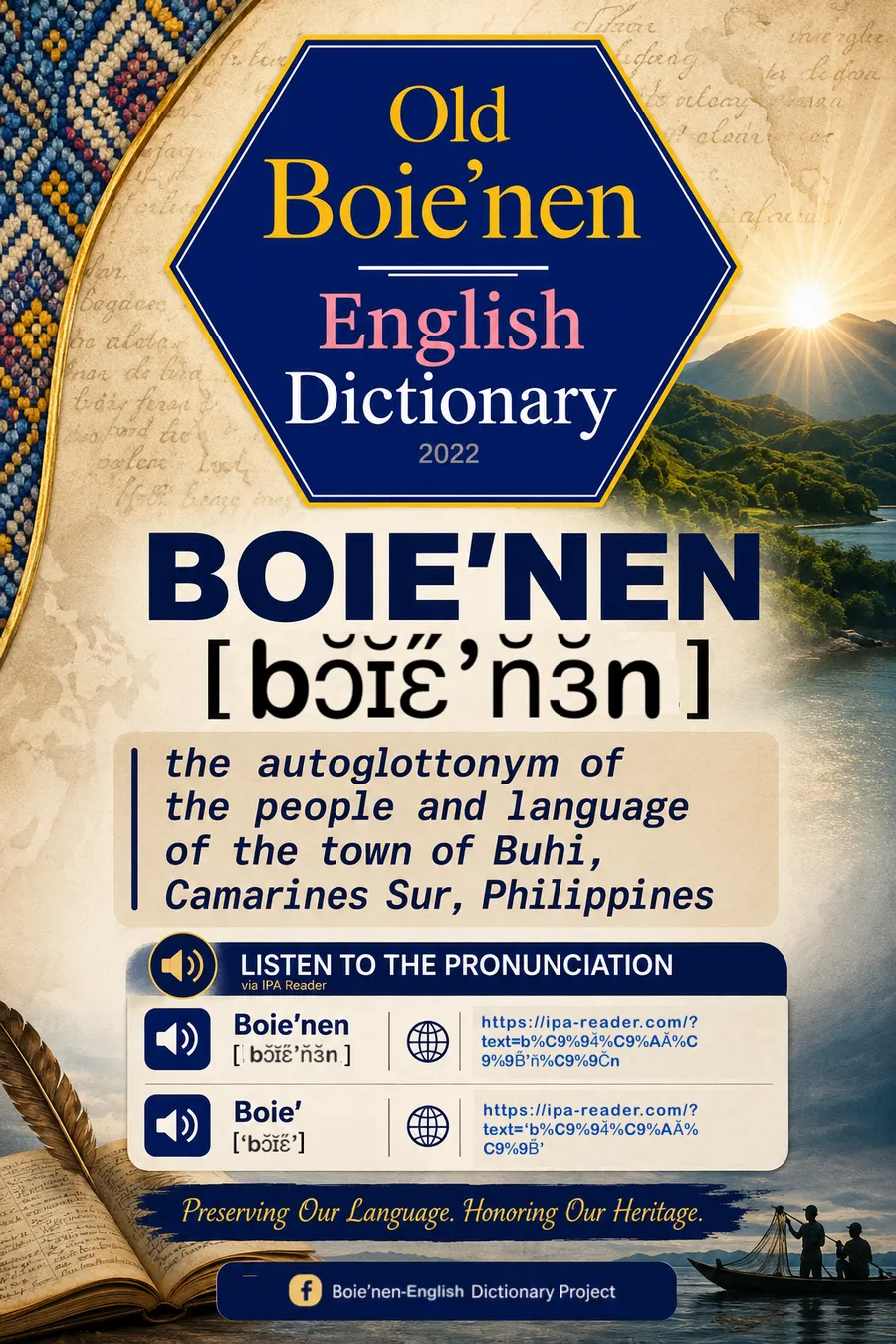
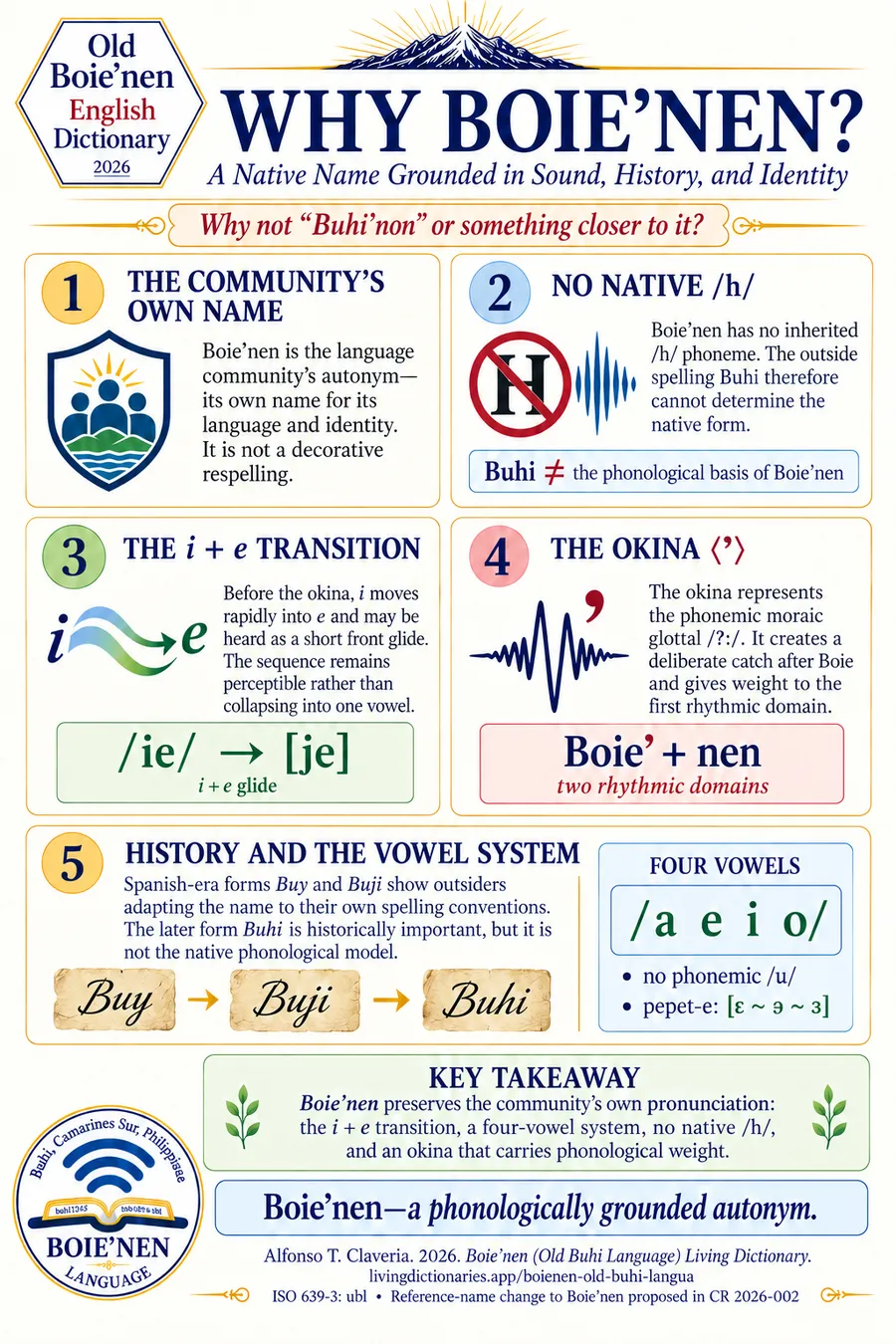
Phonetic: [bɔ̆ɪ̆ɛ̋ʔː.n̆ɜ̆n]
Part of Speech: proper noun
Semantic Domain: Language; Ethnic and cultural identity; Names
Pronunciation Note
IPA: /bɔ̆ɪ̆ɛ̋ʔː.n̆ɜ̆n/
The name is pronounced in two rhythmic domains:
[bɔ̆ɪ̆ɛ̋ʔː] + [n̆ɜ̆n]
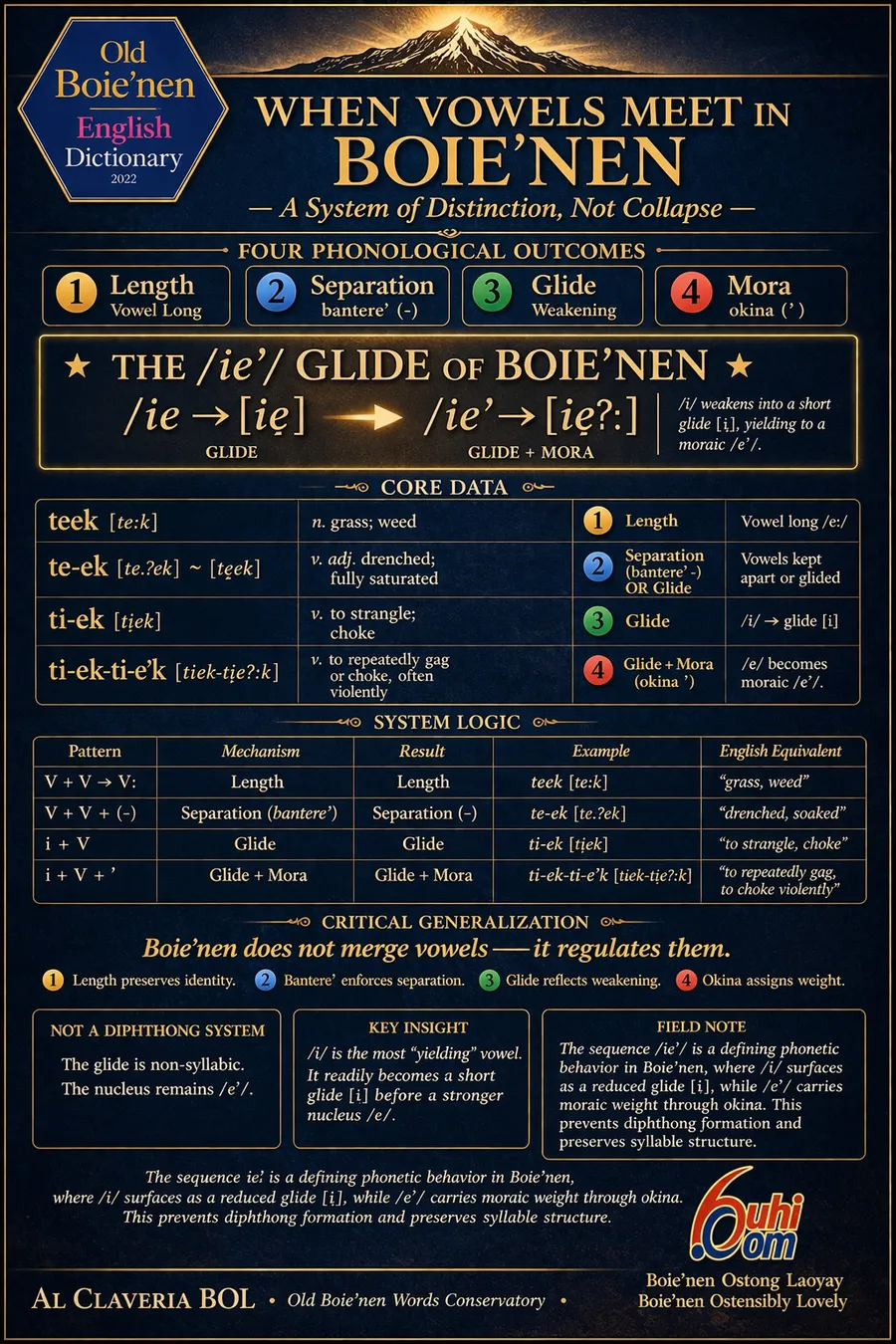
The spelling Boie’nen preserves the vowel sequence i + e heard before the okina. In careful pronunciation, the i moves rapidly toward the following e and may be realized as a short front glide. The sequence therefore remains perceptible as a glide-plus-vowel transition rather than collapsing into a single vowel.
The okina 〈’〉 is not a decorative apostrophe. It represents the phonemic moraic glottal /ʔː/, heard as a deliberate interruption or “catch” after Boie. It gives additional weight to the first rhythmic domain and helps preserve the language’s characteristic pronunciation:
Boie’ + nen
Writing Boi’enen, Boienen, or Boînen alters the internal vowel sequence, glottal placement, syllabic organization, and traditional rhythm of the name.
Notes
Accepted form: Boie’nen
Do not normalize as:
- Boi’enen
- Boienen
- Buhinon
- Buhi’non
- Boînen
- Boînən
Boie’nen is both an autonym—a community’s name for itself—and a glottonym or linguonym—the name of its language. The older forms Buhi, Buhinon, and Buhi’non Bikol are externally established names and do not fully represent the native pronunciation or phonological structure of Boie’nen.
Linguistic History
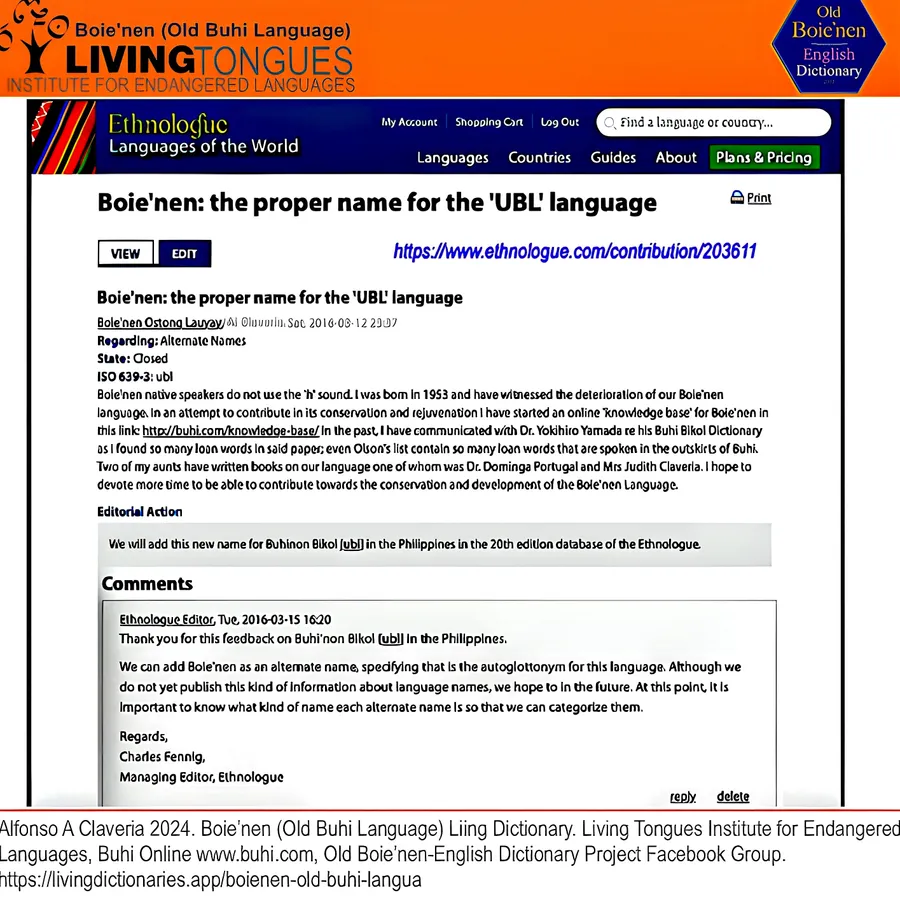
Boie’nen is the community’s native name for the language historically identified in many outside sources as Buhi, Buhinon, or Buhi’non Bikol.
In 2026, ISO 639-3 Change Request 2026-002 was published proposing that the reference name associated with ISO 639-3 code ubl be changed from Buhi’non Bikol to Boie’nen. The proposal concerns the reference name only: the code ubl remains unchanged, and no new language code or language division is proposed. As of September 2026, the request remains pending. ISO 639-3 Change Request 2026-002
The spelling Boie’nen records two important features of the native form: the audible i–e vocalic transition and the moraic glottal represented by the okina. It therefore preserves distinctions that are obscured or altered by spellings such as Boi’enen, Boînen, and Buhi’non.
Classification
Austronesian → Malayo-Polynesian → Central Philippine → Bikol → Inland Bikol → Boie’nen
Identifiers
- ISO 639-3: ubl
- ISO reference name: Buhi’non Bikol; proposed replacement: Boie’nen
- Glottocode: buhi1243
- Glottolog listing: Buhi (Glottolog 5.3)
Related Entries
Boie’nen language; Boie’nen people; Buhi; Buhi’non Bikol; UBL; ISO 639 2026-002; okina; glottal stop; phoneme /X/
Source
Claveria, Alfonso T. 2026. Boie’nen (Old Buhi Language) Living Dictionary.
Claveria, Alfonso T. 2026. “Change Request Number 2026-002: Change the Reference Name for ISO 639-3 [ubl] from ‘Buhi’non Bikol’ to ‘Boie’nen.’” ISO 639-3 Registration Authority.
The chief correction is that Boie’nen is not yet ISO’s official reference name: the code ubl currently retains Buhi’non Bikol, while the change to Boie’nen remains pending.
—-—————— ARCHIVAL MATERIALS
Boie’nen (see FB Post)
IPA
The name is pronounced in two rhythmic domains:
Structural Characteristics
Boie’nen is distinguished by several structural features, including:
- a posterior continuant phoneme /x/
- the historical loss of inherited /h/
- two phonemic glottal stops
- a four-vowel system
- highly productive aspect-voice morphology
- participant-marking strategies for nominal reference
- extensive lexical differentiation reflecting the culture, ecology, and history of the Buhi speech community.
Although genetically related to other Inland Bikol languages, including Rinconada, Boie’nen has followed its own historical path of phonological, grammatical, morphological, and lexical development.
Dialect Areas
The language is traditionally represented by several broad speech sectors:
- Poblacion
- Lake Side–Mt. Asog
- Road/Crossroads
- Mountain
- Malangkaw
These sectors exhibit localized lexical and phonetic variation while remaining mutually intelligible within Boie’nen.
IPA
SAMPA
bO{”}In@n
X-SAMPA
bO{”}In@n
ARPAbet (approximate)
B AW1 IY0 EH1 N AH0 N
, ISO 639-3 Change Request 2026-002 was