sexed
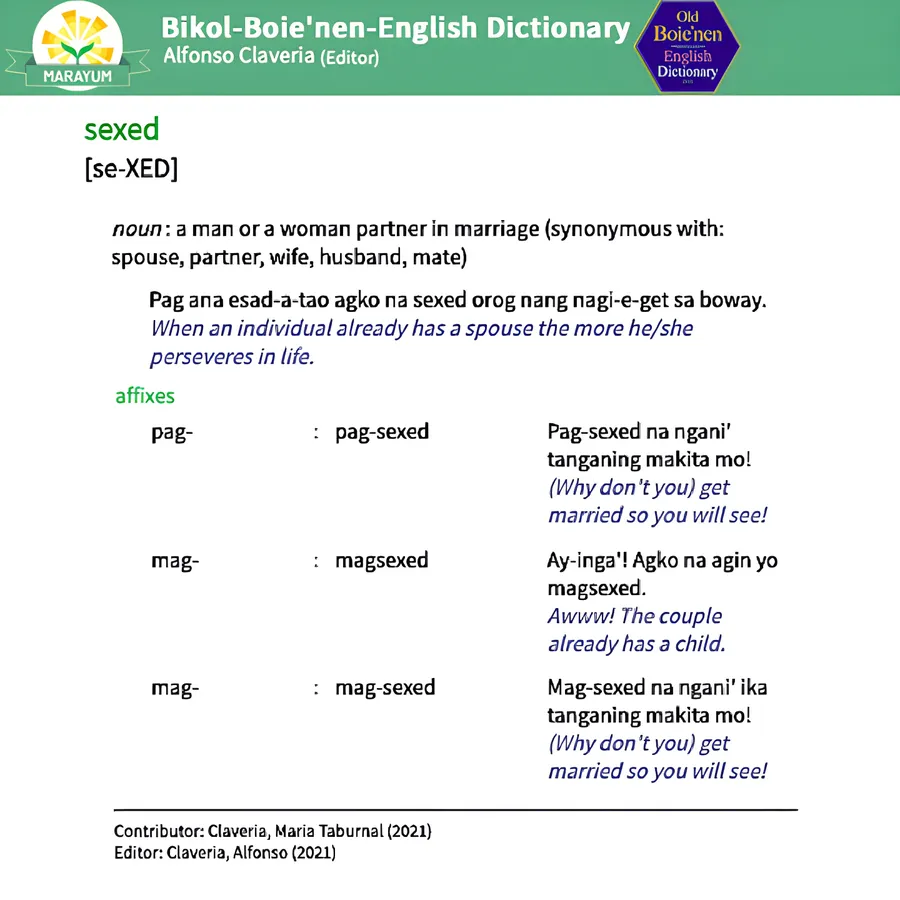
The Boie'nen word "sexed" is likely derived from the Arabic word "زوج" (zawj), which means "spouse", "husband", or "wife".
In Arabic, the word "زوج" (zawj) is a noun that refers to a married partner, and is derived from the root "ز-و-ج" (z-w-j), which carries the meaning of "to pair" or "to join".
The word "sexed" in Boie'nen appears to have retained the same meaning as the Arabic word "زوج" (zawj), which is "spouse". The similarity in sound and meaning between the two words suggests a possible borrowing or influence from Arabic into Boie'nen.
Here's a possible etymological analysis:
1. Arabic "زوج" (zawj) (spouse) > Boie'nen "sexed" (spouse)
2. Arabic root "ز-و-ج" (z-w-j) (to pair or join) > "زوج" (zawj) (spouse)
3. Boie'nen "sexed" retains the meaning of "spouse", but with a distinct pronunciation and spelling that reflects the language's unique sound and orthographic patterns.
The presence of Arabic loanwords like "sexed" in Boie'nen highlights the significant cultural and linguistic exchange between the Philippines and the Middle East during the Islamic period, and demonstrates the complex and multifaceted nature of language contact and borrowing in the region.
It's worth noting that the word "sexed" may have been influenced by other languages, such as Malay or Spanish, which also had contact with Arabic during the Islamic period. However, based on the available evidence, it appears that the word "sexed" is primarily derived from Arabic "زوج" (zawj).