.(yo)
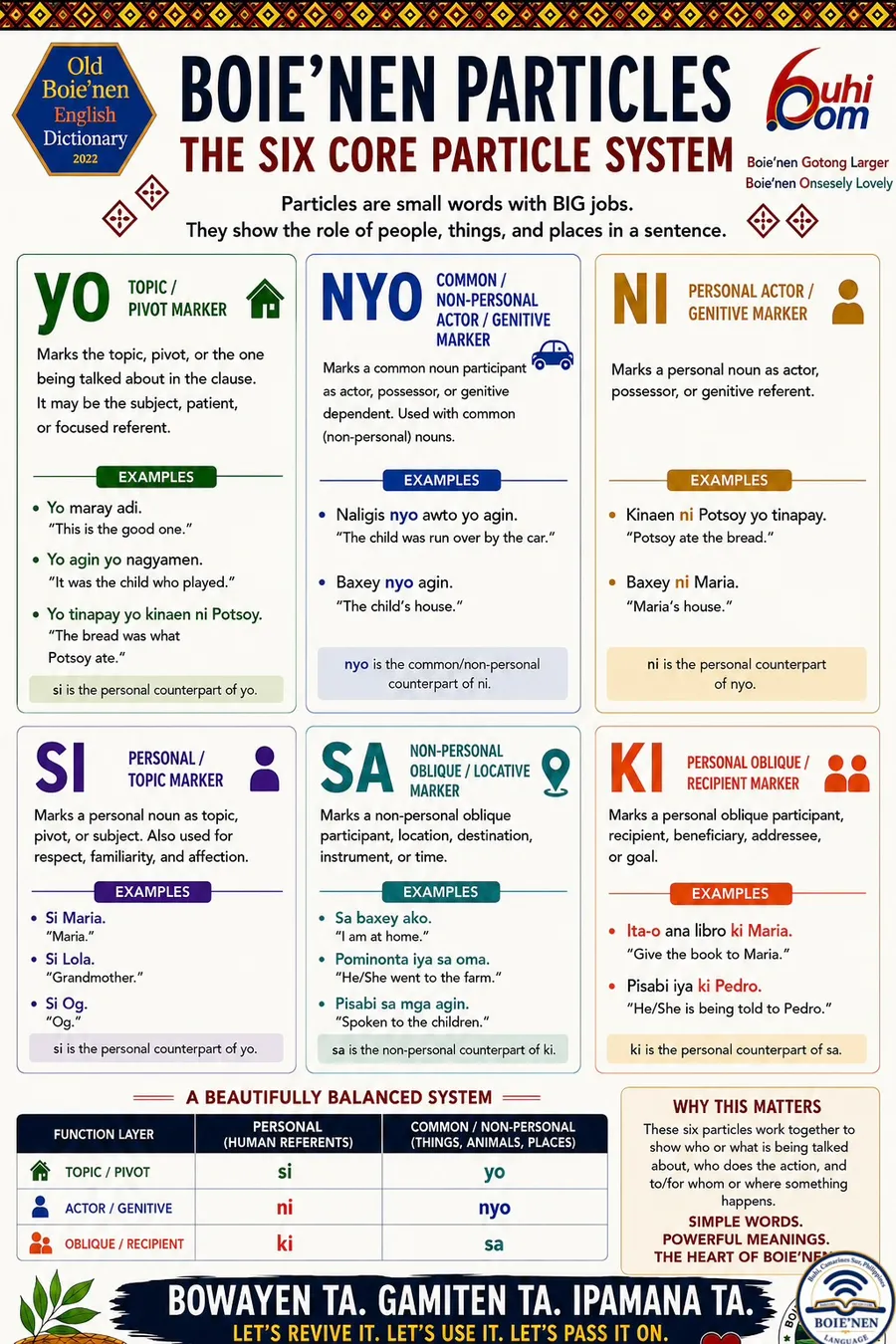
yo
particle
Definition
Common pivot or topic marker. Marks the syntactically privileged common or non-personal noun phrase in a verbal or non-verbal clause.
Functions
- Common pivot marker
- Topic marker
- Marks the privileged participant in verbal clauses
- Marks the subject or topic in non-verbal clauses
- Marks the head or central referent of a nominal construction
- Helps distinguish participant roles independently of constituent order
Examples
Yo baxey nyo agin.
“The house of the child.”
Kina’en nyo agin yo manok.
“The child ate the chicken.”
Kina’en yo agin nyo manok.
“The child that the chicken ate.”
As a complete proposition: “The chicken ate the child.”
Ongaw yo agin.
“The child is a cat.”
Yo agin yo nagyamen.
“It was the child who played.”
Yo baxey adto.
“The house is there.” / “The house there.”
Notes
yo does not inherently mean “patient,” “subject,” “definite,” or “that.” It marks the grammatically privileged common noun phrase—the clause pivot or topic.
The semantic role of the yo-marked participant depends on the construction. It may be:
- the patient of a patient-pivot verb;
- the subject/topic of a non-verbal clause;
- the referent being identified;
- the head or central noun phrase in a possessive construction.
Compare:
Kina’en nyo agin yo manok.
The child is the agent; the chicken is the yo-marked pivot.
Kina’en yo agin nyo manok.
The chicken is the agent; the child is the yo-marked pivot.
Boie’nen does not appear to use yo as a dedicated definite article. Definiteness and specificity are largely recovered from context.
| Personal | Common/non-personal | General relation |
| si | yo | pivot/topic or privileged participant |
| ni | nyo | non-pivot agent, possessor, or genitive participant |
| ki | sa | oblique, recipient, goal, location, or related participant |