/h/ → ∅
Part of Speech
phonological process; linguistic term
Semantic Domain
Language and communication; Phonology; Historical linguistics
Notes
The symbol ∅ represents the absence of a segment; it is not itself a phoneme.
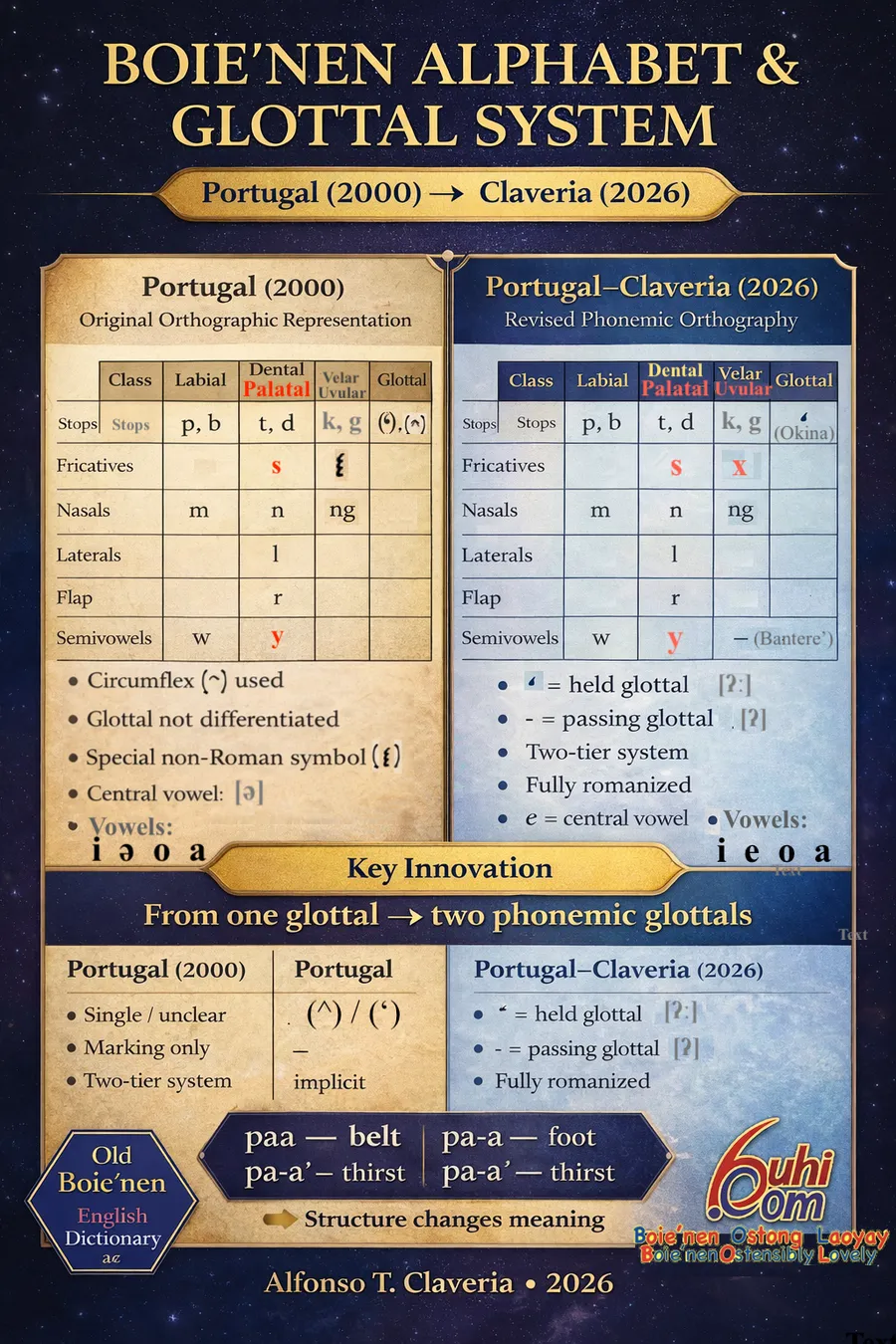
External /h/ does not always correspond to simple deletion in Boie’nen. In some lexical correspondences, /h/ corresponds instead to the Boie’nen posterior continuant written x in this dictionary.
/h/ → ∅
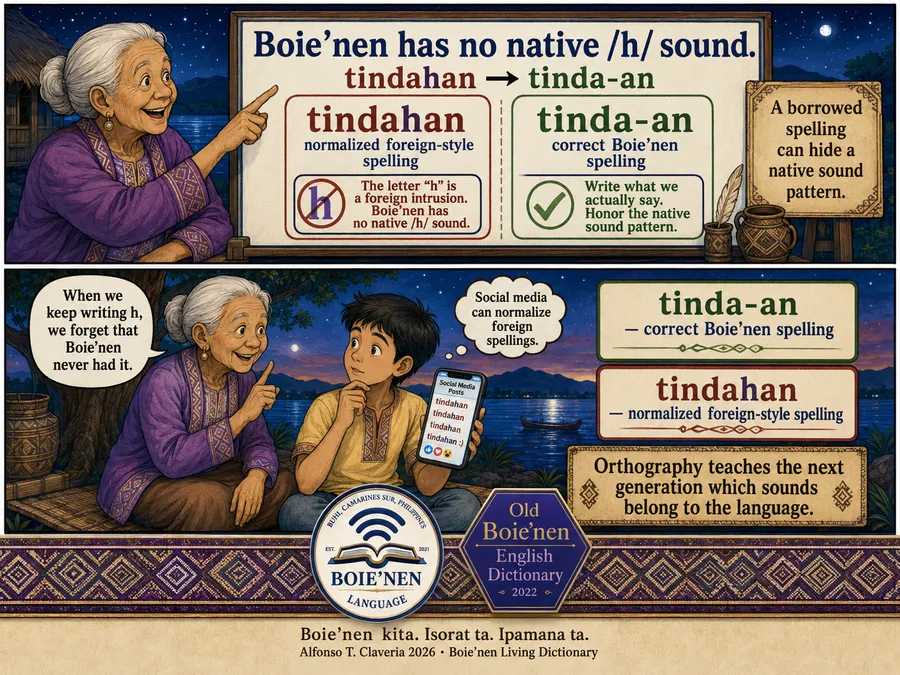
External /h/ corresponds to no consonant in Boie’nen.
Examples
- baha → ba-a’ “flood”
- bahag → ba-ag “loincloth”
- hakot → akot “haul”
- tanhaga’ → tanaga’ “weaving loom; loom frame”
Compare: /h/ → x
- halas / ahas → axas “snake”
- halat → exat “wait”
- habol → abex “weave”
- salag → saxag “nest”
- sulog → sexeg “water current”
Other forms such as dalan → daxan, damika → dakexe’, and gatol → gatex likewise belong to the broader posterior-consonant correspondence and should be treated under /X/ rather than as cases of simple /h/ deletion.
Related Entries
/X/ — See also
Boie’nen consonant phonemes — See also
posterior consonant — See also
phonological correspondence — See also