{Gg}
{Gg}
Orthographic Clarification
In the Portugal–Claveria orthography, the grapheme {Gg} represents only the phoneme /G/ [g], the voiced velar stop.
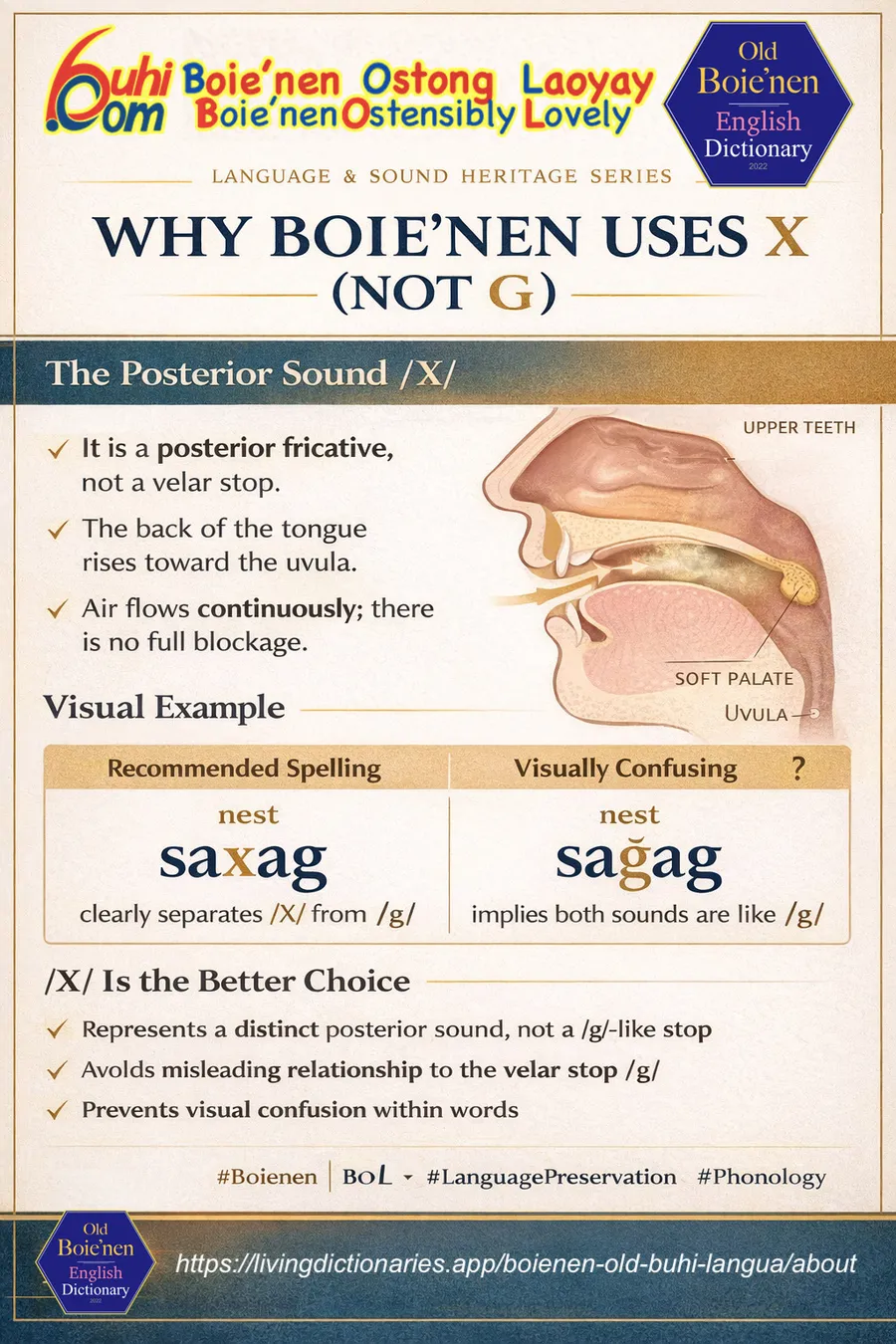
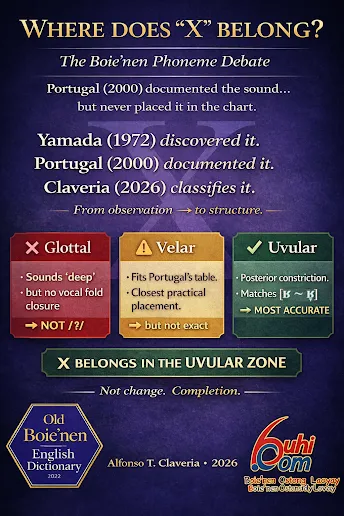
It does not represent the Boie’nen phoneme /X/.
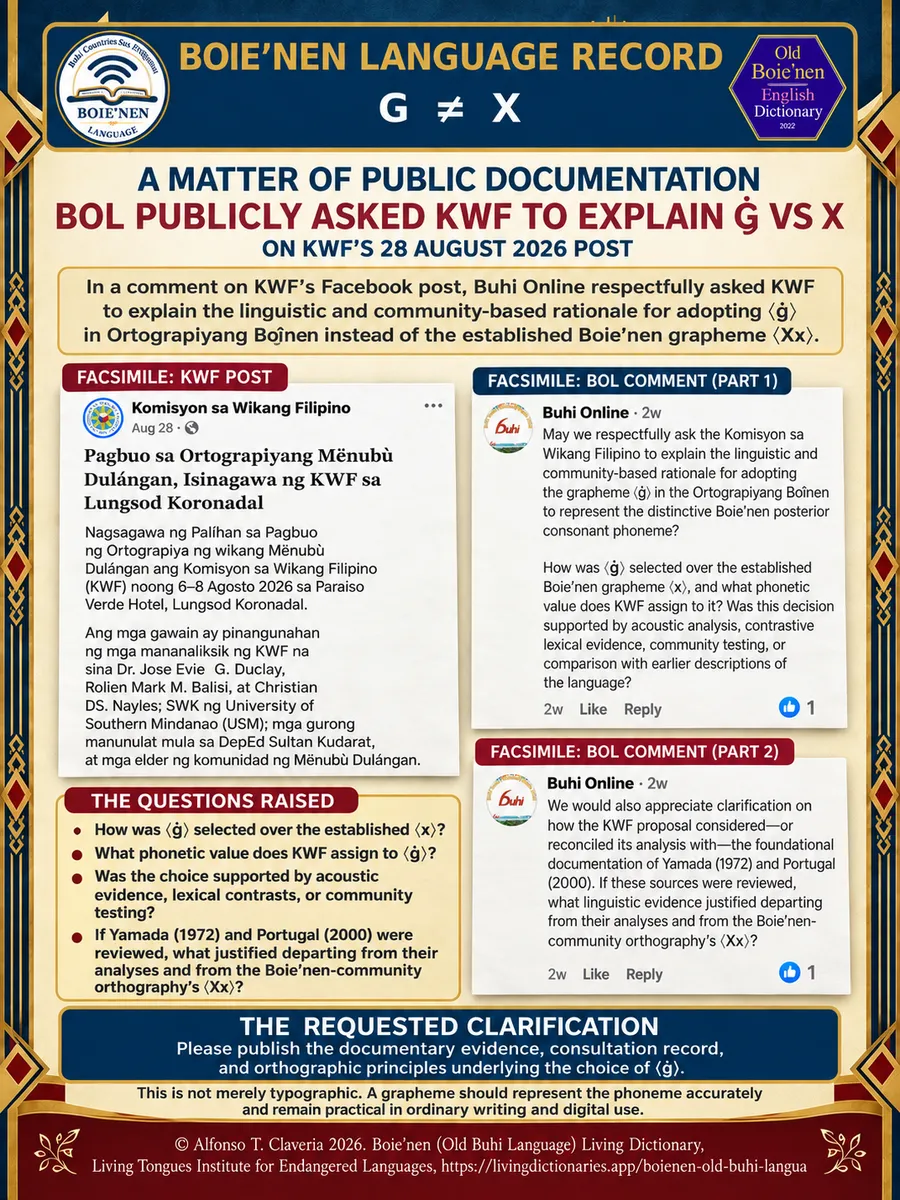
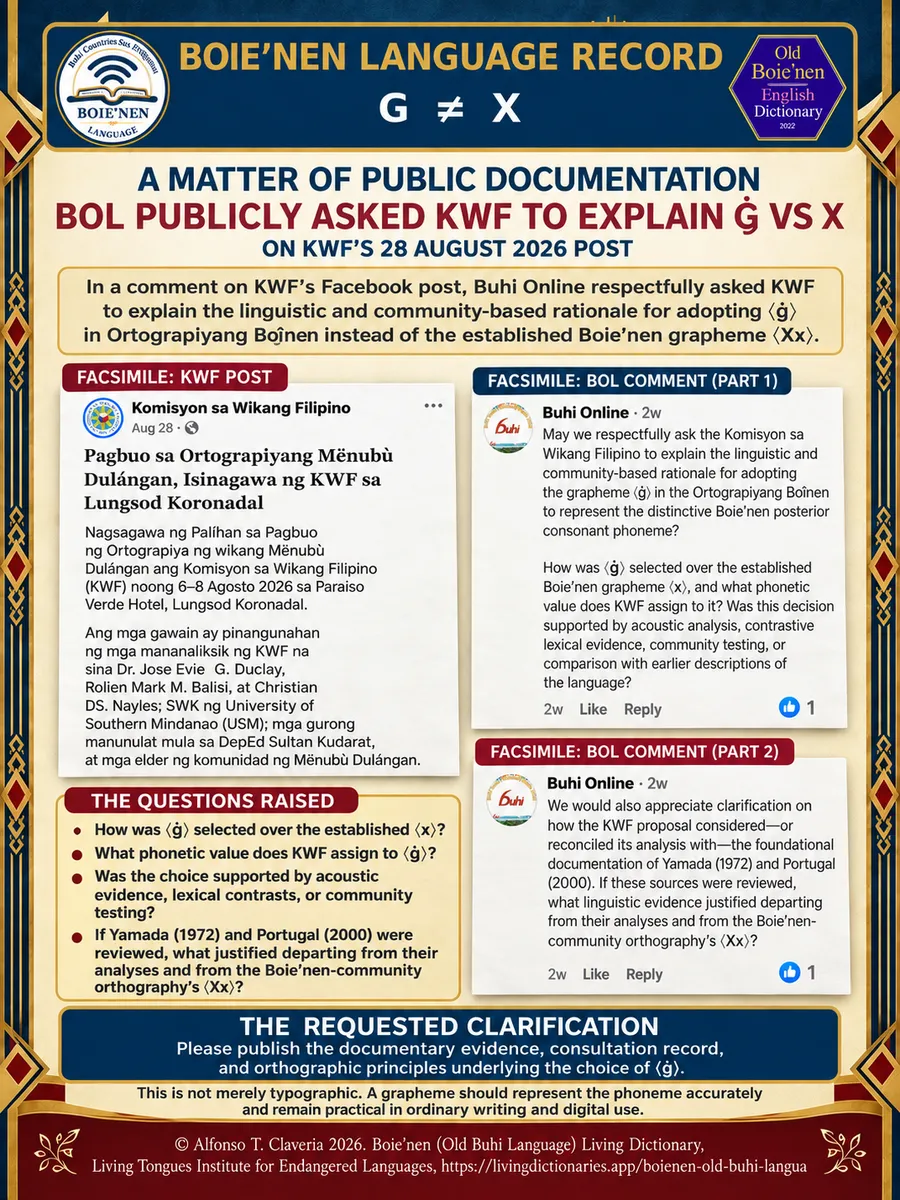
This one-letter-one-phoneme correspondence differs from the 2023 KWF orthography, which assigns two distinct phonemic values to forms of the grapheme G:
| KWF | Value |
| Gg | /g/ |
| Ġġ | /X/ |
While KWF recognizes the distinction between the sounds, both symbols remain graphic variants of the same base letter G, potentially obscuring the phonemic independence of /X/.
The Portugal–Claveria system instead adopts:
| Grapheme | Phoneme |
| {Gg} | /G/ |
| {Xx} | /X/ |
This creates a strict one-to-one relationship between grapheme and phoneme.
⸻
Why This Matters
Boie’nen speakers perceive:
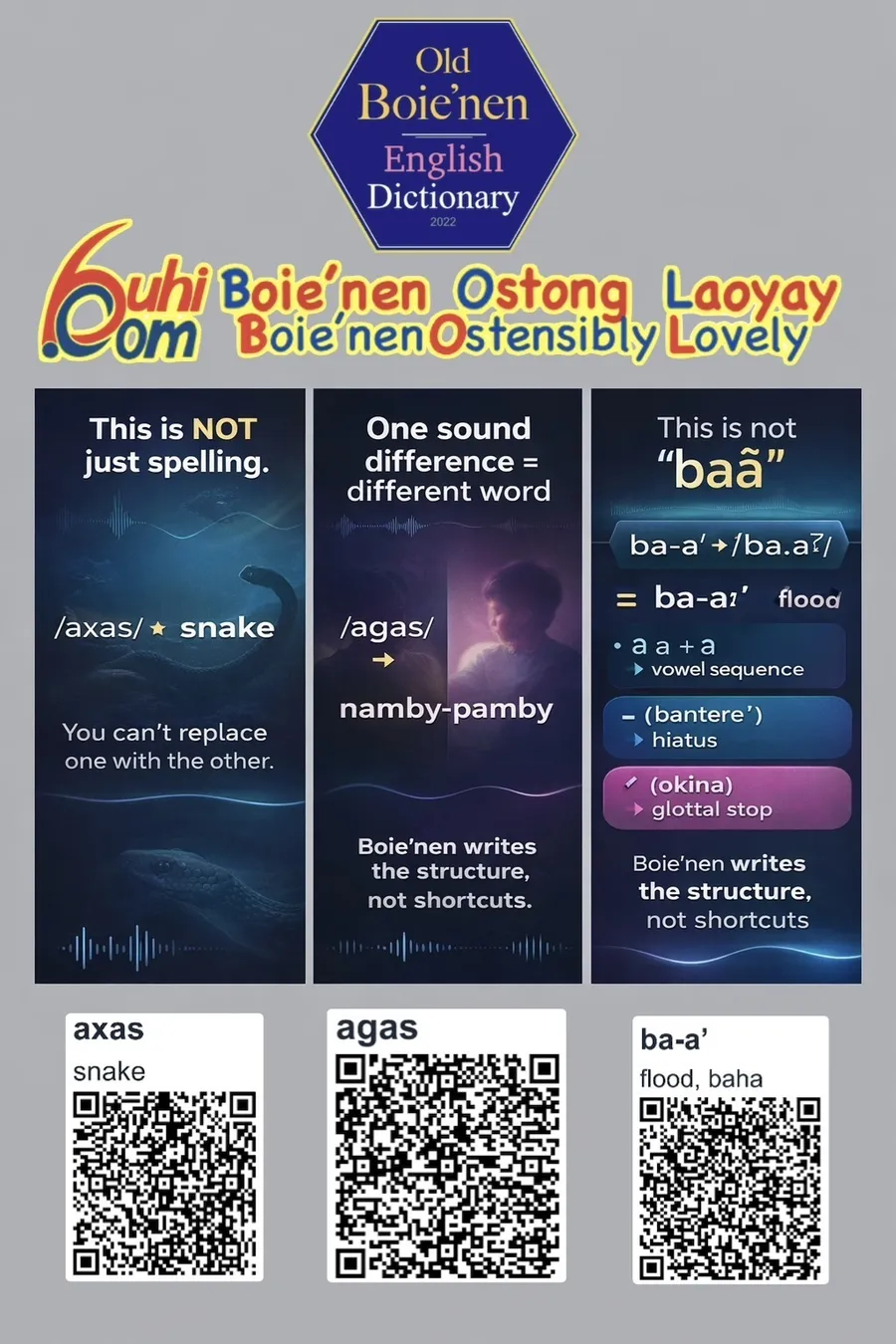
- agas “namby-pamby”
- axas “snake”
as fundamentally different words.
Likewise:
- angngeg “forehead”
- angngex “breath odor”
demonstrate that /g/ and /x/ contrast lexically.
Because these contrasts create differences in meaning, /G/ and /X/ must be treated as separate phonemes rather than variants of a single consonant.
⸻
A traditional Boie’nen learner taught through the old Cartilla/Katon method learned:
- ga ge gi go gu
as syllables built from the consonant /g/.
Under such a system, assigning the same base grapheme G to both:
- /g/
- /X/
introduces ambiguity absent from traditional literacy practices.
The Portugal–Claveria orthography preserves the pedagogical principle:
one letter, one sound
- G → /g/
- X → /X/
which aligns more closely with historical syllabic reading traditions in Buhi.
⸻
Comparative Note
The orthographic choice of Xx is not arbitrary.
It serves four functions simultaneously:
- distinguishes /X/ from /G/
- avoids diacritics and special Unicode characters
- improves keyboard and mobile compatibility
- supports clean machine-sorting in digital dictionaries
This last point is especially important for the Living Dictionary architecture, where:
/phoneme/
/G/
/X/
remain visually and computationally distinct.
Orthographic Clarification. In the Portugal–Claveria orthography, the grapheme {Gg} represents only the phoneme /G/. It never represents /X/. This differs from KWF (2023), which employs two graphic forms of the letter G (Gg and Ġġ) for two separate phonemes. The Portugal–Claveria system instead adopts a one-grapheme-one-phoneme correspondence:
• {Gg} → /G/
• {Xx} → /X/
This preserves the traditional Boie’nen Cartilla/Katon principle of “one letter, one sound,” improves keyboard compatibility, and maintains clean machine sorting in digital dictionaries.
Notes
See also: {Xx}, /G/, /X/.
Unlike KWF (2023), the Portugal–Claveria orthography assigns separate graphemes to the phonemes /G/ and /X/, maintaining a one-grapheme-one-phoneme correspondence.