sasabien
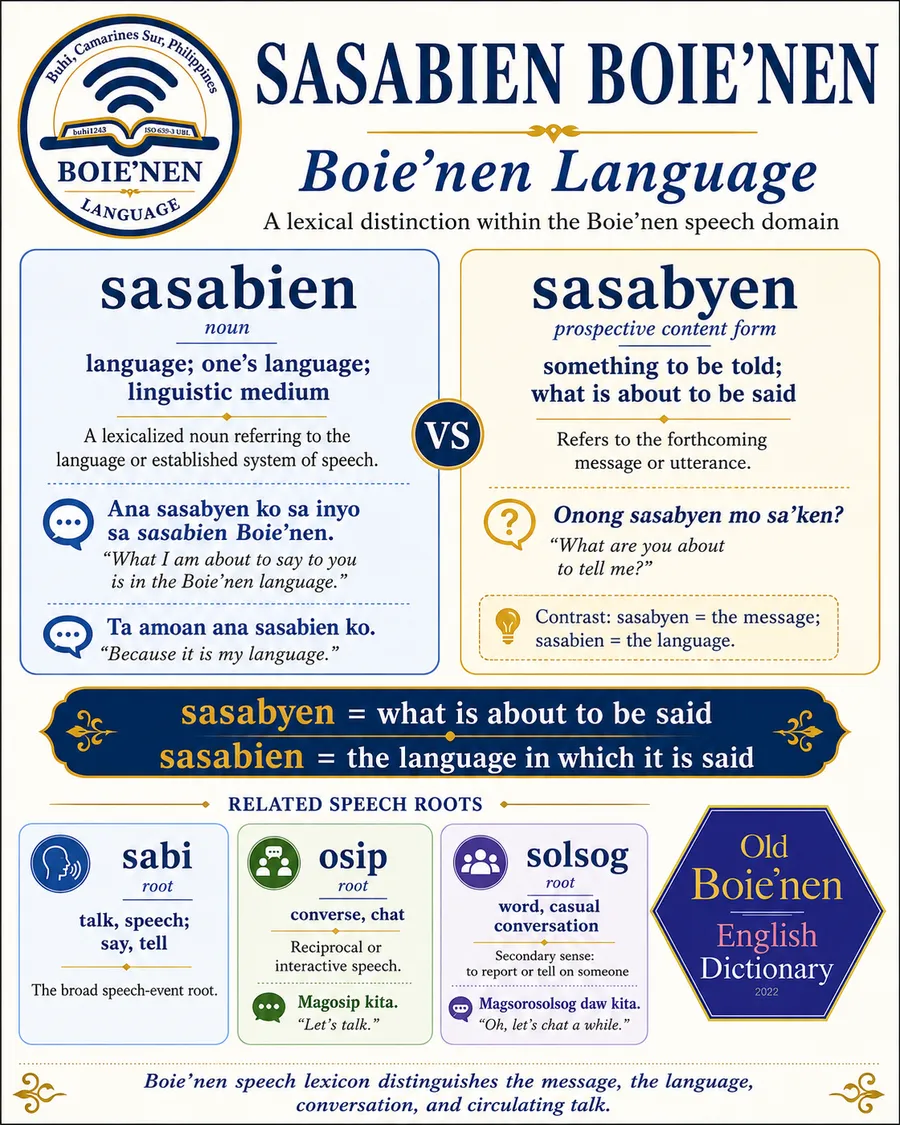
sasabien
n.
- Language; a recognized system or variety of speech used by a community.
- One’s own language or inherited manner of speaking.
- The linguistic medium in which something is spoken or expressed.
Unlike the event-oriented form sasabyen, sasabien has become lexicalized as a noun referring to language as an established and continuing system of verbal communication.
Usage
Ana sasabyen ko sa inyo sa sasabien Boie’nen.
“What I am about to say to you is in the Boie’nen language.”
Ta amoan ana sasabien ko.
“Because it is my language.”
Depending on discourse context, the second sentence may also carry the more identity-centered sense:
“It is because that is the language I speak.”
“Because that is my own language.”
Phonological note
The i remains syllabic in sasabien and does not ordinarily become the glide y. This distinguishes the lexicalized noun from sasabyen “what is about to be said.”
The contrast should therefore be preserved in dictionary spelling:
sasabyen — forthcoming speech content
sasabien — language
Semantic note
Sasabien refers not to an individual utterance but to the enduring linguistic code, speech variety, or language through which utterances are produced.
Compare
sabi — talk; speech; say; tell.
sasabyen — something about to be said.
sasabien — language; one’s linguistic medium.
Boie’nen — the proper name of the language.