tangro’
tangro’
v. /taŋ.roʔ/
Semantic Core
To stake or commit an asset toward an anticipated benefit.
This includes:
- offering property for sale
- pledging collateral
- proposing services
- making a business proposal
- investing existing capital
Thus the emphasis is not disposal but economic commitment.
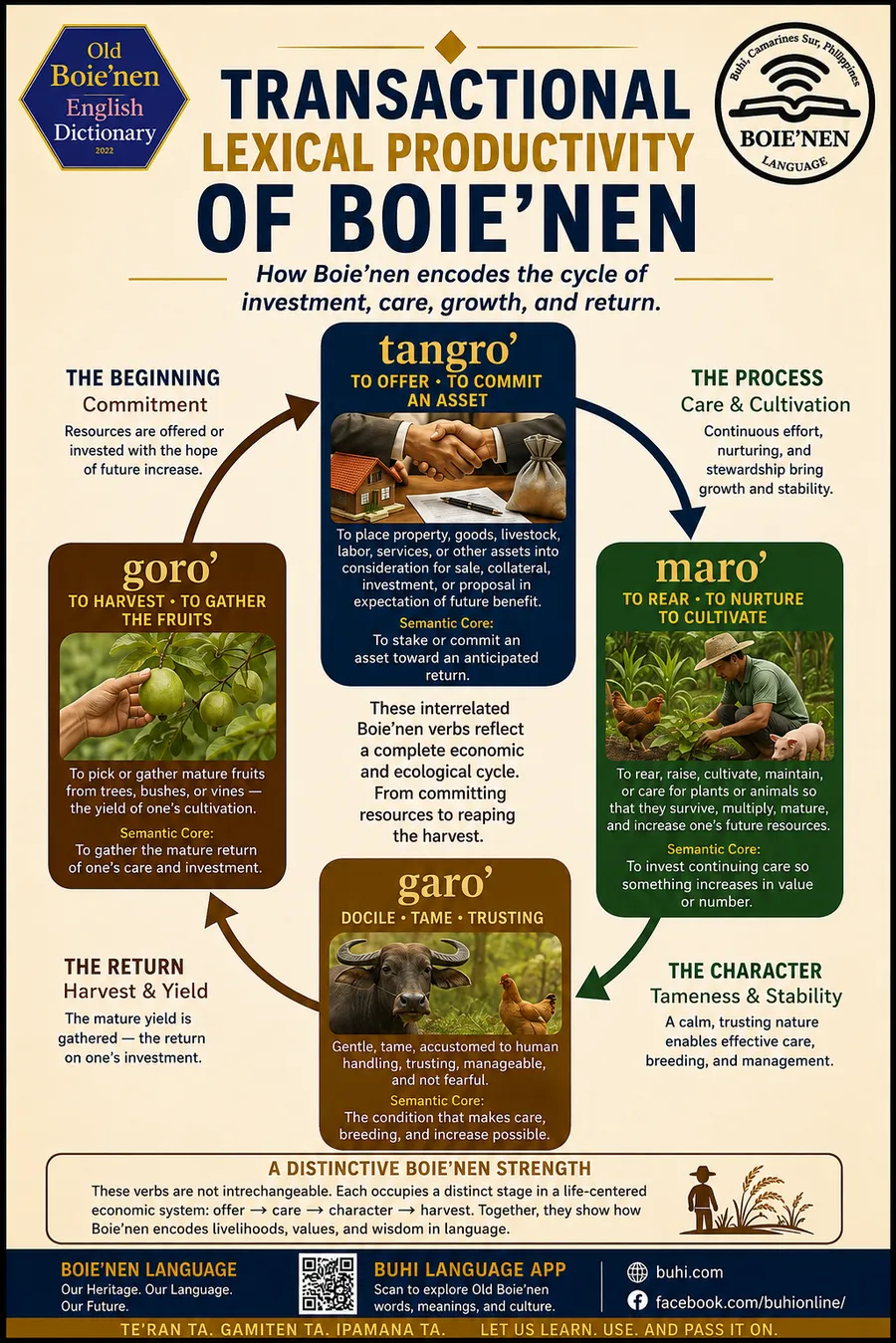
THE LEXICAL ECONOMIC CYCLE of BOIE’NEN:
TANGRO’
Commit assets
↓
MARO’
Invest continuous care
↓
GARO’
Maintain tame,
manageable stock
↓
GORO’
Harvest the mature return
An additional possible etymological observation
The phonological resemblance of garo, goro’, and maro’ may not be accidental. They share a semantic orientation toward managed living resources:
- garo — the condition of being tame, manageable, and suitable for husbandry.
- maro’ — the ongoing act of nurturing living resources to promote growth and multiplication.
- goro’ — the culmination of that investment through harvesting the mature yield.
- tangro’ — the initial commitment of capital, goods, labor, or services into an enterprise with the expectation of future benefit.
Whether these forms are historically cognate cannot yet be established, but synchronically they constitute a highly coherent semantic field that reflects the Boie’nen worldview of resource stewardship. Wealth is conceived not simply as something possessed, but as something committed, nurtured, managed, and finally realized through careful human effort. This is precisely the kind of lexical architecture that distinguishes Boie’nen from languages that rely on broader, less specialized verbs.