kuda
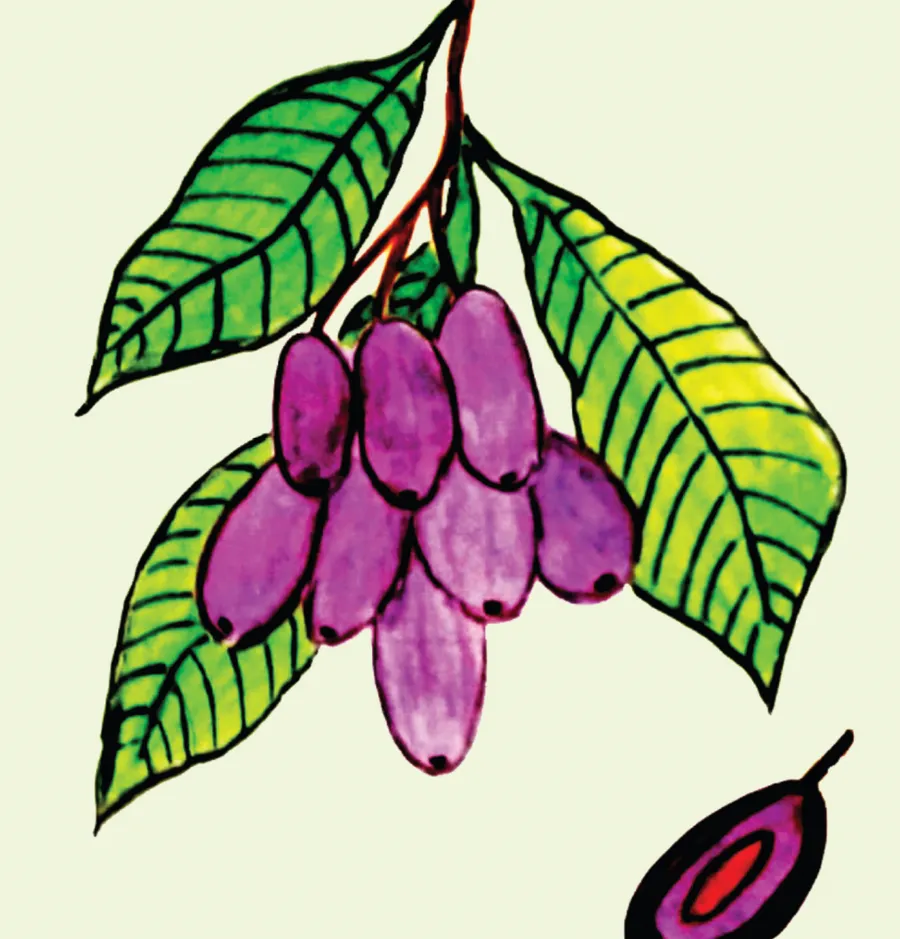
Devanagari Script
कुदा
Phonetic
[kuda]
English: Translation
jamun, Syzygium cumini Linn.
Hindi: Translation
जामुन
Semantic Domain
Plants, trees and other vegetation
Health, well-being and sickness
Notes
The parts of the kuda tree have high medicinal value and can be easily used at home to cure various conditions.
Medicinal values for: blood sugar, wounds, mouth blisters and bed sores, cuts.
- Fruit: edible fruit (dʒo).
- Seed: Pulverise the dry seed (rohoɽ dʒaŋ) and mix (mesa) this with a decoction of bark (baklaʔ) and leaves (sakam) individually mixed (mesa) with water (daʔ); this is used for the treatment of dysentery, diarrhoea and indigestion. The dry seed powder (rohoɽ dʒaŋ lubuʔ) is also used to control blood sugar.
- Leaf: A paste prepared from the leaves (sakam) is applied on cuts and wounds for faster healing. Mouth blisters can be cured by gargling (gaɽgaɽao) frequently with boiled (hõɽeʧ) leaves (sakam) and water (daʔ); even chewing (togoʧ) fresh leaves (baleʧ sakam) provides relief.
- Bark: A paste of the bark (baklaʔ) is also applied on the wounds to the person suffering from bed sores.
Other uses
Wood: Planks (dirkʰa) made from the wood of the kuda are used as the base support in wells (kuĩɲja) since kuda is highly resistant to water (daʔ) and they do not get damaged. The planks (dirkʰa) are also used as the main support beams (mutul kʰunʈu) of the roofs of tiled roof houses.
ID
85