putri sakam
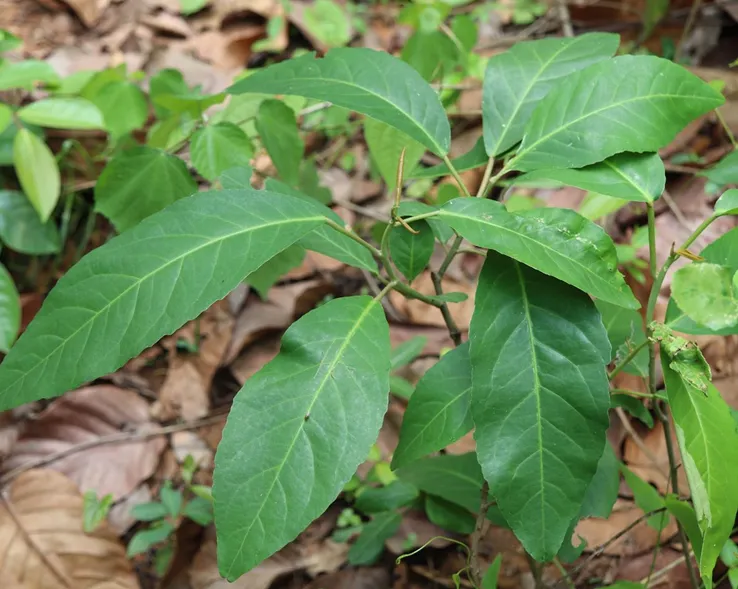
Devanagari Script
पुतरि सकाम
Phonetic
[putri sakam]
English: Translation
Croton oblongifolius Roxb.
Hindi: Translation
पुतरी
Santali: Translation
goṭe
Semantic Domain
Plants, trees and other vegetation
Health, well-being and sickness
Notes
Medicinal values for: diarrhoea, dysentery, snake bites, sprains, bruises
- Root: A decoction of the root (rehet) and bark (baklaʔ) with black pepper (golki) is given in diarrhoea and dysentery. The ground-up root (rehet) is an antidote for poison (bikʰ) from all kinds of snakebites.
- Bark: A paste prepared from bark (baklaʔ) and root (rehet) is applied externally to sprains and bruises.
Interesting fact: The stem (ɖãʈiʧ) of this tree is used to produce fire (seŋgel). - Step 1: Take a thick branch and make a hole in it that is not very deep or wide.
- Step 2: From another branch, small pieces of sticks are made that can fit into the hole. The thickness of the sticks should be such that they do not get packed into the hole. They should be free to slide in and out.
- Step 3: A few dry bark (baklaʔ) pieces and dry grasses are put around the hole and some into the hole leaving some space for the small sticks. The small pieces of stick are then put in the hole, balancing them in between the palms. It is then rotated clockwise and counterclockwise (golgu).
- Step 4: The rotation of the stick is done at a fast pace so that the movement generates heat (dʒuruʔ) and the dry bark (baklaʔ) and dry leaves (sakam) catch fire. Once the smoke (dʰuŋga) starts coming out, air is blown from the mouth to accelerate the ember. After the bark (baklaʔ) and leaves (sakam) catch fire more sticks are added to it as required.
ID
33