muruk baha
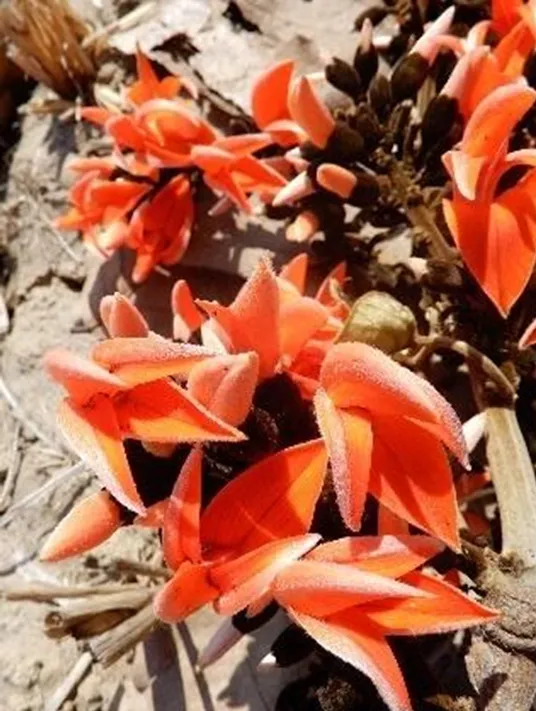
Devanagari Script
मुरुक बाहा
Phonetic
[muruk baha]
English: Translation
Butea monosperma (Lam.) Taub.
Hindi: Translation
पलाश
Semantic Domain
Plants, trees and other vegetation
Health, well-being and sickness
Notes
Medicinal values for: mouth blisters, menstrual cycle
- Root: The root (rehet) is used for blisters in the mouth. Pluck a small plant with the root (rehet). Clean (sapʰa-em) the root (rehet) with water (daʔ) and after peeling (ʧʰolaʔ) out the skin of the root (rehet), chew (togoʧ) it for some time and swallow (utem) it.
- Flower: The flower (baha) is also used during the menstruation period (kiʧriʔ kana). The flowers (baha) are either picked (halaŋ) or plucked (got) and washed (ʧapi-kam) thoroughly with water (daʔ). After that, the flowers (baha) are ground up (rid) and sieved (ʧʰakao) with the help of a strainer and kept in a bottle. It is advised to mix two drops of the decoction into a glass of water and then drink it. It helps relieve an irregular or painful menstrual cycle.
Other uses: The tree is also a good host for the lac insect and therefore it is useful in production of natural lac (bãnda).
- Flower: The flowers (baha) are used for the preparation of a yellow dye. A bright yellow to deep orange-red dye can be prepared from the flowers (baha). Also, a red dye is obtained from the roots (rehet). It is used as a coloring-agent for dyeing clothes. However, the community uses the same to celebrate Holi (the Indian festival of colors). Preparation method: For making colours used as dyes, first the flowers (baha) are ground up (rid) and then boiled (hõɽeʧ), adding a small amount of water (daʔ). When the water (daʔ) changes colour and turns reddish, the pot is set down to cool off
- Leaf: The leaves (sakam) of muruk baha are used in the preparation of cheap (alga) leaf plates (khalaʔ) and leaf cups (phuɽuʔ) for rural feasts (bʰodʒ**)**.
ID
18